How Much Does an AI Memory Layer Cost?
What AI memory infrastructure actually costs: the five pricing models, which one hides costs at scale, and the enterprise line items nobody quotes upfront.
Self-serve AI memory infrastructure generally runs from free developer tiers to around $3,000 per month for production team plans. Enterprise deployments are quoted per contract and typically land in six figures annually once data residency, self-hosting, and support commitments are included.
That range is wide enough to be almost useless, which is the actual problem with this question. The number that matters is not the sticker price but which pricing model the vendor uses, because the same workload can differ by an order of magnitude between two vendors whose headline numbers look similar.
The five pricing models
| Model | Charged on | Predictable? | Punishes you for |
|---|---|---|---|
| Per seat | Human users | Very | Nothing much |
| Per stored memory | Memories retained | Moderate | Keeping history |
| Per operation | Reads and writes | Poor | Success |
| Per token | Tokens processed | Poor | Verbose context |
| Flat platform fee | Nothing variable | Very | Nothing, until you outgrow the cap |
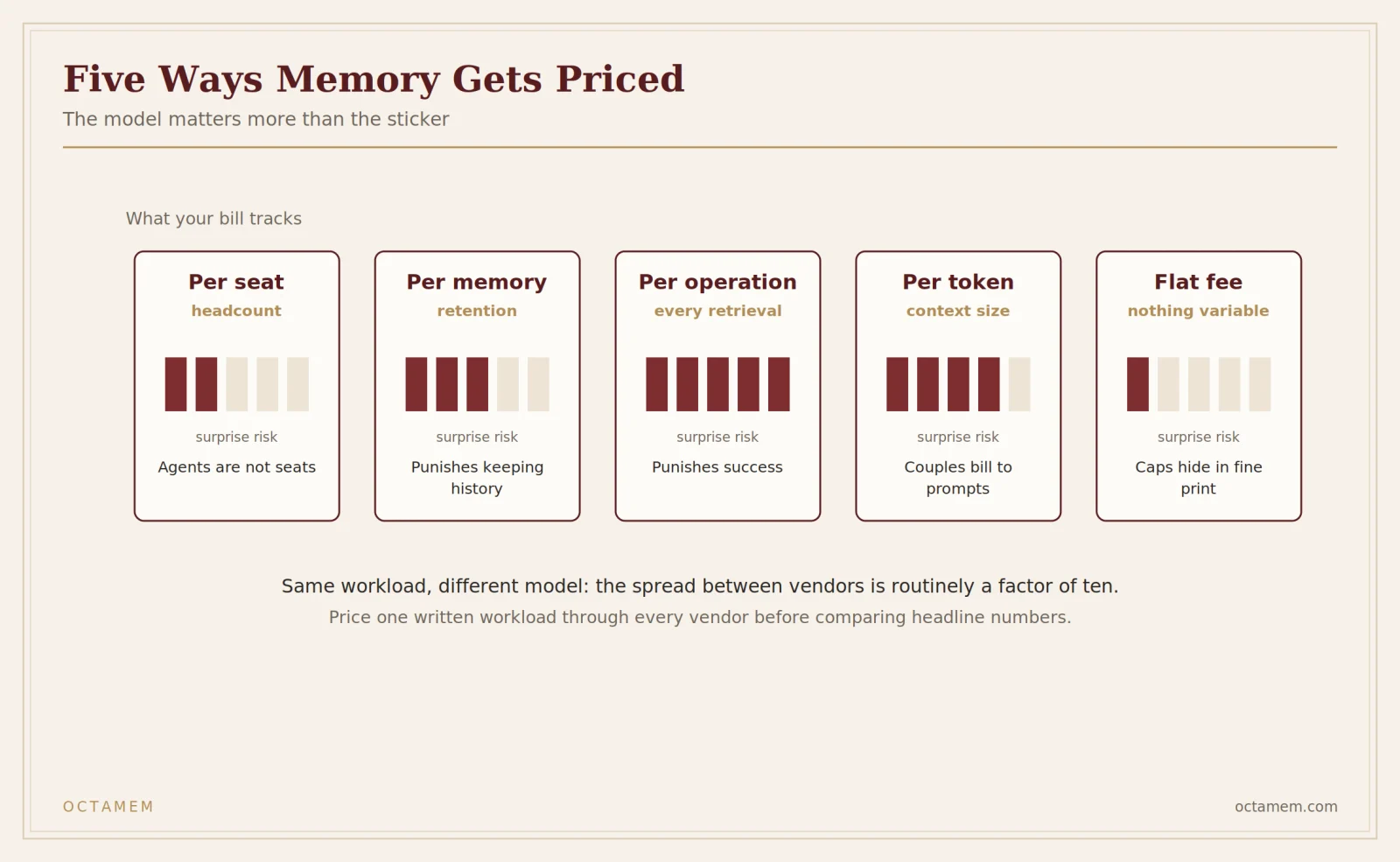
Per seat is the easiest to forecast and the worst fit for agent workloads, because agents are not seats. One engineer running twelve agents overnight generates a thousand times the memory traffic of a colleague using one chat window. Per-seat pricing either subsidises the first engineer or overcharges the second.
Per stored memory is honest but creates a bad incentive: you start deleting history to control spend, which defeats the purpose of buying memory. Watch for whether consolidated or superseded memories still count against the total.
Per operation is where the surprises live. Every agent turn does at least one retrieval, and agentic loops do many. A single user request in a multi-step agent might trigger fifteen retrievals and three writes. Multiply that by your daily active usage before you sign anything. This model looks cheapest in a pilot and is frequently the most expensive in production, because your bill grows with adoption rather than with headcount.
Per token couples your memory bill to your prompt engineering. It also means a system that retrieves ten memories when three would do costs you three times over: once in memory fees, once in inference fees, once in latency.
Flat platform fee is what most enterprise contracts collapse into, usually with usage caps somewhere in the fine print.
What drives cost
Four variables, and only one of them is the one people ask about.
Memory volume. How many distinct facts, events and procedures you retain. Grows roughly with users multiplied by interaction depth multiplied by time. The last term is the one that catches people, because year two is not like year one.
Retrieval frequency. How many times per interaction the agent reads memory. This is an architecture decision more than a usage one. Agents that retrieve once per turn cost a fraction of agents that retrieve inside every reasoning step.
Deployment model. Shared multi-tenant cloud is cheapest. Dedicated region or VPC costs more. Self-hosted or air-gapped costs most, both in licence and in the engineering time to run it. If you are in banking, healthcare, defence, or legal, you are probably in the third bucket, and you should price that in from the start rather than discovering it during procurement.
Compliance surface. SOC 2 reports, DPAs, EU data residency, audit logging, deletion guarantees. Some vendors include these; some gate them behind enterprise tiers; some do not have them.
The enterprise line items nobody quotes upfront
If you are buying for a regulated organisation, the software licence is often not the largest number in the first year.
- Deployment engineering for sovereign or self-hosted installs. Usually a one-off fee, frequently in the tens of thousands, sometimes disguised as "onboarding".
- Security review. Your own team's time answering questionnaires, plus any penetration testing the vendor requires you to fund.
- Migration. Getting existing memory out of whatever you built internally and into the new system, including reconciling contradictions your old store never resolved.
- The exit. Ask what a full export looks like and what format it comes in. If the answer is vague, price the lock-in. Memory is stickier than most infrastructure because the accumulated data is the value.
What OctaMem costs
Published tiers, for transparency:
| Tier | Price | For |
|---|---|---|
| Free | $0 | Evaluation and side projects |
| Builder | $49/mo | Individual developers shipping something real |
| Startup | $199/mo | Small teams in production |
| Team | $750/mo | Multiple products, shared memory groups, RBAC |
| Scale | $3,000/mo | Production workloads with compliance requirements |
| Enterprise | Quoted | Sovereign deployment, custom residency, contractual SLAs |
Annual prepayment carries a discount. Enterprise pricing is quoted per deployment because the variables that drive it, mainly residency and hosting model, are not things we can guess from a form.
Current pricing is at octamem.com/pricing.
Named vendor comparison
<!-- TODO before publishing: Verify each competitor's pricing against their live pricing page on the day of publication. Include date-stamped figures and a "verified on" line. Do not publish estimates. Do not make relative performance claims here; pricing only. -->
This section will be published once each vendor's figures have been verified against their live pricing pages, with a verification date attached. Comparison tables built from remembered numbers go stale within weeks and we would rather have an empty section than a wrong one.
How to actually compare offers
Build one workload model and price it through every vendor's calculator. The model needs four numbers:
1. Monthly active users 2. Interactions per user per month 3. Retrievals and writes per interaction, from your own traces rather than an estimate 4. Total memories retained after 24 months
Then ask each vendor to price that specific workload in writing. Most will, and the exercise surfaces which pricing model you are actually signing up for. It also tends to reveal a factor-of-ten spread between offers whose homepage numbers looked comparable.
One more question, which sounds commercial but is really technical: ask what happens to your bill if your agent's retrieval strategy gets worse. If the answer is "it goes up a lot", you have coupled your infrastructure spend to your prompt quality, and you will be tuning prompts for cost rather than for accuracy.
Related reading
Frequently asked questions
Is there a free AI memory layer?
Most vendors offer a free developer tier with volume caps, including OctaMem. Free tiers are for evaluation; they generally exclude the compliance features that matter in production.
Why is enterprise memory pricing not published?
Because deployment model drives most of the cost. A shared-cloud enterprise contract and an air-gapped on-premise install have little in common financially.
Is building cheaper than buying?
The first version is. Contradiction handling, audit trails, deletion guarantees and retrieval quality at scale are where the cost accumulates, and it lands as engineering salary rather than a line item. See build or buy.
Does a larger context window reduce memory cost?
It moves the cost to your inference bill, usually unfavourably, since you pay per token on every call for history the model mostly ignores.
What should I budget for a pilot?
A realistic technical pilot fits inside a $200 to $750 monthly tier. If a vendor requires an enterprise contract to run a pilot, that tells you something about how they sell.