Nine Ways Agent Memory Fails in Production
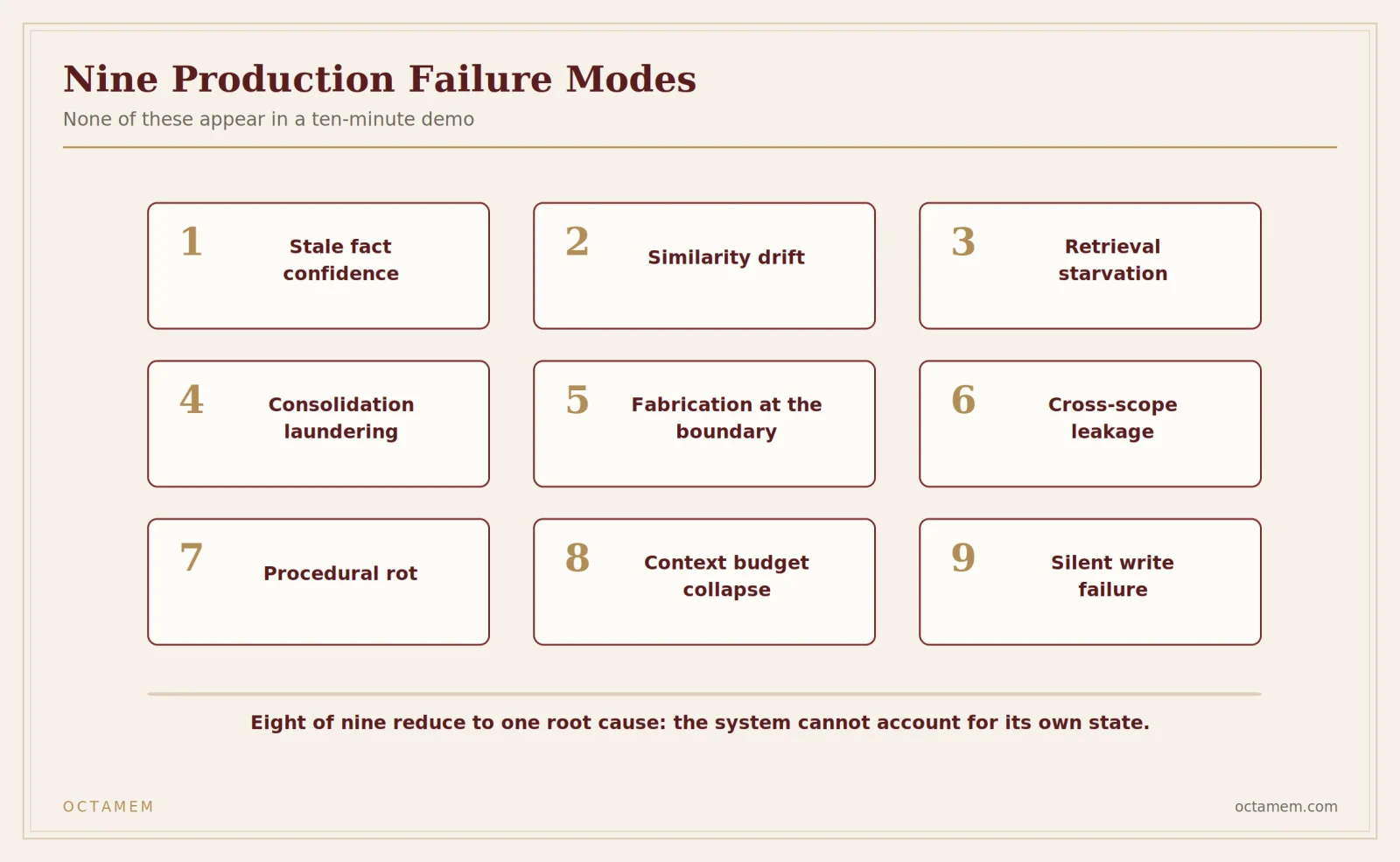
The memory failure modes that never appear in demos: stale fact confidence, similarity drift, consolidation laundering, and six more, each with a fix.
Memory systems fail differently in production than in development, and the reason is time. A demo runs for ten minutes with clean data. Production runs for two years with data that contradicts itself, users who change their minds, and a store large enough that most of it is irrelevant to any given query.
Every failure below is one we have either hit or watched someone hit. Each has a diagnostic you can run today.
1. Stale fact confidence
What it looks like: the agent states something that was true six months ago as though it is true now. No hedging, no timestamp, no indication anything has changed.
Why it happens: the store is append-only, or supersession is handled by ranking rather than structurally. Semantic similarity has no opinion about recency, so an old fact that embeds closer to the query outranks its own replacement.
Diagnostic: write a fact, write its contradiction, query. If both come back unranked, or the older one wins, you have this.
Fix: structural supersession. When a new fact addresses the same subject and predicate, mark the old one replaced and point to what replaced it. Keep the old value, because you will need to answer what the system believed last quarter. Filter superseded entries before ranking rather than after.
This is the most common serious failure in production memory and it is almost invisible until someone acts on a wrong answer.
2. Similarity drift
What it looks like: retrieval returns memories that are topically adjacent but useless. Ask about a failed deployment and get three successful ones, because they all discuss deployment.
Why it happens: embedding distance measures topical similarity, not usefulness. For episodic memory the most similar past event is frequently not the most instructive one. The failure you need to remember shares vocabulary with the successes you do not.
Diagnostic: query with a task where a specific past failure is the relevant memory. See whether it surfaces or whether you get generic neighbours.
Fix: multi-signal retrieval. Recency, an importance score assigned at write time, and outcome, combined with similarity rather than replaced by it. Scoring importance at write costs one extra model call per stored episode and it is usually worth it. See episodic memory in AI agents.
3. Retrieval starvation
What it looks like: the system worked well at a thousand memories and degrades quietly at forty thousand. Nothing errors. Answers just get vaguer.
Why it happens: early on, nearly everything in the store is plausibly relevant, so almost any retrieval strategy looks competent. The strategy is only tested once the ratio of relevant to stored drops by three orders of magnitude. Then a top-k of ten out of forty thousand needs to be genuinely discriminating, and most systems are not.
Diagnostic: load the store to your projected year-two volume and re-run your retrieval quality tests. Compare against your month-one numbers.
Fix: filter before you rank. Scope by user, group, entity, or time window first, then rank within the candidate set. Retrieval over a filtered thousand beats ranking over an unfiltered forty thousand, and it is faster.
4. Consolidation laundering
What it looks like: you delete a user's memories on request. The individual entries disappear. A summary generated three weeks ago still contains their information, and it no longer names them, so nothing flags it.
Why it happens: consolidation compresses many episodes into a durable pattern. That is a valuable operation. It also severs the link between the summary and its sources, so deletion has nothing to follow.
Diagnostic: write memories about a fictional person, let consolidation run, delete them, then query for anything they contributed.
Fix: retain source attribution through consolidation. Every derived artefact should list its contributing memories, and deletion should invalidate or regenerate any artefact a deleted memory fed. It costs storage and it is the difference between a deletion feature and a deletion guarantee. More in GDPR Article 17 and AI memory.
5. Fabrication at the retrieval boundary
What it looks like: the agent invents a plausible answer instead of saying it does not know. The invented detail is usually correct in shape and wrong in substance: a well-formatted VAT number that belongs to nobody.
Why it happens: retrieval returns the nearest available memories regardless of whether they answer the question. The model receives context that is topically related, assumes it is relevant, and completes the pattern. The memory system did not hallucinate. It handed over adjacent material and the model did the rest.
Diagnostic: ask about something you never stored. Specifically something adjacent to what you did store, since that is the hard case.
Fix: relevance thresholds on retrieval, so weak matches return nothing rather than something. Then instruct explicitly on empty results. Abstention is one of the abilities LongMemEval measures and it is worth asking any vendor for that sub-score specifically.
6. Cross-scope leakage
What it looks like: one user's memory surfaces in another's session. Or in a professional-services context, information from one client's matter appears while working on another's.
Why it happens: scoping applied at query time as a filter rather than enforced at the data layer. One code path that forgets the filter, and it leaks. Shared-agent architectures make it worse, since the agent's own memories may not be scoped at all.
Diagnostic: two tenants, private memories in each, query as one for the other's data using deliberately leading prompts.
Fix: enforce isolation below the application layer so a forgotten filter fails closed. Then check granularity: user-level isolation is table stakes, but most real products need scoping to a project, matter, or engagement. If you cannot get it from the vendor you will build it, and you will build it less carefully.
7. Procedural rot
What it looks like: the agent follows a routine that used to work. The API changed, or the internal process did. It fails in a way that looks like a reasoning error and is actually a stale skill.
Why it happens: procedural memory gets written and rarely reviewed. If the agent composes its own tools, you have code being written, stored, retrieved and executed with no review step. Nothing expires it.
Diagnostic: list every stored skill with its last successful execution. Anything unexecuted for months is suspect.
Fix: version procedural memory like the code it is. Track success rates so a routine that has failed its last three attempts drops in ranking. Gate promotion of agent-authored skills behind review or tests. See procedural memory in AI agents.
8. Context budget collapse
What it looks like: retrieval works, the right memories are found, and answer quality is still poor. Latency and cost are both up.
Why it happens: too much retrieved memory. Twenty memories where four would do fills the window, pushes out the actual task, and gives the model more chances to anchor on the wrong one. Accuracy degrades in the middle of long contexts even in models with large windows.
Diagnostic: cut top-k in half and measure quality. If it improves, you were over-retrieving. This is a surprisingly frequent result.
Fix: treat the retrieval budget as a real constraint rather than a maximum to fill. Rank hard, return few, and measure the trade explicitly. Fewer, better memories beat more, adequate ones on every axis including cost.
9. Silent write failure
What it looks like: the agent appears to remember during a session and remembers nothing afterwards. Extraction ran, produced nothing useful, and reported success.
Why it happens: the write path is the least monitored part of most memory systems, largely because almost no public benchmark grades it. Extraction is a model call that can return empty, malformed, or trivially generic output, and unless something checks, it looks like a successful write.
Diagnostic: feed a realistic messy transcript with a decision, a correction, and some noise. Inspect exactly what got stored. Not the count. The content.
Fix: instrument the write path. Alert on suspiciously low extraction rates. Validate that extracted facts have subject, predicate, and source. Sample stored memories and read them regularly, which sounds unglamorous and catches more problems than any dashboard.
The pattern underneath
Eight of these nine are variations on one thing: the system cannot account for its own state. It cannot say what it knew, when it learned it, what replaced what, where something came from, or whether a write succeeded.
That is why we build OctaMem around retrieval accountability rather than retrieval accuracy alone. Accuracy is a score on a benchmark. Accountability is what lets you diagnose failures 1 through 9 in an afternoon instead of a quarter, and it is what you need when someone asks why the agent said what it said.
Related reading
Frequently asked questions
Why does my AI agent forget things?
Usually the write path rather than retrieval: extraction ran and stored nothing useful. Inspect what actually got written before debugging retrieval.
Why does my agent give outdated information?
Append-only storage, or supersession handled by ranking rather than structurally. Similarity search does not prefer recent facts.
Can a memory system cause hallucinations?
Indirectly and often. Returning topically adjacent memories for a question they do not answer gives the model material to complete a pattern with.
Why did memory quality get worse over time?
Retrieval starvation. The ratio of relevant to stored memories fell, and a strategy that worked at a thousand entries does not discriminate at forty thousand.
How do I test a memory system properly?
Contradiction, abstention, deletion, isolation, and a messy realistic write. Full checklist in how to choose an AI memory layer.