GDPR Article 17 and AI Memory: Why the Right to Erasure Is Architecturally Hard
Most AI memory systems cannot honour a deletion request completely. Why consolidation breaks erasure, and what Article 17 actually requires.
Most AI memory systems cannot fully honour a deletion request, and the reason is consolidation. Individual memories are easy to delete. Summaries, patterns, and derived facts built from those memories usually survive, no longer reference the person by name, and therefore trip no alarm. The data is gone from the table and still present in the system.
If you are deploying agent memory anywhere in scope of GDPR, this is the problem to solve before launch rather than after your first deletion request.
This is general information rather than legal advice. Any compliance position needs your own counsel.
What Article 17 requires
The right to erasure entitles a data subject to have their personal data deleted without undue delay in defined circumstances, including where the data is no longer necessary for its original purpose or where consent is withdrawn and no other legal basis applies.
Three properties of the obligation matter architecturally.
It covers derived data. Personal data is not only the field where you stored a name. If a summary contains information relating to an identifiable person, it is personal data regardless of how it was generated. "We only kept the aggregate" is not a defence when the aggregate describes one person's behaviour.
Identifiability is broader than identifiers. Data that can identify someone in combination with other information you hold is still personal data. A memory that says "the London-based partner who objected to the Dubai restructuring" may name nobody and identify one person.
You must be able to demonstrate it. Accountability obligations mean you need to show that erasure happened, not merely assert it. A deletion you cannot evidence is a deletion you cannot defend.
Erasure is not absolute. There are exemptions, and retention under another legal basis is sometimes required. But the architectural requirement is the same either way: you must be able to find everything relating to a person and act on it deliberately.
Why memory systems break this
Four mechanisms, in rough order of how often they cause trouble.
Consolidation severs the audit trail
Consolidation is the operation that makes memory valuable. Twelve occasions where a user rejected verbose answers become one durable fact: this user prefers terse responses. Compression, plus abstraction, plus something that starts to look like learning.
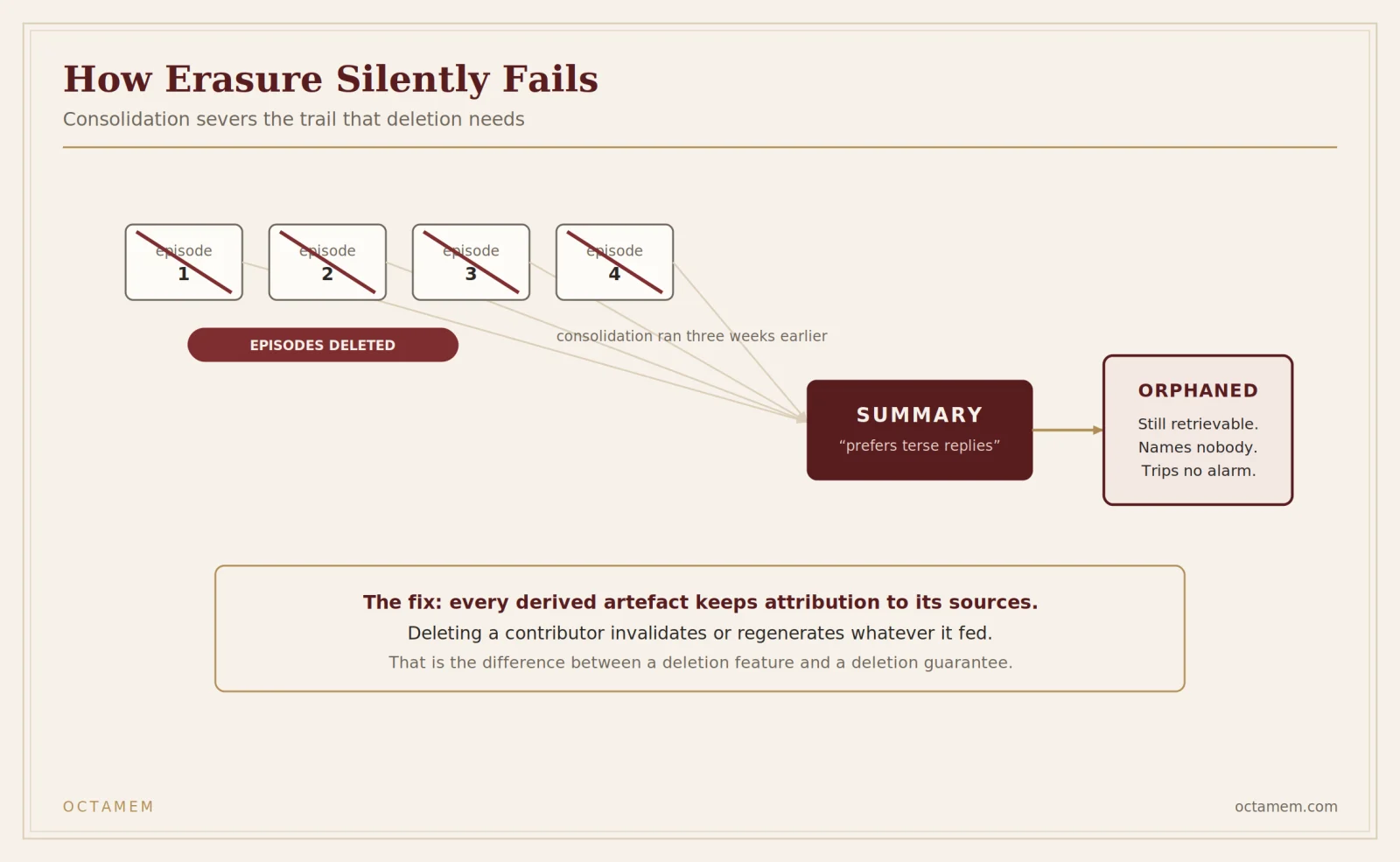
It also destroys the link between the derived fact and its sources. Delete the twelve episodes and the summary persists, describing a person who has exercised their right to be forgotten. Nothing in the system knows the summary is now orphaned, because nothing recorded what it came from.
This is the single most common gap. Ask any vendor directly: when I delete a memory, what happens to summaries derived from it?
Embeddings are not anonymous
Vectors get treated as though they are anonymised because they are not human-readable. They are not anonymised. An embedding is a lossy but often invertible representation, and inversion research has repeatedly recovered substantial source text from embeddings.
If you delete the source text and keep the vector, you have kept a representation of the deleted content. Treat embeddings as personal data and delete them with their sources.
Backups and derived indexes
Deletion from the primary store does not touch replicas, search indexes, caches, or backups. Regulators generally accept that backups cannot be surgically edited immediately, but they expect a documented policy: a defined retention window, a process for handling restores so deleted data is not resurrected, and evidence the policy is followed.
The failure case is a restore that quietly reinstates deleted memories. If you have no process for that, you have a deletion that undoes itself.
Model providers in the write path
Extraction usually runs through a model API. That means personal data has left your infrastructure and entered a subprocessor's, possibly in another jurisdiction, possibly with its own retention window.
A memory vendor hosting in Frankfurt may still route extraction through inference elsewhere. This is the question most security reviews miss: not where the database is, but which parties touch the content on the way in. Ask for the full subprocessor list and each one's retention terms.
What a compliant architecture requires
Six properties. Whether you build or buy, you need all six.
1. Provenance on every memory. Each stored item should record where it came from: session, document, user, timestamp. Without this you cannot find everything relating to a person, and erasure becomes best-effort.
2. Attribution through derivation. Every consolidated artefact should list its contributing memories. When a contributor is deleted, the artefact is invalidated and either regenerated without it or removed. This costs storage. It is the difference between a deletion feature and a deletion guarantee.
3. Supersession rather than silent overwrite. Counterintuitively, keeping old values helps compliance. You need to answer what the system held about a person at a point in time, including for subject access requests. An overwrite that leaves no trace makes that unanswerable.
4. Deletion that cascades and is evidenced. A deletion should propagate to derived artefacts, embeddings, and indexes, and produce a record: what was deleted, when, and what was affected. That record is the thing you show a regulator.
5. Configurable residency, including the write path. Storage region and processing region are separate questions. For some organisations neither can leave a jurisdiction, which means self-hosted or bring-your-own-storage deployment rather than a region toggle on a shared cloud.
6. Scoping below user level. Purpose limitation requires that data collected for one purpose is not used for another. In professional services this maps onto matter or engagement isolation. If your memory scopes only to users, an agent working on matter B can retrieve memory from matter A for the same client, which is a purpose-limitation problem before it is a confidentiality one.
The test to run
Fifteen minutes, on any trial account.
1. Write five memories about a fictional individual, including a preference, an event, and a correction. 2. Trigger consolidation, or wait for the scheduled run. 3. Issue a deletion request for that individual. 4. Query for the preference, the event, and anything derived from them. 5. Ask the system to produce evidence of what was deleted.
Pass: nothing retrievable, and an artefact you could hand to an auditor.
Fail: the consolidated summary still knows the preference. This is common, including in well-regarded systems, and it is worth discovering during evaluation rather than during an incident.
Retention is not the same as forgetting
One distinction that causes confusion in vendor conversations.
Memory systems often implement decay: reducing a memory's retrieval weight over time so it stops surfacing. Decay is a relevance mechanism. The data is still stored, still retrievable through other paths, and still personal data.
Erasure is removal. A vendor describing decay as forgetting is not lying, but the two are not interchangeable for compliance purposes. Ask which one a "forgetting" feature actually does.
How OctaMem handles this
Compliance requirements shaped the architecture rather than being added to it, because the first customers were in legal and regulated services and could not have deployed otherwise.
Provenance is recorded on every memory: source, timestamp, and what it superseded. Consolidated artefacts retain attribution to contributing memories, so deletion cascades to anything derived from a removed memory. Supersession keeps prior values so point-in-time questions remain answerable. Residency is configurable with EU-region hosting, and self-hosted deployment exists for organisations that cannot send memory content to a vendor's cloud at all. Access control scopes to memory groups rather than only to users, which is what matter-level isolation requires.
Trust and security · DPA · Talk to us
Related reading
- How to choose an AI memory layer
- Nine ways agent memory fails in production
- What is an AI memory layer?
General information, not legal advice. Last updated 10 August 2026.
Frequently asked questions
Does GDPR apply to AI agent memory?
If the memory contains personal data of people in scope, yes. Memory is a processing activity like any other.
Can I delete a single person's data from an AI memory system?
Only if the system tracks provenance and attributes derived artefacts to their sources. Many do not, which makes complete deletion impossible rather than merely difficult.
Are embeddings personal data?
Treat them as such. Inversion techniques can recover meaningful source content, so an embedding of personal data is a representation of personal data.
Is decay the same as deletion?
No. Decay reduces retrieval weight; the data remains stored. Erasure removes it.
What about backups?
Regulators generally accept that backups cannot be edited instantly, but expect a documented retention window and a restore process that does not resurrect deleted data.
Where should EU memory data be stored?
In an EU region if you can, and check the processing path as well as the storage location. Extraction routed through a model provider elsewhere is a transfer.
Does self-hosting solve compliance?
It solves residency and subprocessor exposure. It does not solve consolidation attribution, cascading deletion, or evidence, which are architectural regardless of where the software runs.