AI memory access control and offboarding
What actually happens to shared AI memory when an employee leaves — grants, sessions, API key rotation — and the questions to ask any memory vendor.
Every memory vendor will tell you access can be revoked. The question that separates them is narrower: what happens to the API key the departing employee copied into a script eight months ago? Ending a session does not touch it.
Two authorities, kept apart
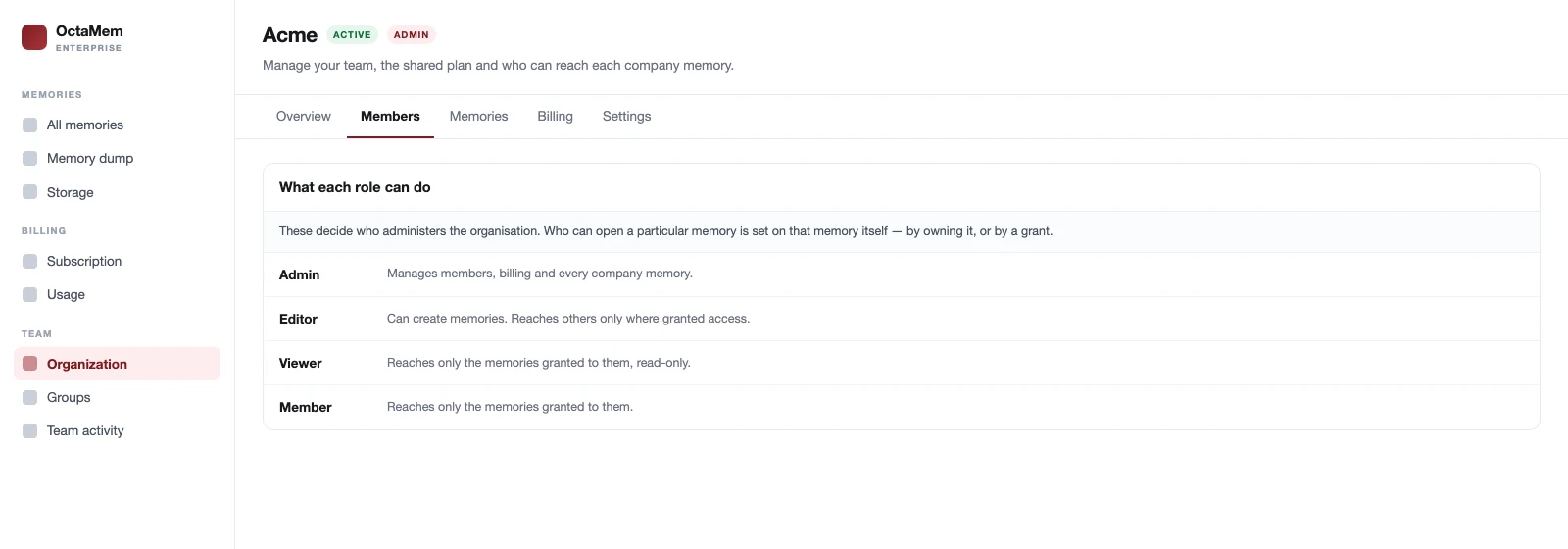
Access to a memory is decided by exactly two things: you own it, or you hold a grant on it. An organisational role is not consulted. This is worth stating plainly because the alternative — roles implying content access — is common, and it produces a system where promoting someone silently opens years of material nobody reviewed.
Owning a company memory is itself conditional. The person a memory was provisioned for holds owner rights only while their membership is active. The moment it ends, the pointer confers nothing — their access must come from a grant like anyone else's, and offboarding deleted theirs. Nothing is rewritten on the memory document to achieve that; the check simply asks whether the membership is live.
What offboarding actually does
Removing a member is a single action with five consequences, and the order matters less than the completeness:
| Action | Why |
|---|---|
| Membership set to removed, with the stint recorded | The audit trail is a history, not a flag — repeated join/leave cycles stay legible |
| Sessions and tokens revoked | Ends every live surface immediately |
| All their grants deleted | Access to every shared memory ends at once |
| Every company memory they worked in has its API key rotated | A copied key is a bearer credential that survives logout — rotation is the only real revocation |
| Their account, personal memories and own plan left untouched | Those were never the company's to take |
Deleting the person to remove them from a company destroys data that was never the company's. Offboarding revokes access; it does not delete a human being's account.
One guard worth knowing about: removing or demoting the last admin is refused. An organisation with no admins is unmanageable, and the failure mode is discovered at the worst possible moment. Transfer admin first.
Rejoining
People come back. When they do, the memory provisioned for them originally is reused rather than a second one created — so a returning employee gets their workspace back, and the company is not billed for an accumulating pile of orphaned spaces. Each stint is recorded separately, so the history reads as a history.
Questions to ask any memory vendor
- After offboarding, is the memory's API key rotated? If not, the departed employee's copy still works. This is the single most revealing question in the category.
- Does an org role imply access to content? If yes, every promotion is an unreviewed data grant.
- Can an admin read a personal memory? If yes, employees have no private workspace, whatever the marketing says.
- Is admin access to a colleague's memory recorded? Invisible capability and audited capability look identical until the day you need the log.
- Can the last admin be removed? If yes, you can lock yourself out of your own organisation.
For what is recorded once access is granted — every operation, by whom, and what it cost — see audit logs and compliance.
Frequently asked questions
What happens to shared AI memory when an employee is offboarded?
Their membership is marked removed, sessions and tokens are revoked, every grant they held is deleted, and the API key of each company memory they worked in is rotated. The memories and their contents stay with the company; the person's account and personal memories are untouched.
Why does offboarding rotate API keys?
Because a key is a bearer credential. Someone who copied it into a script months ago can keep using it after their sessions end and their grants are deleted — revoking access in the product does not reach a key that already left it. Rotation is the only revocation that works.
Does an admin automatically get access to every memory?
To company-owned memories, yes — an admin administers what the company owns. But reaching a colleague's memory is a recorded act with an actor and a timestamp, not a silent capability, and memories created personally are outside the organisation entirely.
What happens if someone rejoins the company?
The memory originally provisioned for them is reused rather than a new one created, so they get their workspace back and the organisation is not billed for duplicates. Every stint is recorded separately in the membership history.