How pooled billing works for shared AI memory
One company plan, pooled memory operations and storage, no seat counting. How shared AI memory is billed and why the company — not the admin — is the customer.
Per-seat pricing punishes exactly the behaviour a memory product needs: adding the colleague who would contribute the one document that makes the memory useful. Shared memory is billed as one pool — nothing counts seats, and adding someone costs nothing until they do work.
The company is the customer
The Stripe customer, the subscription, the card and the invoices belong to the organisation — not to the admin who happened to set it up. That sounds like an accounting detail and is actually a continuity guarantee: an admin leaving, or handing over to someone else, does not disturb billing at all. There is no moment where the company's subscription is attached to a person who has resigned.
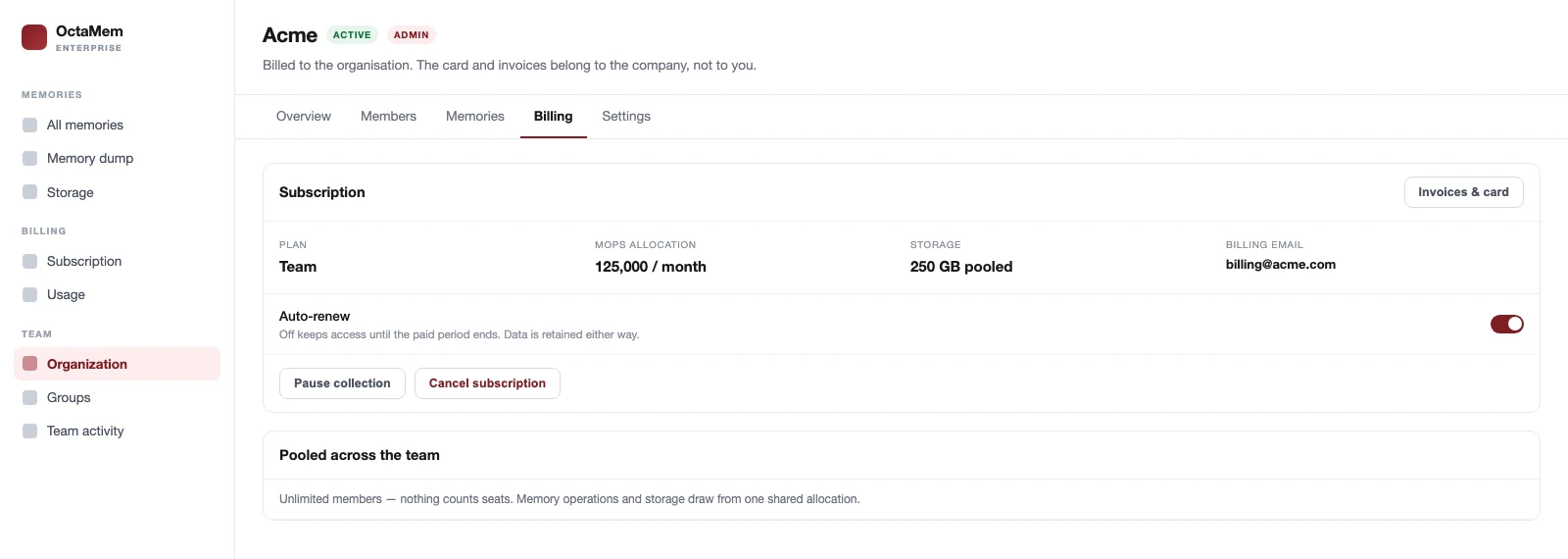
What is pooled
Two things draw from one shared allocation: memory operations (the billable unit of work — one chunk written, or one query read) and storage. Both are claimed atomically, so two colleagues uploading at the same time cannot collectively overshoot the quota, and neither of them gets a confusing partial failure.
| Operation | Cost |
|---|---|
| Search / retrieve | 1 operation, flat |
| Add text | 1 + one per 3,000 characters |
| Upload a PDF | one per page |
| Upload other files | one per 4 KB |
| Check plan and balance | Free — never billed |
The principle is to meter the work, not the call. Ingestion is where the real cost sits — chunking, extraction, embeddings, indexing — so a fifty-page PDF costs about fifty operations while a search costs one however large the memory is. Reads stay cheap on purpose. Checking your own balance is never billed, which sounds obvious until you meet a product that charges for it.
Adding people is free
No plan limits how many people you can add. Suggested team sizes on the pricing page are guidance for choosing an allocation, not a licence count, and nothing in the system counts seats. A colleague who reads occasionally costs approximately nothing; the bill tracks work performed, not headcount.
This also means capacity is never stranded. On per-seat pricing the licences bought for people who are not using the product this quarter are simply wasted. On a pooled plan that capacity is available to whoever is actually working.
Cancellation retains your data
Turning off auto-renew keeps access until the paid period ends. Cancelling suspends access at the end of the period. Neither deletes anything. The company's memories are retained, and paying again restores access. Suspension is a billing state, not a deletion event — we verified that the suspension path does not touch the memory store at all.
One structural note for finance: a single-user plan cannot fund an organisation. Company plans are what make the pooled operations and storage work, so the allow-list is deliberate rather than an upsell. And per-user spend is visible — see audit logs for who consumed what.
Frequently asked questions
Is shared AI memory priced per seat?
No. Memory operations and storage are pooled across the whole organisation and nothing counts seats. Adding a colleague costs nothing until they perform work that consumes operations or storage.
Who is billed — the company or the admin who set it up?
The organisation. The Stripe customer, subscription, card and invoices all belong to the company, so an admin leaving or handing over never disturbs billing.
What happens to our memories if we cancel?
They are retained. Cancelling suspends access at the end of the paid period; it does not delete data, and paying again restores access.
How much does a document cost to store in memory?
A PDF costs roughly one memory operation per page. Text costs one operation plus one per 3,000 characters. Searching costs a flat one operation regardless of how much is in the memory.