Open source AI is winning. Here is how the best founders build on it in 2026.
Open weight models now sit within points of the frontier at a tenth of the price. How founders route across models — and the layer the stack gets wrong.
Short answer: Open weight models stopped being the budget option in 2026 and became the default for most production work. The best founders do not pick one model. They route: routine tasks to a cheap open model served fast (often through OpenRouter, often on Cerebras), the hard 20% to a frontier model, all behind one API. That cuts inference bills by an order of magnitude. The layer the open stack still gets wrong is memory, and that is where the advantage actually comes from.
What changed this year
Eighteen months ago the choice was easy. If you needed real reasoning in production you paid for Claude or GPT and moved on. Open models were interesting and clearly behind.
That is no longer true. DeepSeek's V4 Flash, released in April 2026 under an MIT licence, scores 79.0% on SWE-bench Verified at a first party price of $0.14 per million input tokens and $0.28 output, according to OpenRouter's June 2026 open weight review. Its larger sibling holds the top open weight score on the same benchmark. Z.ai's GLM 5.2 followed in June and now leads Artificial Analysis's intelligence index among open weights, a few points behind the best closed model. Qwen, Kimi, MiniMax, Mistral and OpenAI's own gpt-oss models fill out a field that did not exist at this quality two years ago.
Frontier models still win on the hardest reasoning, the trickiest tool use and the widest multimodal tasks. Nobody serious disputes that. But for the bulk of what a startup's product actually does, drafting, extracting, classifying, summarising, answering from documents, following a workflow, open models are now good enough and roughly ten to fifteen times cheaper when served through inference providers.
That gap is a business model.
The three pieces founders are using
OpenRouter, the switchboard. One API key, one billing relationship, and a listing that ran to over 400 models in September 2026. Prices pass through from each provider with a fee on credit purchases, currently 5.5%. Failover between providers is built in, the API is OpenAI compatible so existing code works unchanged, and you can switch a model with a string change. For a small team, that last point is the whole argument: you are never locked into one lab's roadmap, and you can move workloads to whatever is cheapest and best this month.
Cerebras, the speed. Cerebras runs open weight models on its own wafer scale chips rather than GPUs, and the result is throughput nobody else matches: around 3,000 tokens per second on gpt-oss-120b by its own published figures, at $0.35 per million input tokens and $0.75 output. The catalogue is narrow and deliberately so. But for anything where a human is waiting, voice agents, live coding assistance, interactive chat over documents, or where you need to churn through a million records overnight, speed at that price changes what is feasible. OpenAI committed a reported $20 billion plus to Cerebras compute in April 2026, which tells you how the largest lab sees it.
Frontier models, for the 20%. Claude, GPT, Gemini. Kept for the tasks where the difference between very good and best is worth ten times the price: the complex multi step reasoning, the customer facing answer that cannot be wrong, the agentic task that has to use tools reliably.
How orchestration actually works
The pattern is simpler than the word suggests.
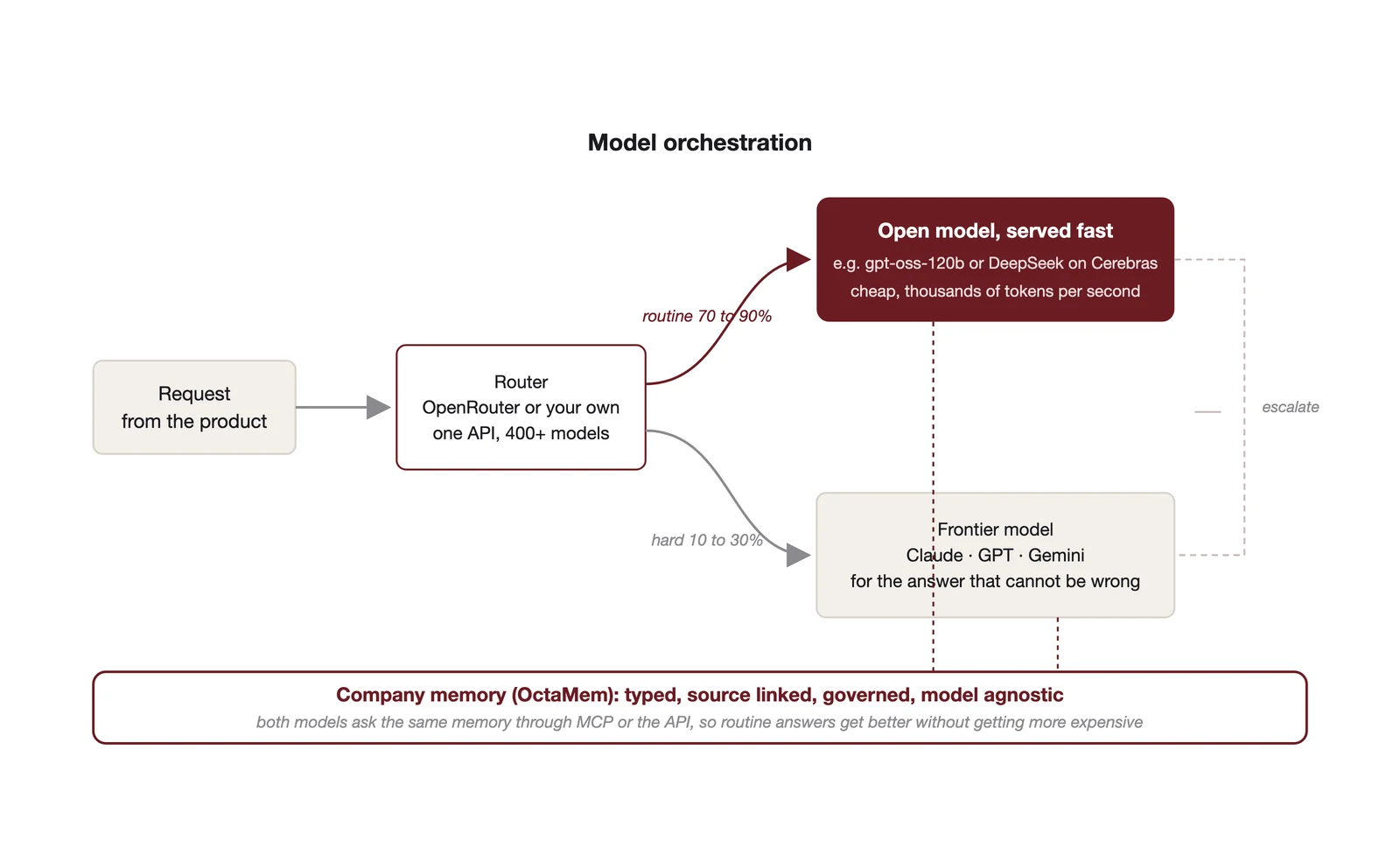
A request comes in. A small, fast classifier, often an open model itself, decides how hard it is. Routine work goes to a cheap open model on fast hardware. Anything flagged as difficult, high stakes or ambiguous goes to a frontier model. If the cheap model's answer fails a check, it escalates. All of it goes through one router, so the code does not care which model answered.
Done well, 70% to 90% of requests never touch a frontier model. The bill drops accordingly, response times drop for the routine work, and quality on the hard cases is unchanged because those still get the best model.
Done badly, teams route everything to the cheapest model, watch quality slip, and conclude that open source does not work. It works. Routing is the skill.
Where the open stack still fails
Every piece above is about the model. Which one, how fast, how cheap. And the model has become close to a commodity. You can swap it with a string change.
What you cannot swap in is memory. An open model behind OpenRouter knows nothing about your company. Neither does a frontier model. The difference between a generic answer and a useful one is what the model can see about your customers, your documents, your history and your decisions, and the open stack's answer to that has been "build it yourself on a vector database".
Founders who do that spend a quarter on it, end up with a bag of text chunks that grows without bound, cannot say who is allowed to see what, cannot show where an answer came from, and cannot delete anything with confidence. The model was the easy part. Memory is where the advantage was hiding all along.
How OctaMem fits the open stack
OctaMem is model agnostic. It is a governed memory layer that any model can ask, through MCP or the API, which means it sits naturally behind a router. The cheap open model on Cerebras and the frontier model both draw on the same typed, source linked memory of the company, so the routine answers get better without getting more expensive, and the hard answers get the full context.
Connect Drive, Outlook, Teams, GitHub and SharePoint once. Access is scoped by role down to the record, every read is logged, deletion is provable. On the LoCoMo long term memory benchmark OctaMem scores 93.51% at about $0.00076 per question, and we publish where we fall short. Team plans start at $199 a month, which is less than most teams' monthly router bill.
Advice for founders
Route from day one, even if you start with one model. Put a router in front so switching is free later.
Buy speed where a human is waiting and buy cheap where nobody is. Those are different workloads and deserve different models.
Keep a frontier model for the work that cannot be wrong, and measure how much of your traffic actually needs it. It is usually less than you think.
And do not build the memory yourself. The model stack has been commoditised. The memory layer has not, and it is the part that makes your product know your customer.
Frequently asked questions
Is open source AI cheaper than OpenAI or Anthropic?
Per token, usually by a factor of ten or more when served by inference providers. Whether it is cheaper overall depends on how much re-work the cheaper answers create, which is why routing matters.
Is OpenRouter worth the fee?
For teams using several models, needing failover, or wanting one bill, yes. For a team using one model at very high volume, direct billing may be cheaper.
When is Cerebras the right choice?
When generation speed is the bottleneck: real time agents, voice, interactive assistants, or large batch jobs where throughput per dollar matters. Its catalogue is small, so check your model is supported.
Does OctaMem work with open models?
Yes. Any model or agent that can call an MCP server or an API can ask OctaMem. It does not care which model is asking.Route the model. Own the memory. See how OctaMem fits an open stack at octamem.com/developers.