How to onboard a developer or contractor in a day: give them the codebase's memory
Developer onboarding takes weeks because the knowledge is in people's heads. How founders cut it to a day with a memory of the codebase.
Short answer: New developers take weeks to become useful because everything they need to know is in another engineer's head. Give them a memory of the codebase, its history and the decisions behind it, scoped to what they should see, and the first week becomes a day. The same memory means a contractor can start on Monday, a departing engineer leaves nothing behind, and technical due diligence stops being a scramble.
The real cost of a new engineer
The salary is the visible cost. The invisible one is the productivity of the engineer who already knows the system, because for the first month they are the new hire's search engine.
Why is this module structured like that? Because of an incident in February. Where do we handle currency conversion? Three places, for historical reasons, and here is which one to use. Why does the test suite skip that case? Nobody remembers, but do not remove it.
Each question costs the senior engineer ten minutes and a lost train of thought. Multiply by fifty questions a week and the company has effectively lost half a senior engineer to onboarding one junior. Small teams feel this hardest, because the one person who knows is also the one person who ships.
Contractors make it worse. They join for eight weeks, spend two of them learning, leave, and take what they learned with them. The next contractor starts from zero.
Why documentation never fixed it
Every engineering team has tried. An onboarding doc. An architecture wiki. A README per service. They are written once, in a burst of good intentions, and are wrong within a quarter because the code kept moving and the docs did not.
The knowledge was never in the docs anyway. It was in the commits, the pull request discussions, the incident threads in Teams and the meeting where the team decided to defer the refactor. Nobody was reading those as knowledge. A new engineer had no way to.
What onboarding looks like with a codebase memory
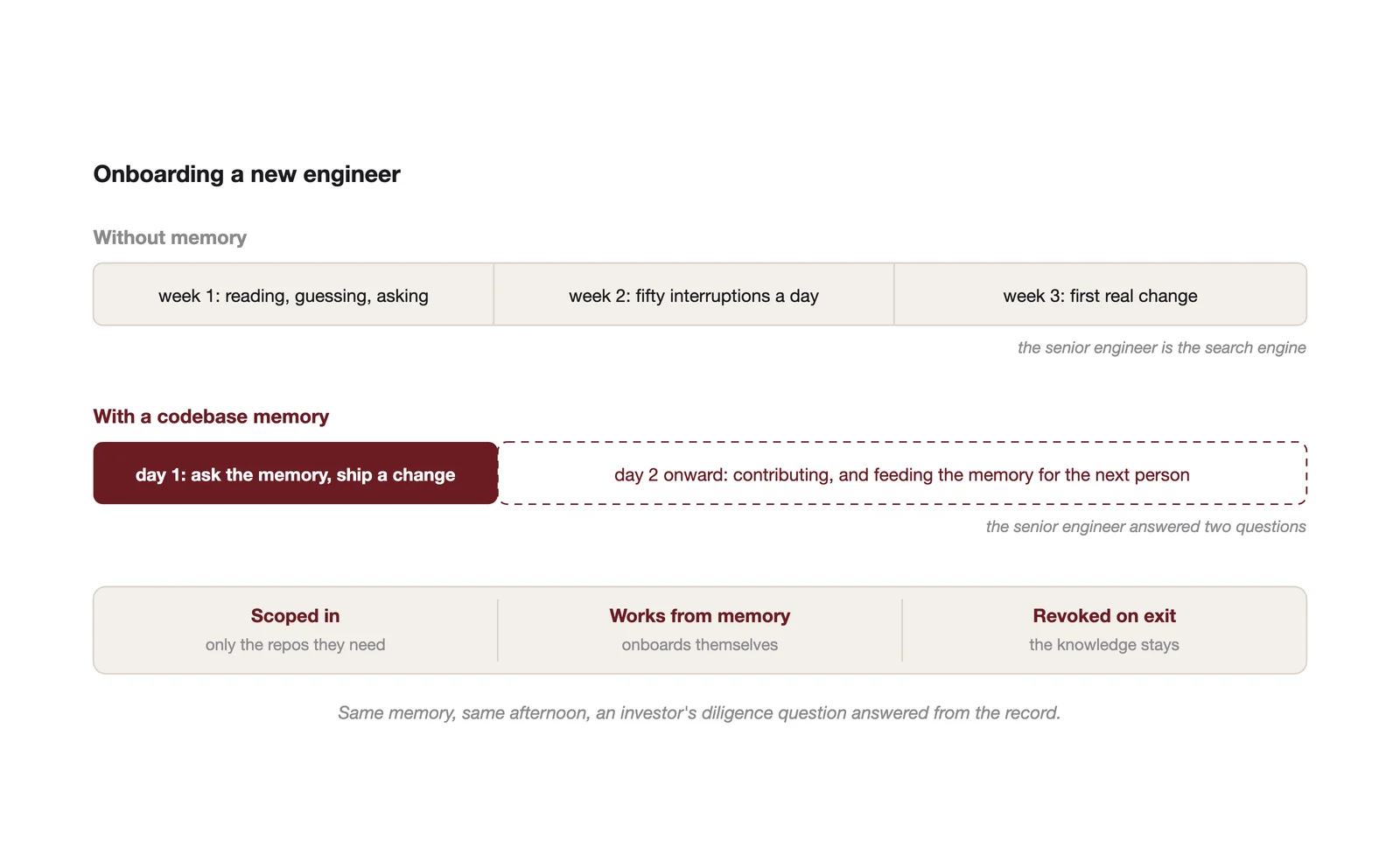
Day one, morning. The new engineer gets access to the memory group for the repositories they will work on. They open Claude, ChatGPT, Cursor or Claude Code, all connected to the same memory, and start asking.
How is the system laid out and what depends on what? Answered from the files and configuration, with sources. What are the conventions here and where were they decided? Answered from the history and the discussions. Why is payments structured this way? Answered with the February incident thread. Which parts of the system are fragile, and who last touched them? Answered from the commit pattern.
Day one, afternoon. They pick up their first ticket. Before changing anything, their coding agent asks the memory whether this has been tried before and what depends on the module. They ship a small change by the end of the day, and the senior engineer answered two questions instead of fifty.
Day two onward. They are contributing, and everything they do feeds the memory for the next person.
Contractors: scoped in, revoked out
The contractor case is where this pays back fastest.
Scope the access. A contractor gets a memory group containing the repositories and the context they need, and nothing else. Not the financials, not the customer list, not the other product line. Enforced on every record.
Let them work from the memory. They onboard themselves, ask the memory instead of the team, and ship within the engagement rather than spending a quarter of it learning.
Revoke on exit, keep the knowledge. When the engagement ends, their access ends. Everything they built, decided and explained stays in the company's memory. The next contractor, or the eventual full time hire, starts where they left off instead of at zero.
For a founder this changes the hiring calculus. You can use specialist contractors for longer, with less risk, because the knowledge no longer leaves with them.
When an engineer leaves
The mirror image of onboarding is handover, and most companies do it badly for the same reason. The departing engineer writes a handover doc in their last week, covering what they remember and what they think matters. Six months later someone finds the thing they did not think mattered.
With a codebase memory, handover is already done. Every commit they made, every discussion they had, every decision they were part of is in the memory with their name and the date. The team asks the memory what the departed engineer would have known. The "bus factor" that keeps founders awake, the risk that one departure takes down the company's understanding of its own product, drops sharply.
Technical due diligence, without the scramble
Investors, acquirers and enterprise customers all ask the same questions eventually. How is the system built? How much technical debt is there? Who understands what? What has changed and why? Can you show us?
Most founders answer these with a hurried deck and a CTO on a call. Founders with a codebase memory answer from the record. Here are the commits behind that decision. Here is the honest state of the payments module, with the incident history. Here is who has touched what, so you can see the knowledge is not concentrated in one person. Diligence goes faster, and the questions the founder cannot answer get smaller.
How OctaMem does this
OctaMem reads your GitHub repositories through the desktop app, alongside Outlook, Teams, Drive and SharePoint, and turns files and commit history into typed, source linked memory. Memory groups scope access by repository and role down to the record. Every read is logged. Access is granted and revoked by the admin, and the memory stays with the company when a person leaves.
Engineers and their coding agents connect through MCP, so Cursor and Claude Code ask the same memory the founder asks from Claude or ChatGPT. Team plans start at $199 a month, which is less than the cost of one day of a senior engineer answering onboarding questions.
Frequently asked questions
Does this replace an onboarding buddy or mentor?
No. It replaces the fifty interruptions a day about facts the memory can answer, so the mentor's time goes to judgement and craft.
Can contractors see the whole codebase?
Only what you give them. Access is scoped per repository and per memory group, and enforced on every record.
What happens to the memory when someone leaves?
Nothing. Their access ends. Everything they contributed stays with the company.
How long before the memory is useful for onboarding?
Immediately for the code and history, since those are read on connection. It gets richer with every synced day of conversation and decisions.Onboard in a day. Lose nothing when someone leaves. See how at octamem.com.