Claude Code and Cursor forget your codebase every session. The fix also helps your CEO.
Coding agents know the code in front of them and nothing about why it is that way. How session indexing differs from durable memory, and the fix.
Short answer: Cursor indexes your repository for fast retrieval inside a session. Claude Code reads files as it works and picks up conventions from a CLAUDE.md file at the start of each session. Both understand the code in front of them and neither remembers why it is that way, what was tried before, or what the team decided in Teams last week. The fix is a durable, shared memory the agent can ask, and the same memory answers the founder's questions in plain English.
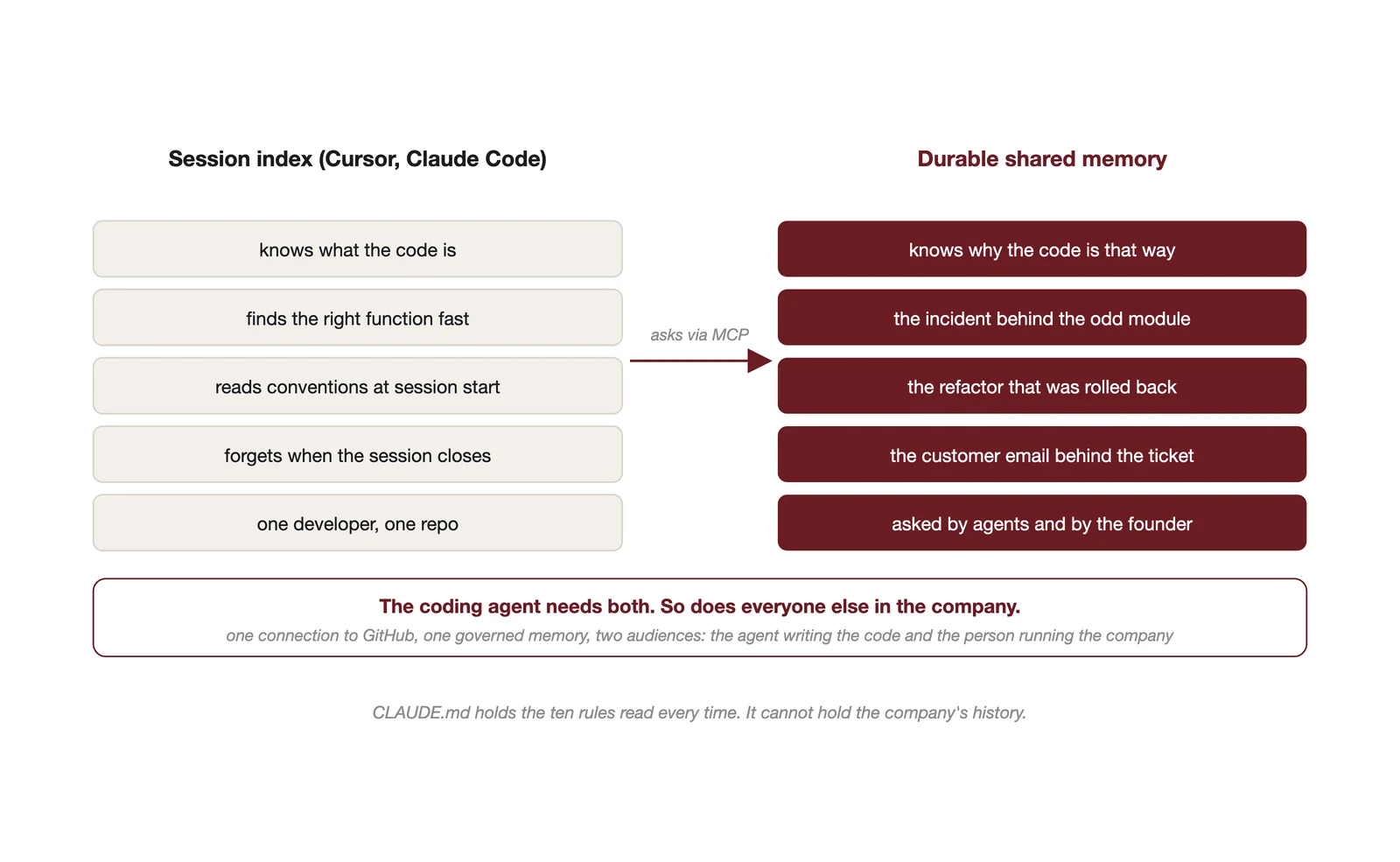
Two kinds of knowing
There is knowing what the code is, and there is knowing why.
Cursor is very good at the first. It builds a semantic index of your repository so it can find the relevant function in a large codebase in milliseconds. Claude Code takes a different route to the same place, searching and reading files live as it works, guided by a project file of conventions it reads when a session starts.
Both are stateless by design. Close the session and the understanding is gone. Open a new one and the agent rediscovers the codebase from scratch. It does not remember that the odd structure in the payments module exists because of an incident in February. It does not remember that the team tried the obvious refactor last quarter and rolled it back. It does not know that a customer escalation on Tuesday is the reason the ticket it is about to work on exists.
So it makes confident, well formed changes that contradict decisions it was never told about. Engineers know this feeling. It is why they keep re-explaining the same context at the start of every session.
The cottage industry this created
Look at what developers have built to cope. Persistent memory plugins for Claude Code and Cursor. Knowledge graph indexers that map every function and call chain. Tools that mine past agent conversations for decisions, patterns and gotchas. Open source memory layers with dedicated Claude Code plugins. There are a dozen projects on GitHub whose README opens with some version of "Claude Code does not remember; every session starts blank; you are the memory, and that does not scale."
They are right about the problem. Most of them solve a narrow version of it: memory for one developer's coding agent about one repository. The knowledge still stops at the edge of the editor.
Why the fix should not live in the editor
The reason the payments module looks the way it does is not in the repository. It is in the incident thread. The reason the refactor was rolled back is in a pull request discussion and a meeting. The reason the ticket exists is in a customer email. A memory that only knows the code can only ever answer half the question.
And the coding agent is not the only one asking. The founder wants to know why billing was rebuilt in March. The new contractor wants to know the conventions. The product manager wants to know what shipped. If each of them has a different memory, or none, they get different answers.
So the memory belongs one layer up. Shared across the company. Fed by the repositories and by the inbox, the chat, the meeting notes and the documents. Asked by the coding agent through MCP and by everyone else through the assistant they already use.
What the coding agent does differently with a memory
Before it changes a module, it asks the memory what depends on it and whether this has been tried. It finds the February incident and works with the odd structure instead of "fixing" it.
When it hits a convention it does not recognise, it asks where the convention was decided and follows the decision rather than its default.
When it finishes, the change and the reasoning land back in the memory through the commit, so the next session, or the next engineer, or the founder, can ask about it.
CLAUDE.md and its equivalents still have a role. They are the place for the ten rules that must be read every time. They are not the place for a company's history, because a file that tries to hold everything ends up holding nothing anyone reads.
What the founder gets from the same memory
This is the part engineers usually miss. The memory that makes the coding agent smarter is the same memory that lets a non technical founder ask "what changed before the churn spike" and get an answer with the commits attached. One connection to GitHub, one governed memory, two audiences: the agent that writes the code and the person who is responsible for the company.
That alignment matters more than it sounds. Most of the friction between founders and engineers comes from arguing about facts that a shared memory would simply answer.
How OctaMem does this
OctaMem reads your GitHub repositories through the desktop app and turns files and commit history into typed, source linked memory, alongside Outlook, Teams, Drive, SharePoint and meeting notes. Access is scoped by role and repository down to the record. Every read is logged.
Claude Code and Cursor connect through MCP; the exact configuration is at octamem.com/docs/cursor and octamem.com/docs/mcp-server. Claude and ChatGPT connect as custom connectors. Python and JavaScript SDKs cover anything you build yourself. Team plans start at $199 a month.
Frequently asked questions
Does this replace Cursor's codebase index?
No. The index is for fast retrieval inside a session and it is good at it. The memory is for what the index cannot hold: why, when, who, and what the rest of the company knows.
Can I use this with just Claude Code and no team?
Yes. A solo founder gets the same benefit: the agent stops forgetting between sessions. The shared part matters when there is someone to share with.
Does the agent write to the memory or only read from it?
It reads through MCP, and its work lands in the memory through the commits and discussions it produces. Agents can also write directly through the API where you want them to.
What about other coding agents?
Anything that speaks MCP can connect. The docs list current integrations.Give your coding agent, and your CEO, the same memory of why. Connect GitHub to OctaMem at octamem.com.