AI for real estate agents and brokerages: why 82% use it and only 17% see results
Most agents use AI. Most say it made no difference. What AI really saves time on in a brokerage, what it fails at, and how firms are fixing the gap.
Short answer: AI saves real estate agents time on writing, which is why 82% now use it. It fails at the part that closes deals, which is knowing your clients, your listings and your market history, because every AI tool starts from zero. The brokerages seeing real results have given their AI a shared memory of the business. The rest are using very fast autocomplete.
Adoption went vertical. Value did not follow.
Two surveys published this year say the same thing from different angles.
Realtors Property Resource surveyed agents in February 2026 and found 82% now use AI in their business. Delta Media's brokerage leadership survey put it higher still: 97% of brokerage leaders say their agents use AI, and only 2% of brokerages have no plans to adopt it.
Then there is the other number. In the National Association of Realtors' 2025 Technology Survey, just 17% of agents said AI had a significant positive impact on their business. Forty six percent said they noticed no difference at all.
Nearly everyone is using it. Fewer than one in five think it matters. That is not a story about bad technology. It is a story about what the technology is being used for.
What agents actually use AI for
Look at where the usage concentrates and the gap explains itself.
Listing descriptions. Social captions. Email drafts. Blog posts. The RPR data shows writing tools are by far the most used category. This is real time saved. It is also the lowest value work an agent does, and the agent down the road is saving the same time on the same tasks with the same tool.
The work that actually wins and closes deals looks different. Knowing that a buyer said no to three houses because of the school catchment, not the price. Remembering that the vendor at number 42 is emotionally attached to the garden and will react badly to any offer that mentions redevelopment. Recalling what a particular solicitor's turnaround time has been on the last five completions. Knowing what the brokerage agreed with a developer on the last phase before negotiating the next one.
None of that is writing. All of it is memory. And none of the AI tools agents currently use can do it, because each one starts every session knowing nothing about the business.
The point tool tax
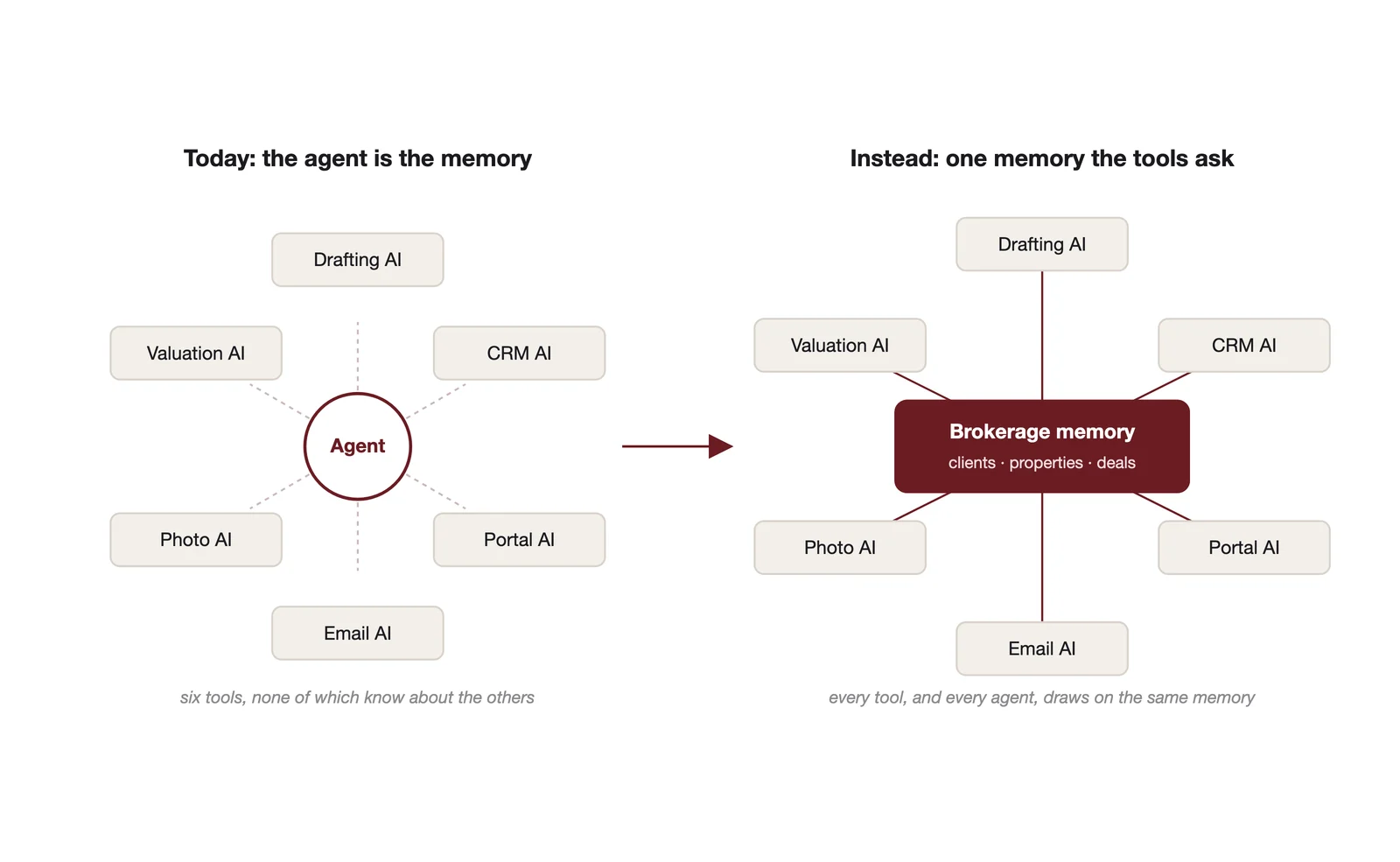
Here is what an agent's day looks like with AI in 2026. A chatbot for drafting. A different AI inside the CRM. An AI feature in the listing portal. An assistant in the email client. A photo editing tool. A valuation tool.
Each one is useful. None of them know about the others. The listing AI does not know what the buyer told you on the viewing. The email assistant does not know what the CRM says about the client's budget. The valuation tool does not know that the comparable sale two doors down had a leaking roof, which is why it went cheap.
So the agent becomes the integration layer. They carry the context between tools in their head and re-type it into each one. The minutes saved on the writing get spent on the switching. This is the point tool tax, and it is why 46% of agents feel no difference.
What a brokerage memory does differently
The brokerages pulling ahead have made one structural change. Instead of giving each agent a dozen AI tools with no memory, they have given the whole business one memory that every tool and every person can ask.
It connects to the sources the brokerage already runs. The shared drive with the property files. The mailboxes where every negotiation actually happened. Teams or Slack where the office talks. The CRM export. It reads them continuously and turns them into structured memory: facts about properties and clients, events like offers and completions, and how to knowledge about how the firm does things.
Then anyone at the firm, and any AI tool the firm runs, can ask it. What did we learn about this buyer on previous viewings? What has this developer accepted before? Which solicitors on our panel have been slow this quarter? What did we say to this vendor last time about price?
The answer comes with the email or note it came from. Access follows role, so a new agent sees the team's knowledge but not the director's confidential files. When an agent leaves for a rival, the client knowledge stays with the brokerage, because it was never in one person's phone.
Three places this changes the numbers
Conversion from viewing to offer, because the follow up draws on everything the buyer has ever said to anyone at the firm, rather than only what one agent remembers.
Speed to completion, because the team knows which conveyancers, surveyors and lenders actually perform, based on the firm's own history rather than reputation.
Retention of client relationships when agents move, which is the quiet leak in every brokerage's revenue.
How OctaMem does this
OctaMem is a governed memory layer for businesses where knowledge has to outlive the people who first learned it. Real estate groups were among the first to run it.
The desktop app connects Google Drive, OneDrive, Outlook, Teams and SharePoint in about two minutes and syncs on a schedule you set. Property files, negotiations and client correspondence become typed, source linked memory. Memory groups give each team its own space with role based access down to the individual record, and every read is logged.
Agents ask it questions in plain language and get answers with receipts. The AI tools the brokerage already uses can draw on the same memory. And when someone leaves, the brokerage keeps what they learned.
Frequently asked questions
What is the best AI tool for real estate agents?
For writing, any modern chatbot works. For the part that closes deals, agents need a memory of their clients and market that their tools can draw on. That is a different category of product from a writing assistant.
Is AI going to replace real estate agents?
No. The evidence so far is that AI has replaced very little agent work beyond drafting. What it can do is make every agent at a firm as informed as the most experienced one, which is a different and better outcome.
How much does a brokerage memory cost?
OctaMem plans for teams start at $199 a month, with a free tier for trying it. Larger groups with data residency requirements are priced per deployment.
Does this work for a small independent agency?
Yes, and the value is often higher, because in a small agency each person holds more of the firm's knowledge and losing one of them hurts more.OctaMem gives your brokerage one memory of every client, property and deal, which every agent and every AI tool can ask. See how real estate teams use it at octamem.com/industries/real-estate.