Can law firms use ChatGPT safely? What confidentiality actually requires in 2026
Most lawyers already use AI; most firms have no policy. The three real risks of ChatGPT in a law firm, and what a defensible setup looks like.
Short answer: Lawyers can use AI, and most already do. The risk is not the technology. It is using a consumer chatbot with no confidentiality guarantees, no source for its answers, and no record of what was asked. A safe setup needs three things: client data that stays inside your control, answers that cite their source, and a log of every query. Most firms have none of them yet.
The gap between using AI and governing it
The numbers tell a clear story. Roughly seven in ten legal professionals now use generative AI at work, more than double the figure a year earlier, according to the 8am 2026 Legal Industry Report. The same report found that 54% of firms provide no AI training and 43% have no AI use policy and no plan to write one.
Read those two findings together. Lawyers are using AI every day. Their firms have not decided what is allowed.
That is where the risk lives. Not in a partner deciding to adopt a legal AI platform after a procurement review. In an associate pasting a client's contract into a free chatbot at 11pm because it is faster than reading it.
The three real risks
Risk one: confidentiality. When you paste client material into a public AI tool, you are sending it to a third party's servers under that third party's terms. Some consumer AI services use conversations to improve their models unless you opt out. Even where they do not, you have disclosed privileged information to a system you do not control and cannot audit. For most bar associations, that alone is a problem.
Risk two: answers without a source. A general purpose chatbot will give you a confident summary of a case, a clause or a precedent. It will not tell you where the answer came from, and sometimes the answer came from nowhere. Courts in several jurisdictions have now sanctioned lawyers for filing AI generated citations that did not exist. The problem was never that the lawyer used AI. It was that the AI gave an answer with no receipt and the lawyer did not check.
Risk three: no record. If a client, a regulator or a court asks what AI was used on a matter, what it was told and what it produced, most firms cannot answer. Consumer chatbots keep a chat history for the individual user, not an audit log for the firm. Bloomberg Law's 2026 survey found that 41% of firms do not disclose AI use on client bills. That is a transparency question regulators have started to ask.
What safe actually looks like
The answer is not to ban AI. Firms that try end up with shadow AI, which is the same usage with less visibility. The answer is to give lawyers something that is both safe and better than the free tool.
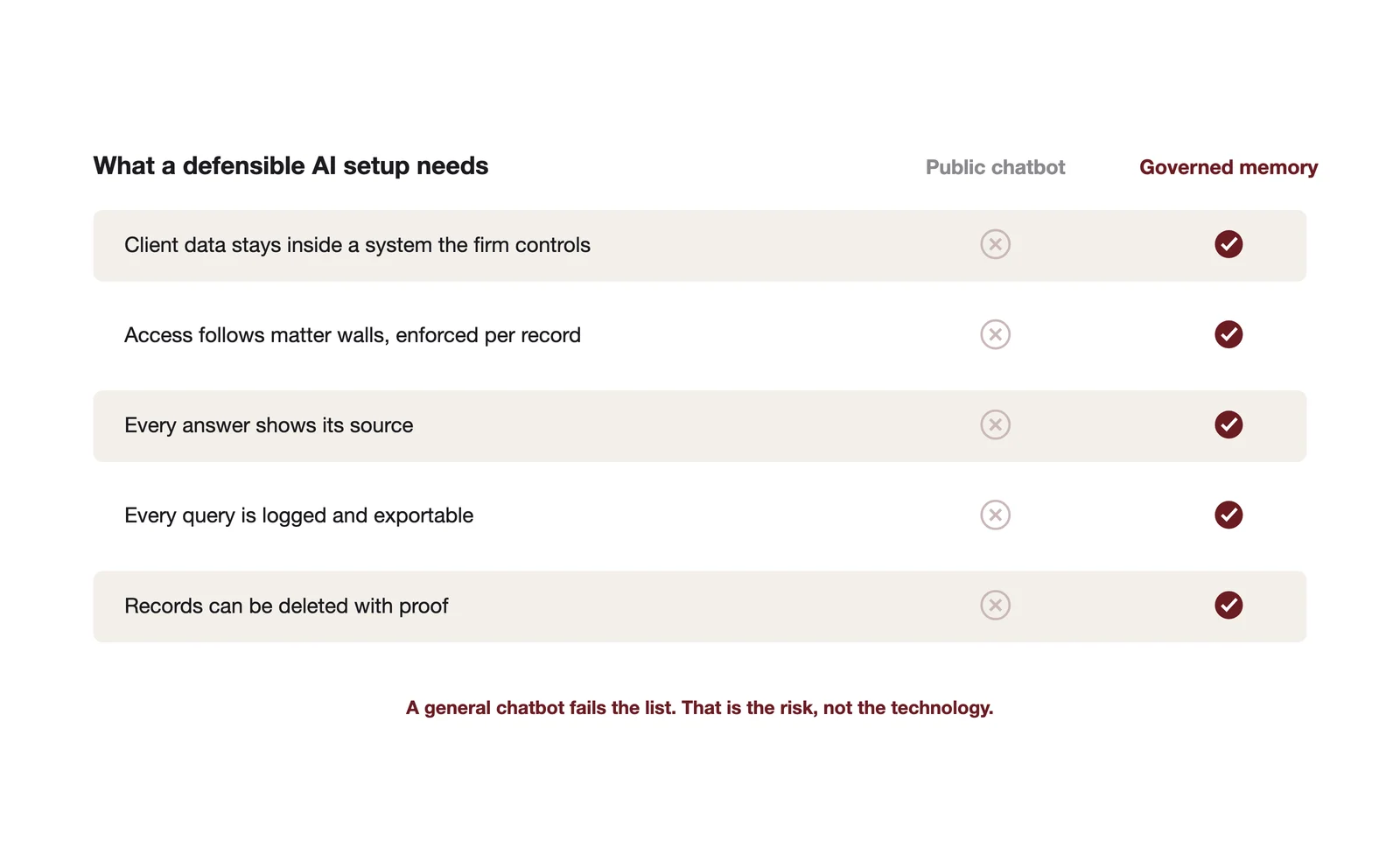
A safe setup has five properties.
Client data stays inside a system the firm controls. That means a dedicated deployment or an account the firm owns, with contractual terms about data use, not a personal login.
Access follows matter walls. The AI can only draw on documents the person asking is allowed to see. This has to be enforced at the record level by the system, not by asking people to be careful about which folder they open.
Every answer shows its source. When the AI says the client agreed to a variation on 3 March, it shows the email. If it cannot show a source, it says so.
Every query is logged. Who asked what, when, and what the system read to answer. Exportable, so it can be produced if required.
Records can be deleted with proof. When a matter closes or a client exercises their data rights, the firm can demonstrate that the material is gone.
A general chatbot fails four of these five. A firm wide memory layer built for regulated work should pass all of them.
The better argument: it is not about safety
Here is what firms that have adopted governed AI memory tend to discover. Safety was the reason they started. It is not the reason they keep using it.
The reason they keep using it is that a memory that knows every matter the firm has ever worked is more useful than a chatbot that knows nothing. An associate preparing a defence can ask what arguments the firm ran on similar facts and get the prior submissions, with citations, in seconds. A partner negotiating a contract can ask how the counterparty behaved on the last three deals. None of that is possible with a tool that starts from zero every morning.
Confidentiality gets you in the door. Institutional memory is why you stay.
How OctaMem handles this
OctaMem is a governed memory layer built for exactly this kind of firm. It connects to the sources a firm already uses, including Outlook, SharePoint, OneDrive and Teams, and turns matter files, correspondence and research into typed memory with the source attached to every record.
Access is scoped by role down to the individual record, so memory groups can mirror matter walls. Every read and every write lands in the audit log. Deletion is provable. A litigation team currently running OctaMem as a design partner pipes matter files and research into memory groups, and associates recall prior arguments with citations while access follows the walls the firm already has.
For firms with strict data residency requirements, sovereign deployments run entirely on infrastructure the firm controls.
Frequently asked questions
Is it unethical for a lawyer to use ChatGPT?
Not inherently. Most professional bodies allow AI use with appropriate supervision. What creates ethical exposure is disclosing confidential client information to a system you do not control, or relying on AI output without verifying it.
Do we need to tell clients we use AI?
Rules vary by jurisdiction and are changing. A growing number of regulators and clients expect disclosure. Having an audit log makes the disclosure easy to make and easy to back up.
Can a small firm afford a governed AI memory?
Yes. OctaMem plans for small teams start at $199 a month, and setup takes minutes rather than a procurement cycle.
What about legal specific AI research tools?
They solve a different problem. Research tools search external law. A memory layer holds what your firm has learned on its own matters. Most firms end up wanting both.OctaMem gives law firms one governed memory of every matter, with matter walls, an audit log and provable deletion built in. See how it works for legal teams at octamem.com/industries/legal.