When a partner leaves, what leaves with them? Institutional memory in law firms
Every firm loses years of judgement when a senior lawyer leaves. What actually walks out, why knowledge management never fixed it, and what does.
Short answer: When a senior lawyer leaves, the firm keeps the documents and loses the judgement: which arguments worked, how each client and counterparty behaves, why past decisions were made. Traditional knowledge management asked lawyers to write this down, and they never did. AI memory captures it from the work itself, so the firm keeps what it paid decades to learn.
The exit interview nobody can hold
A partner gives notice. Over the following weeks, the firm does what firms do. Client relationships are reassigned. Live matters are handed over with a memo. Files are checked in. The door closes.
Two years later, a client comes back with a dispute that looks a lot like one the departed partner handled in 2021. The documents are all there in the system. The associate opens them and finds a set of final agreements with no explanation of why clause 14 was drafted the way it was, a folder of correspondence that presupposes context nobody has any more, and a research memo that stops just before the interesting part.
What the firm lost was never the documents. It was everything that made the documents make sense.
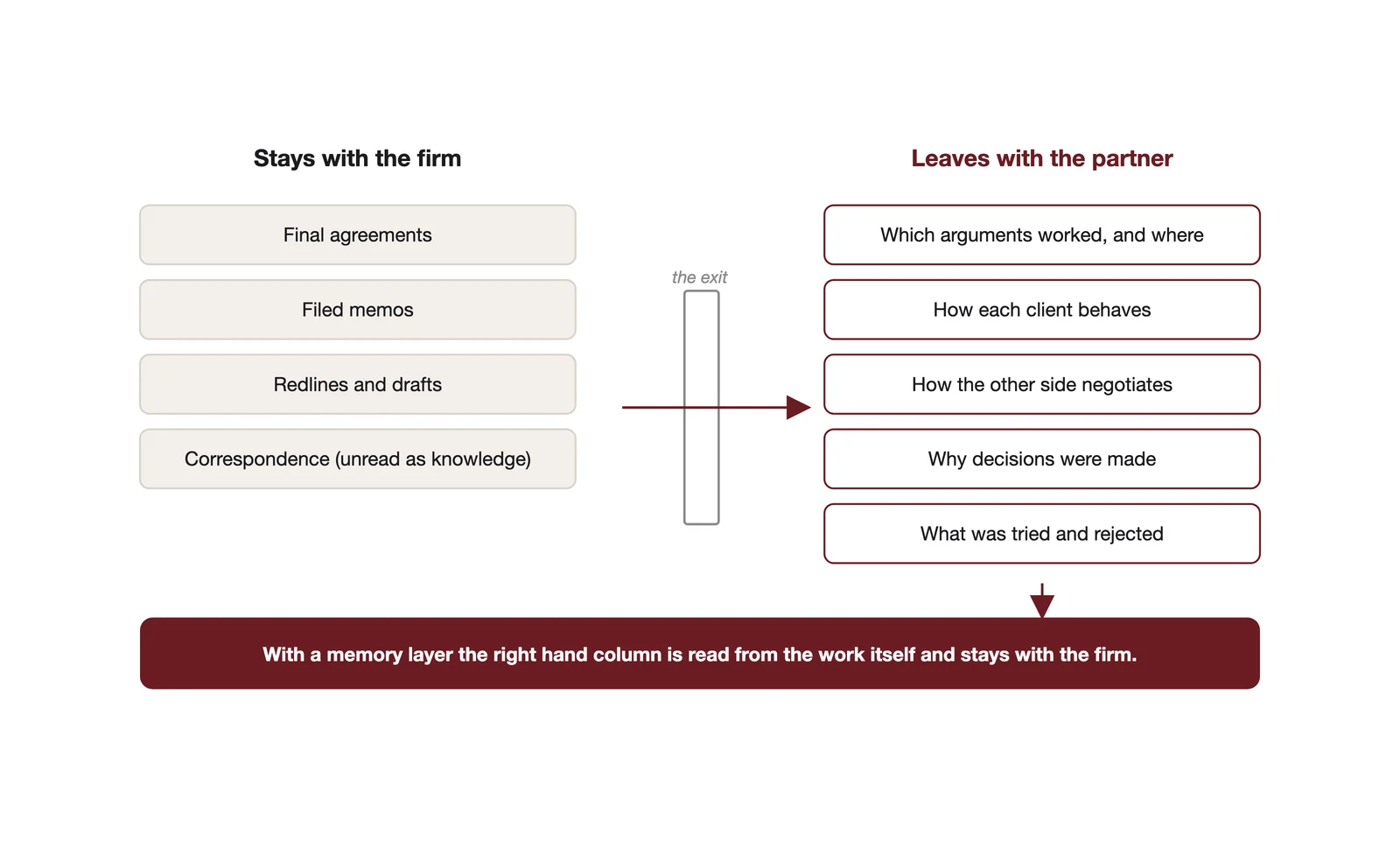
What actually walks out the door
Ask a knowledge management director what they wish they could keep when a senior lawyer leaves and you get a consistent list.
Which arguments worked, and in front of whom. The firm has the submission. It does not have the note that the judge found the second limb unpersuasive and the case turned on the third.
How each client behaves. That the general counsel at a longstanding client always wants the risk register before the draft, and will not read the draft until she has it. That another client says yes in meetings and no by email.
How the other side behaves. That a particular counterparty's lawyers open every negotiation at an aggressive position and settle in the middle by the third draft, so there is no point conceding early.
Why decisions were made. The reasoning behind the structure, the clause, the strategy. It exists in emails, in call notes, in the partner's head. It rarely exists in the file.
What was tried and rejected. The options considered and dismissed are often more valuable than the option chosen. They almost never get written down.
None of this is in the document management system. All of it is what clients pay senior lawyers for.
Why knowledge management never fixed it
Law firms have spent thirty years and considerable money on knowledge management. Precedent banks. Know how databases. Wikis. Practice group intranets. Most of them share a fate: heavily used for six months, then quietly abandoned.
The reason is structural. Every one of these systems depended on busy lawyers stopping billable work to write down what they knew, in a format the system accepted, at the moment it was fresh. It was a tax on the people with the least time and the most knowledge. They did not pay it. Nobody would.
The knowledge was there the whole time. It was in the emails, the drafts, the redlines, the call notes, the matter files. Nobody was reading them as knowledge, because the firm had no way to.
What AI memory changes
An AI memory layer reverses the model. Instead of asking lawyers to write knowledge down, it reads the work as it happens.
Connect the firm's document system, mailboxes and collaboration tools once. From then on, every matter file, every email chain, every research memo and every redline feeds a structured memory. Facts, events and how to knowledge, each record linked back to its source.
Then anyone with the right access can ask it questions in plain language. What arguments have we run on limitation in construction disputes? How did this counterparty behave on our last three deals with them? Why did we structure the 2021 acquisition as an asset purchase? The answer comes back with the documents that support it.
Access follows matter walls, enforced at the record level. Every question and every record read is logged. When the partner leaves, the memory stays, because it was never theirs. It was the firm's.
This is not about replacing lawyers
There is a version of the legal AI pitch that talks about replacing associates. This is the opposite.
A junior lawyer with access to the firm's whole institutional memory is a better lawyer on day one than a junior lawyer without it. They ask better questions in the first client meeting. They draft from what worked rather than from a template. They walk into a negotiation knowing how the other side plays. The partner supervising them spends less time explaining history and more time on judgement.
Every lawyer in the firm, at every level, gets the benefit of every matter the firm has ever worked. That is not fewer lawyers. It is the same lawyers, many times more effective.
How OctaMem does this
OctaMem is a governed memory layer built for firms where context must outlive the people who created it. It connects to Outlook, SharePoint, OneDrive, Teams and Google Drive through a desktop app in about two minutes and syncs continuously.
Matter files and correspondence become typed, source linked memory. Memory groups mirror matter walls, with access scoped by role down to the individual record. Every read lands in the audit log. Deletion is provable, which matters for retention policy and client data rights.
A litigation team running OctaMem as a design partner has associates recalling prior arguments with citations, across the matters they are permitted to see. That is what the firm keeps when the next partner leaves.
Frequently asked questions
Is this different from a document management system?
Yes. A DMS stores and finds documents. AI memory holds structured knowledge extracted from documents and correspondence, and answers questions about it with the sources attached.
Does it work for small firms?
Small firms lose proportionally more when someone leaves, because each person holds a larger share of the firm's knowledge. Setup takes minutes and plans for small teams start at $199 a month.
How does it handle conflicts and confidentiality?
Memory groups are scoped by role and enforced at the record level, so the AI can only draw on what the person asking is permitted to see. Every access is logged.
Can we remove a client's data when a matter closes?
Yes, and the deletion can be demonstrated, which is what most professional rules and GDPR actually require.OctaMem keeps what your firm has learned, even when the people who learned it move on. See how legal teams use it at octamem.com/industries/legal.