Why every property deal starts from zero, and how real estate groups are fixing it
Lender terms, diligence findings and the reasons behind an investment get lost between acquisition and sale. How to give an asset a memory that lasts.
Short answer: Real estate groups lose knowledge at every handoff in an asset's life. Acquisitions knows why the deal was done. Financing knows what the lender agreed. Asset management inherits neither. By the time the asset is sold, nobody can say why it was bought. A deal memory keeps all of it attached to the asset, so the answer to "what did we agree, when, and with whom" is one question away.
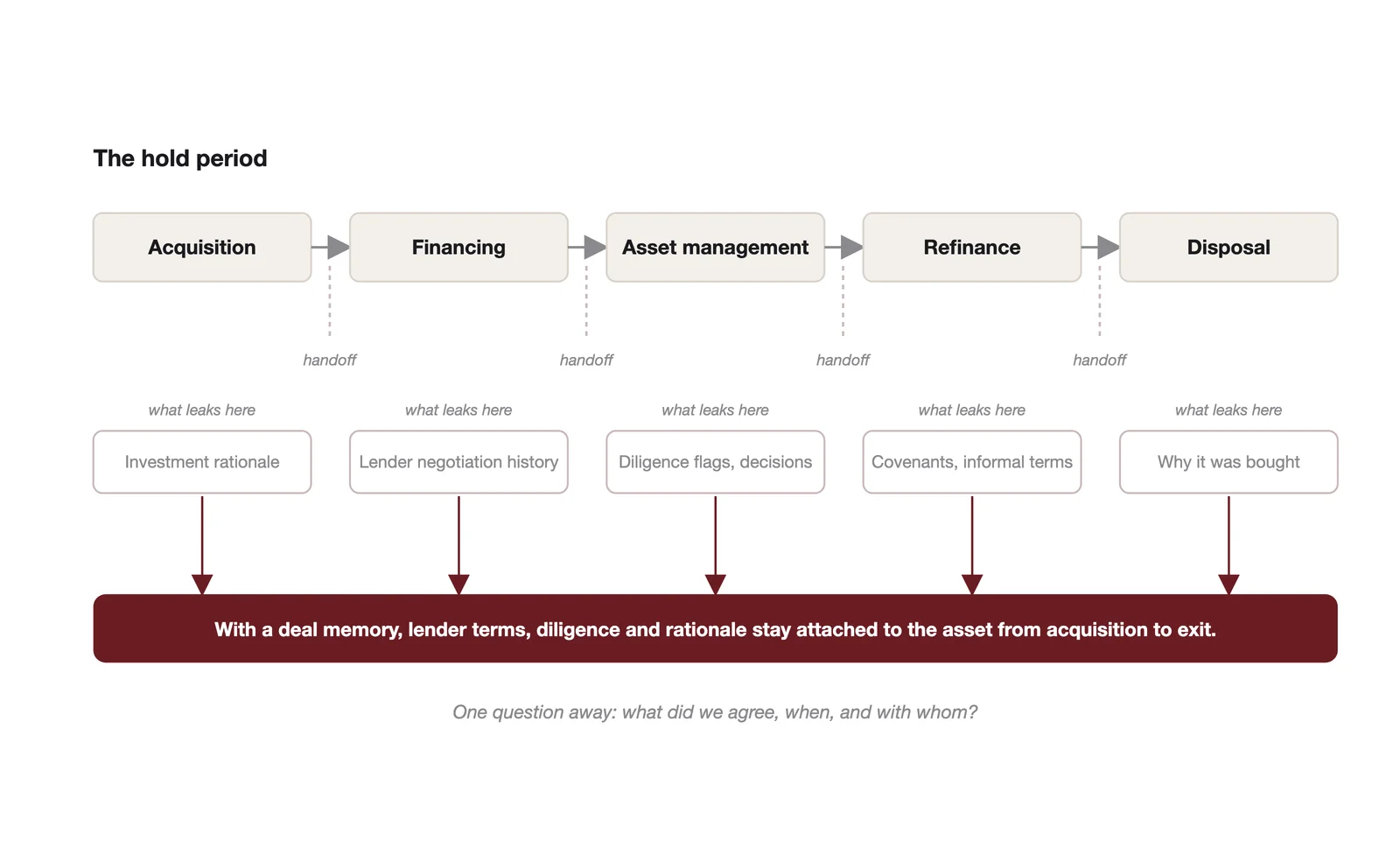
The five year game of telephone
A property group buys a building. The acquisitions team spent four months on it. They know why the price made sense, what the diligence found, which risks they accepted and why, and what the seller's agent let slip in the final week.
The deal closes. The file goes to asset management. Most of what the acquisitions team knew never makes the trip, because it was in their heads, their inboxes and a deck that summarised the conclusion without the reasoning.
Eighteen months later the loan is refinanced. The financing lead negotiates with the lender and agrees to a set of covenants and carve outs. That knowledge lives in the financing lead's email.
Three years in, the asset manager changes. The new one inherits a lease schedule, a rent roll and a folder of documents that presuppose context she does not have. She calls the acquisitions lead, who left the firm last year.
Five years in, the building is sold. Nobody currently at the firm can fully explain why it was bought, what was agreed with the lender in year two, or why the third floor was never refurbished. The investor letter says the thesis played out. Nobody can check.
This is the normal life of an asset at most real estate groups. Every handoff is a lossy copy.
What gets lost, specifically
The investment rationale. Not the headline yield but the reasoning: which risks were accepted, what the downside case was, what would have made the team walk away.
Lender terms and their history. What was agreed, what was pushed back on, what the lender said informally about future flexibility. The loan agreement holds the final position. The negotiation held the useful part.
Diligence findings that did not make the deck. The survey noted something that was judged acceptable. Two years later it matters, and nobody remembers it was ever flagged.
Counterparty behaviour. How this lender, this managing agent, this planning authority, this tenant's parent company has behaved on every previous interaction with the group.
Decisions and their reasons. Why capex was deferred. Why a lease renewal was structured that way. Why a disposal was pulled in 2023.
Multi entity groups have it worse. The same lender appears across six vehicles, the same tenant across three, and the knowledge about them is spread across six teams who do not talk.
Why the data room did not solve it
Every group has a document system. Many have a deal room platform. They hold the documents. They do not hold the knowledge.
The knowledge is in the emails between the financing lead and the lender's relationship manager. It is in the call notes. It is in the version history of the model. It is in the memo that the investment committee actually debated, not the one that was filed. The document system was never designed to read any of that as knowledge, and asking busy deal teams to write it up after the fact has never worked anywhere.
What a deal memory does
A deal memory reverses the flow. Rather than asking people to record what they know, it reads the sources where the work already happens and keeps the knowledge attached to the asset.
Connect the group's drives, mailboxes and collaboration tools once. From that point, every lender email, every diligence report, every committee paper and every decision feeds a structured memory. Facts about the asset, events like refinancings and lease events, and how to knowledge about how the group operates, each record linked to its source document.
Then anyone with the right access asks in plain language. What did we agree with the lender on this asset, and when? What did the diligence flag on the roof? Why did we underwrite this at that exit yield? What has this managing agent's performance been across all our assets?
The answer comes back with the email, report or paper that supports it. Access follows role and entity, enforced at the record level, so the fund vehicle walls hold. Every question and every record read is logged, which is what an auditor or an investor's due diligence team actually wants to see.
When the asset manager changes, the memory does not. When the acquisitions lead leaves, the rationale stays with the asset.
The compounding effect across a portfolio
The value of this grows with the size of the group, for a simple reason. Every asset teaches the memory something about the counterparties, markets and structures the group works with. The fifth deal with the same lender is negotiated by a team that knows exactly how the previous four went. The tenth asset in a market is underwritten against the group's own experience of the first nine.
Groups have always had this knowledge. It has just never been in one place, and it has never survived staff turnover.
How OctaMem does this
OctaMem is a governed memory layer built for organisations where context must outlive the people who created it. A multi entity real estate group runs it today as a design partner, feeding leases, lender emails and deal files into scoped memory. Asset managers ask what was agreed, when, and by whom, and the source document comes back with the answer.
The desktop app connects Google Drive, OneDrive, Outlook, Teams and SharePoint in about two minutes. Memory groups give each vehicle or team its own walls, with access scoped down to the record. Every read is logged. Deletion is provable. For groups with strict data residency requirements, sovereign deployments run on infrastructure the group controls.
Frequently asked questions
Is this a replacement for our deal room or document system?
No. It sits alongside them and reads from them. The deal room holds the documents. The memory holds what the documents and correspondence mean, and answers questions about it with sources.
How does it handle information walls between funds or entities?
Memory groups are scoped by role and entity, enforced on every record. A user only ever gets answers drawn from what they are permitted to see, and every access is logged.
How long until it is useful?
Setup takes minutes. The memory gets more useful with every synced day, and groups typically see it pay off the first time a new team member asks a question about an asset they did not work on.
What does it cost for a property group?
Plans for teams start at $750 a month. Multi entity groups with sovereign hosting requirements are priced per deployment.OctaMem keeps lender terms, diligence and investment rationale attached to the asset for the whole hold period. See how real estate groups use it at octamem.com/industries/real-estate.