Every founder should be able to ask their codebase questions, even if they cannot read code
Your codebase is the most honest record of what your company built and why. Why founders who can query it in plain English make better decisions.
Short answer: Your codebase is the only record of your company that cannot exaggerate. Every commit is a decision somebody made, on a date, for a reason. Founders who can ask it plain English questions ("why did we rebuild billing in March", "what changed before the churn spike", "which parts of the product does one person understand") make faster, better decisions and depend less on a single engineer's memory. You do not need to read code. You need a memory that has read it for you.
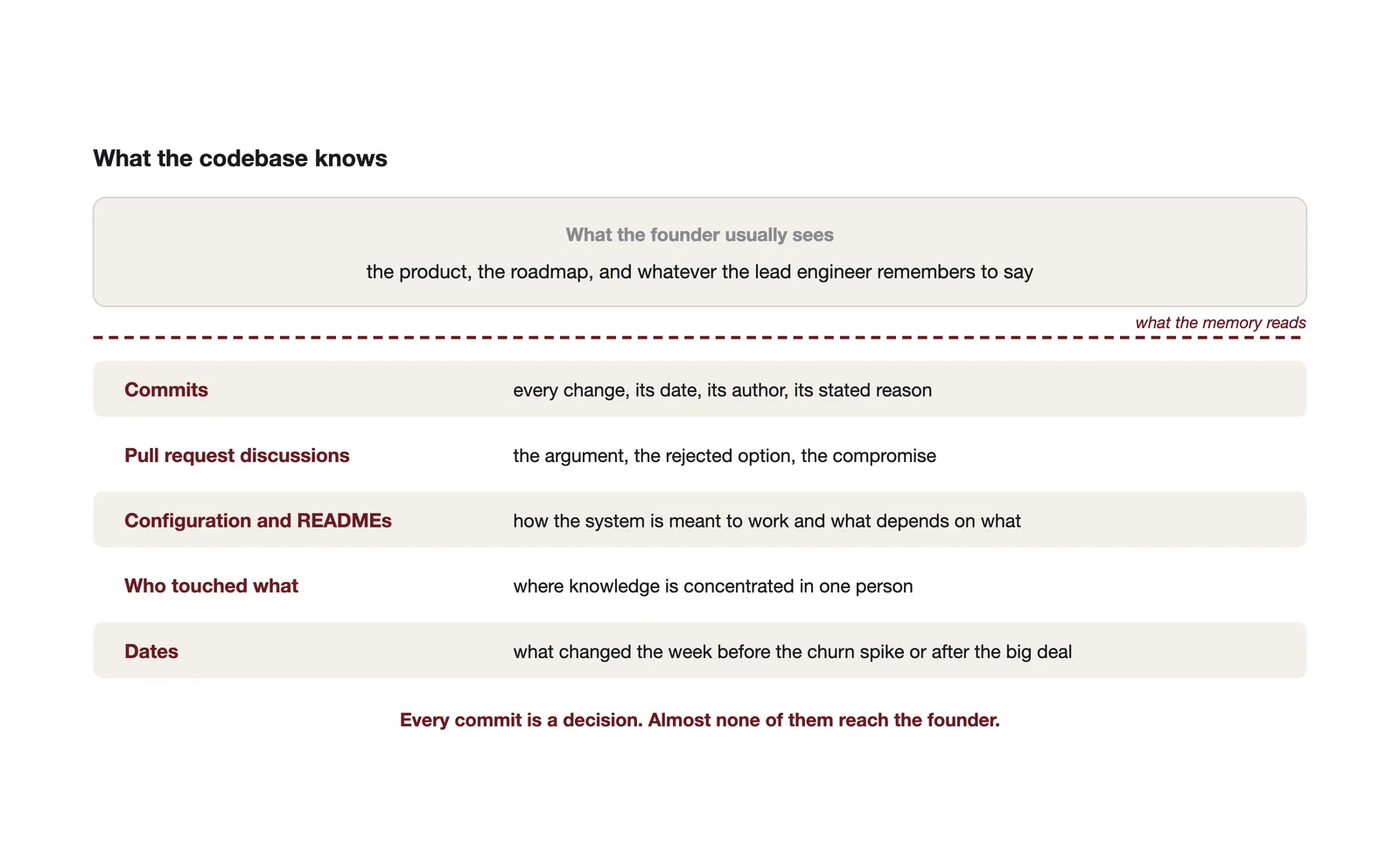
The most honest document in the company
Ask a founder how the product works and they will tell you what they believe. Ask the pitch deck and it will tell you what they hoped. Ask the codebase and it will tell you what actually got built, when, by whom, and what got quietly removed.
Most founders never ask it. Not because they do not care, but because the codebase speaks a language they do not read, and the only translator is the engineer who wrote it. So the founder asks the engineer, the engineer gives a summary shaped by what they remember and what they want to emphasise, and the founder makes decisions on that.
This works until it does not. The engineer leaves. The engineer is on holiday when an investor asks a hard question. The engineer remembers the decision but not the reason. Or the founder simply cannot tell whether "that would take three weeks" is true.
What the codebase actually knows
The code itself is the smallest part. The history around it is where the value sits.
Commits and their messages record every change and, when the team is disciplined, why it was made. The commit history is a timeline of the company's real priorities, as opposed to the roadmap's stated ones.
Pull requests and their discussions record the arguments. Which approach was rejected and why. Who pushed back. What compromise was reached. This is where most engineering decisions actually get made, and almost none of it reaches the founder.
The README files, the architecture notes and the configuration record how the system is meant to work and what depends on what.
The pattern of who touched what tells you where the knowledge is concentrated. If one person has written 90% of the payments code, that is a business risk with a name on it.
And the dates connect all of it to the rest of the company. What changed in the product the week before the churn spike? What did we ship in the fortnight after the big customer signed? These questions are answerable, and almost nobody asks them.
Questions a founder can ask once the codebase can answer
Not code questions. Business questions the code happens to hold the answer to.
Why did we rebuild the billing system in March, and what did it cost us in time?
What has changed in the onboarding flow in the last six months, and who made each change?
Which parts of the product does only one engineer understand?
What did we try and abandon this year, and why?
Which customer requests have actually been built, and which are still in the backlog?
What changed in the two weeks before support tickets doubled?
If our lead engineer left tomorrow, which parts of the system would nobody be able to explain?
When an investor asks about technical debt, what is the honest answer, with examples?
Every one of these has traditionally required a meeting with an engineer and an answer you could not check. With a memory that has read the repositories, it is a question typed into the assistant you already use, answered with the commit or discussion that backs it up.
Why this changes how a founder runs the company
Three things happen when the codebase becomes askable.
Estimates get honest. When you can see how long the last three similar changes took, "three weeks" becomes a conversation rather than an article of faith.
Risk becomes visible. Knowledge concentration, abandoned work, the module nobody has touched since the person who wrote it left. These show up in the history long before they show up as an outage.
Diligence stops being frightening. When an investor or an acquirer asks technical questions, the founder can answer from the record rather than from a hurried call with the CTO. Companies that can do this get through technical diligence faster and with fewer discounts.
None of this replaces the engineers. It makes the founder a better partner to them, because the conversation starts from the same facts.
How OctaMem does this
OctaMem connects to GitHub through the same desktop app that connects your Drive, inbox and Teams. Point it at the repositories you choose and it reads them continuously. Files and commit history become typed, source linked memory alongside the rest of the company's knowledge, so a question about the March billing rebuild can pull the commits, the Teams thread where it was debated and the customer email that triggered it, together, with sources.
Access is scoped by role down to the record. A founder can see everything. A contractor can see the repositories they are working on and nothing else. Every read is logged. And when the memory answers, it shows the commit, file or message it drew from, so a non technical founder can trust the answer without being able to read the code behind it.
You ask from Claude, ChatGPT, Cursor or Claude Code through the standard MCP integration, or from the OctaMem app directly.
Frequently asked questions
Do I need to know Git or read code for this to be useful?
No. You ask in plain English and the answer comes back in plain English with the commit or discussion it came from. Reading the code is optional.
Will my engineers feel surveilled?
The point is shared understanding, not monitoring. Most engineers welcome a founder who asks informed questions instead of vague ones, and the same memory saves them from re-explaining history every quarter.
Does this work with private repositories?
Yes. You authorise OctaMem to read the repositories you choose, and access to the resulting memory follows your role rules.
What if our codebase is a mess?
Then you will finally know exactly how much of a mess, where, and who can fix it. That is the point.Ask your codebase what it knows. Connect GitHub to OctaMem in about two minutes at octamem.com.