How to start an AI native real estate company in 2026 (and why the same plan works for a law firm)
Three models for an AI native property business, the stack each one needs, what regulators and clients will ask, and a 90 day plan to launch.
Short answer: The opportunity in real estate is not another AI tool for agents. It is being the operator who runs the whole business on AI from day one. Pick one of three models, a brokerage, an investment group or a services firm, give it one governed memory of every client, property and deal, run agents on top of that memory, and hire people to supervise rather than execute. The same plan builds an AI native law firm.
The market is full of tools and empty of operators
Here is the strange state of real estate in 2026. Eighty two percent of agents use AI, according to Realtors Property Resource. Ninety seven percent of brokerage leaders say their agents use it, per Delta Media. And in the National Association of Realtors' 2025 Technology Survey, only 17% of agents said it made a significant difference to their business.
Everyone has the tools. Almost nobody has rebuilt the business around them. Incumbent brokerages and property groups are adding AI to workflows designed for a fax machine. That gap is where a new entrant wins, and it is wide open in law for the same reason.
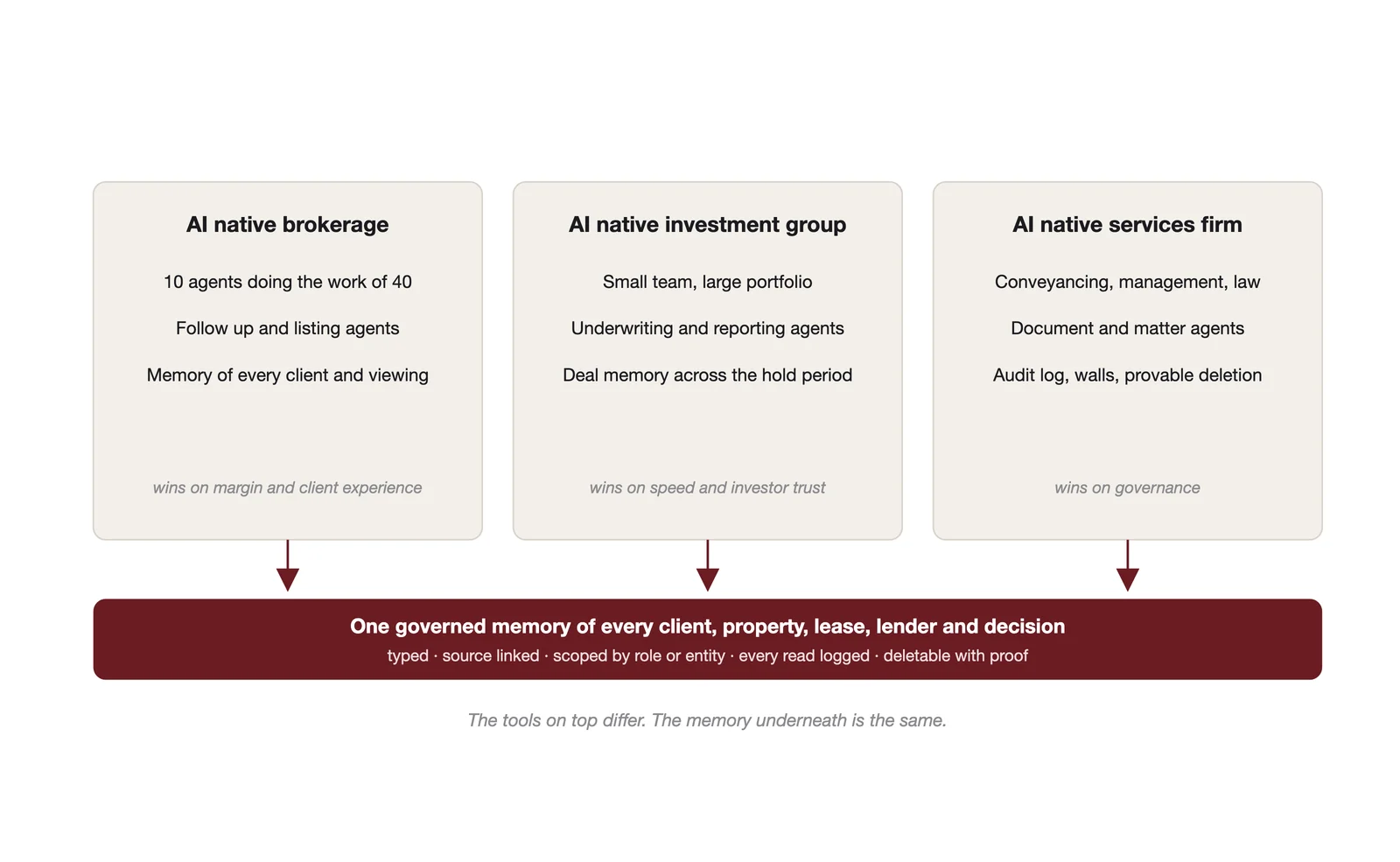
Three models
Model one: the AI native brokerage or agency. Ten agents doing the work of forty, because every agent works from one memory of every client, viewing, offer and vendor the firm has ever dealt with, and agents handle the follow up, the listing copy, the diligence checklists and the reporting. The human agents spend their time in rooms with buyers and sellers. The margin difference against a traditional brokerage is enormous, and the client experience is better, because nobody at the firm ever forgets what a buyer said.
Model two: the AI native investment or asset management group. A small team running a portfolio that would once have needed a floor of analysts. Every lender email, lease, diligence report and committee decision feeds a deal memory that stays attached to the asset for the whole hold period. Underwriting agents draw on the group's own history with every counterparty and market. Investor reporting drafts itself from what actually happened. The people make the calls.
Model three: the AI native services firm. Conveyancing, property management, valuation, or the law firm that serves all three. Here the constraint is not speed but trust. The firm that can show a client, a regulator or a court exactly what its AI knew, what it was asked and where every answer came from can use AI on work that competitors are still doing by hand. Governance is the product.
The stack, in order
Every model needs the same four layers, built in this order.
The memory first. Before the first listing or the first deal, connect your drive, inbox, meeting notes and collaboration tools to one governed memory. Every property file, negotiation, lease and decision after that becomes typed, source linked knowledge that people and agents can ask. This is the layer nobody else in your market has, and it compounds from day one.
The assistant everyone uses. One, not five. Claude or ChatGPT, connected to the memory, so every question about a client or a property gets answered from the firm's actual history with the source attached.
The agents. Start with the three that pay back fastest in property: follow up (every enquiry and viewing gets a next step within the hour, drawn from the memory of that client), document work (leases, offers, diligence checklists abstracted and checked against the firm's own precedents) and reporting (weekly pipeline, monthly investor updates, drafted from what happened rather than typed from memory).
The systems of record. A CRM, a document system, a deal room if you need one. These are commodities. Choose the ones that connect to your memory and do not overthink it.
What clients and regulators will ask
You will be asked, sooner than you expect, four questions. Who at your firm can see my information? What did your AI do with it? Where did that answer come from? Can you delete it and prove you have?
An AI native firm that can answer all four in a sentence wins the mandate. One that cannot will lose it to a firm that uses less AI and can. This is why access control down to the record, a full audit log and provable deletion are not compliance features. They are how you win business against firms that are more established and less careful.
How the best founders do it
They come from the industry. Almost every successful AI native property business is started by someone who spent years as an agent, an analyst or a lawyer and knows exactly which task wastes the most expensive hour of the week.
They build the memory before they hire. The first month is spent connecting sources and letting the memory learn the business, not recruiting.
They use contractors with scoped access. A valuation specialist for a quarter, a marketing contractor for a launch, a paralegal for a matter. Each one gets access to the memory they need, contributes to it, and hands it back when they leave.
They measure revenue per person from month one and treat every hire as a last resort.
And they sell the governance. In a market where everyone claims to use AI, the firm that can show its audit log is the one that gets trusted with the largest clients.
A 90 day plan
Days 1 to 30: connect Drive or OneDrive, Outlook, Teams and your meeting notes to the memory. Import the property files and correspondence you already have. Set up memory groups by team or by entity. Connect the assistant. Start asking it questions every day so it learns what the business needs.
Days 31 to 60: launch the follow up agent and the document agent on live work, with a person reviewing every output. Write down the three questions clients ask most and make sure the memory answers them with sources.
Days 61 to 90: launch the reporting agent. Bring on your first contractor with scoped access. Publish your governance page: who can see what, how the audit log works, how deletion works. Start selling with it.
How OctaMem does this
OctaMem is the memory layer for this plan, and real estate groups and law firms were the first to run it. The desktop app connects Google Drive, OneDrive, Outlook, Teams, SharePoint and GitHub in about two minutes. Everything becomes typed, source linked memory. Memory groups mirror your teams, your fund entities or your matter walls, with access scoped down to the record. Every read is logged. Deletion is provable.
A multi entity real estate group runs OctaMem today, feeding leases, lender emails and deal files into scoped memory so asset managers can ask what was agreed, when and by whom, and get the source document back. A litigation team runs it for matter memory with walls. The assistant and agents you choose connect to it through the standard MCP integration. Plans for teams start at $199 a month.
Frequently asked questions
Do I need a licence to start an AI native brokerage?
The same licences as any brokerage or agency in your jurisdiction. AI changes how the business runs, not what it is legally.
Can I do this as a single agent going independent?
Yes, and it is one of the strongest starting points. A single agent with a memory of every client and property they have ever touched, plus agents handling follow up and documents, competes with a team.
What about a law firm?
The plan is identical. Model three is the law firm. Matter memory replaces deal memory, matter walls replace entity walls, and the governance questions are the ones the bar and your clients already ask.
How much does the memory cost?
OctaMem has a free tier for setup and testing. Team plans start at $199 a month. Groups with sovereign hosting needs are priced per deployment.Start with the memory. See how real estate and legal teams run on OctaMem at octamem.com/industries.