What is a company brain? The plain English guide to organisational intelligence
A company brain is one governed memory of everything your business has learned, which every person and AI agent can ask. What it is, and what it is not.
Short answer: A company brain is a single, governed memory of everything your business has learned, built from the files, emails, messages and decisions you already produce, which every employee and every AI tool you use can ask in plain language. The word "governed" matters. Without access rules and an audit trail, it is just a pile of documents with a chatbot on top.
Every company forgets
Here is a test. Pick a decision your business made eighteen months ago that still affects how you work today. Now try to find out why it was made.
If you are lucky, the answer is in an email somebody can still find. More likely, it is in the head of someone who has since left, or spread across a meeting that was never written up and a Slack thread that scrolled away. The decision is still in force. The reasoning is gone.
This is not a failure of any individual. It is what happens to knowledge in every organisation. Almost every answer a team needs already exists somewhere in the company. It is just not findable, and the person who knows where it is may not be there tomorrow.
A company brain is the fix for that. It is a memory that belongs to the organisation rather than to any one person or any one tool.
What a company brain is made of
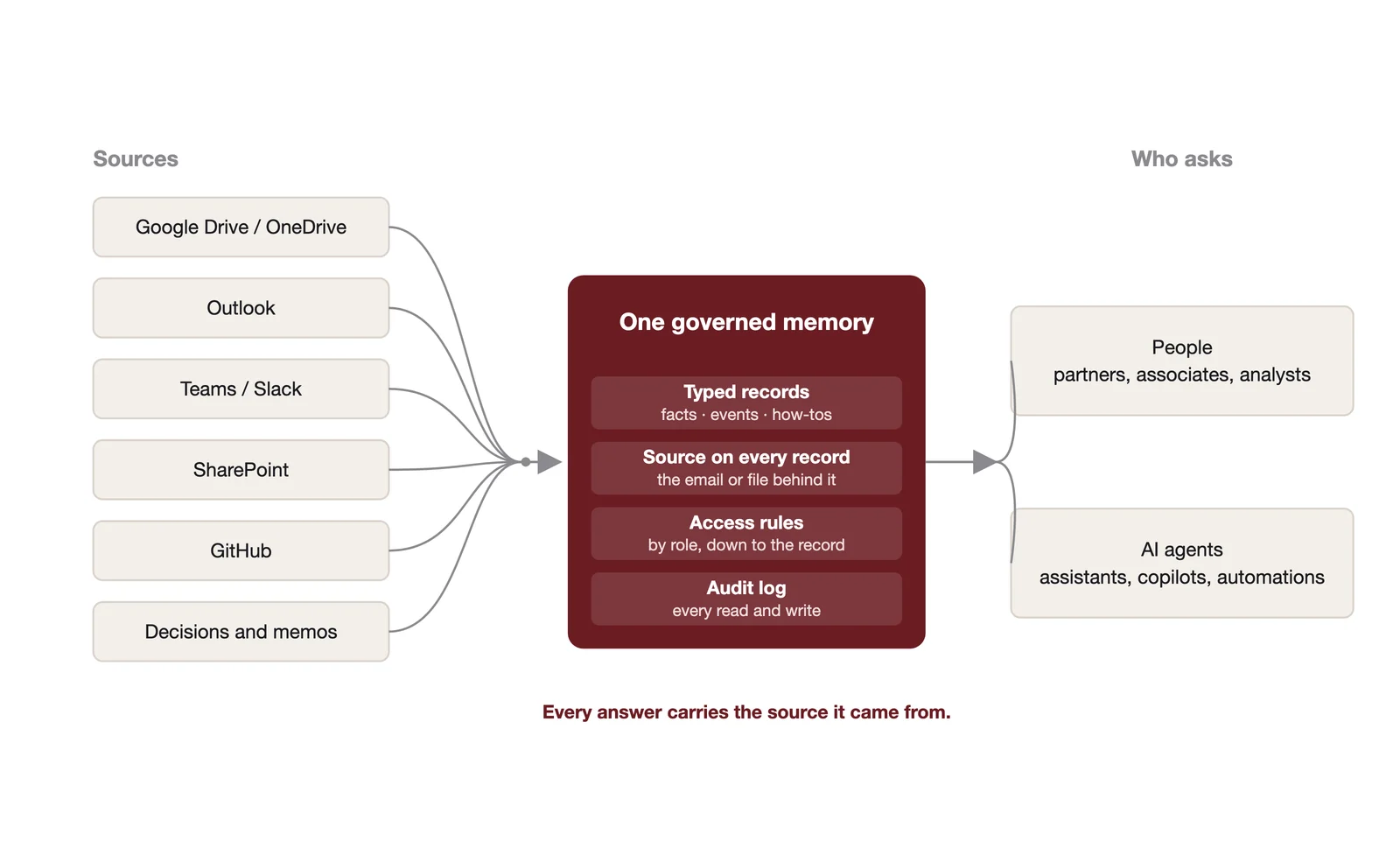
Strip away the marketing and a company brain has four parts.
Sources. The places knowledge already lives. Drive or OneDrive, Outlook or Gmail, Teams or Slack, your document system, your code repositories if you have them. A company brain connects to these once and keeps reading them.
Memory. The sources get turned into structured records rather than left as raw files. A good system separates facts (the lender's rate is 6.2%), events (the client approved the draft on 3 March) and how to knowledge (this is how we run a completion). Each record keeps a link to where it came from.
Access rules. Who can see what, down to the individual record. A real estate group does not want the acquisitions team reading HR files. A law firm cannot let one matter's documents leak into another. This has to be enforced by the memory itself, not by asking people to be careful.
An audit trail. Every question asked and every record read or written is logged. This sounds like a compliance box to tick. In practice it is what makes the whole thing trustworthy, because when the AI gives an answer, you can see exactly what it looked at.
Once those four parts are in place, two kinds of user can ask the brain questions. People, through a search box or chat. And AI agents, which means every assistant, copilot and automation you run can draw on the same memory instead of starting from nothing.
What a company brain is not
It is not a bigger chat window. Uploading fifty PDFs into ChatGPT and asking questions is useful for an afternoon. It does not remember anything next week, it is not shared with your team, and it leaves no record of what was said.
It is not a wiki. Wikis depend on people writing things down after the fact. Nobody does this reliably, which is why every company wiki is a graveyard of pages last edited in 2023. A company brain reads the work as it happens, from the sources where it already lives.
It is not a search engine over your files. Search finds documents. A brain answers questions, and it can hold the kind of knowledge that never appears in a single document, like the fact that a particular client always pushes back on clause 14.
It is not a generic AI agent. Agents do tasks. A company brain is what the agents remember. You can run any agent you like on top of it.
Why this matters more now than it did two years ago
Two things changed.
First, AI tools became part of everyone's day. Most of your staff already paste company information into some chatbot. Each of those chatbots learns a little about your business, separately, in a way you cannot see or control. Ten people, ten partial and inconsistent versions of your company, none of them yours.
Second, AI agents started doing real work. Drafting, researching, following up, reconciling. An agent with no memory of your company is a very fast new hire on their first day, forever. An agent that can ask the company brain is a new hire who read every file before they started.
The firms that get this right will have AI that gets sharper every month, because every document, message and decision after setup feeds the memory. The firms that do not will keep re-explaining themselves to software.
How to tell a real one from a fake one
Ask five questions of any product that calls itself a company brain, a second brain for business, or an AI knowledge base.
Does it connect to our sources and keep syncing, or do we have to upload things manually? Manual upload means it will be out of date within a month.
Does every answer show its source? If it cannot show you the email or document behind an answer, you cannot trust the answer.
Can we set access at the record level? Folder level permissions are not enough for a firm with confidential matters or deals.
Is every read and write logged, and can we export the log? This is the difference between a tool you can defend to a regulator and one you cannot.
Can we delete a record and prove it is gone? Under GDPR and most professional rules, "we think it is deleted" is not an answer.
If a product passes all five, it is a company brain. If it passes two, it is a chatbot with a folder attached.
Where OctaMem fits
OctaMem is a company brain built for organisations where context has to outlive the people who first created it. It connects to Google Drive, OneDrive, GitHub, Outlook, Teams and SharePoint in about two minutes through a desktop app, then turns everything it reads into typed, source linked memory.
Access is scoped by role down to the individual record. Every read lands in the audit log. Every record can be deleted with proof. Teams work in memory groups, so a litigation team's matter files and a real estate group's deal rooms each have their own walls, and anyone with the right access can ask across everything their team has learned.
Law firms and real estate investment groups were the first design partners, and both are running it on live work today. If your firm has ever lost a piece of knowledge when someone left, this is what it was missing.
Frequently asked questions
Is a company brain the same as a second brain?
A second brain is a personal system for one person's notes. A company brain is shared, governed and auditable, and it is fed by the organisation's real sources rather than by what one person chooses to write down.
How long does it take to set up?
Connecting sources takes about two minutes. The memory gets more useful with every day of synced data, so most teams see the value within the first couple of weeks.
Where does our data live?
In your OctaMem account, scoped by your access rules, with every read logged. Sovereign deployments are available for firms that need everything on their own infrastructure. The details are on our trust page at octamem.com/trust.
Can our existing AI tools use it?
Yes. OctaMem exposes memory to people through the app and to AI agents through standard integrations, so assistants, copilots and custom agents can all draw on the same memory.Every company forgets. Yours doesn't have to. See how OctaMem works at octamem.com, or talk to us about a deployment for your firm.