Why Law Firms Need Organisational Intelligence: A Universal Brain for Legal Work
Law firms run on institutional memory, and it leaves with every departure. Why legal AI without organisational intelligence is an intern with amnesia.
A law firm's real product is judgement, and judgement is stored in people. Which arguments this regulator accepts. How that counterparty behaves at exchange. What the firm advised this client in 2023, and why. When a partner retires or an associate moves on, the firm keeps the files and loses the judgement.
Legal AI, as most firms have deployed it, makes this worse rather than better. A drafting assistant that starts every session cold is a very fast paralegal with no memory of the firm, the client, or the matter. It re-reads what it can be given, reasons well, and forgets everything by morning. Firms are buying intelligence and getting amnesia with good manners.
Organisational intelligence is the missing layer: a universal brain that holds what the firm knows, scoped by matter, governed by the same walls the firm already enforces, and available to every fee earner and every AI tool the firm runs.
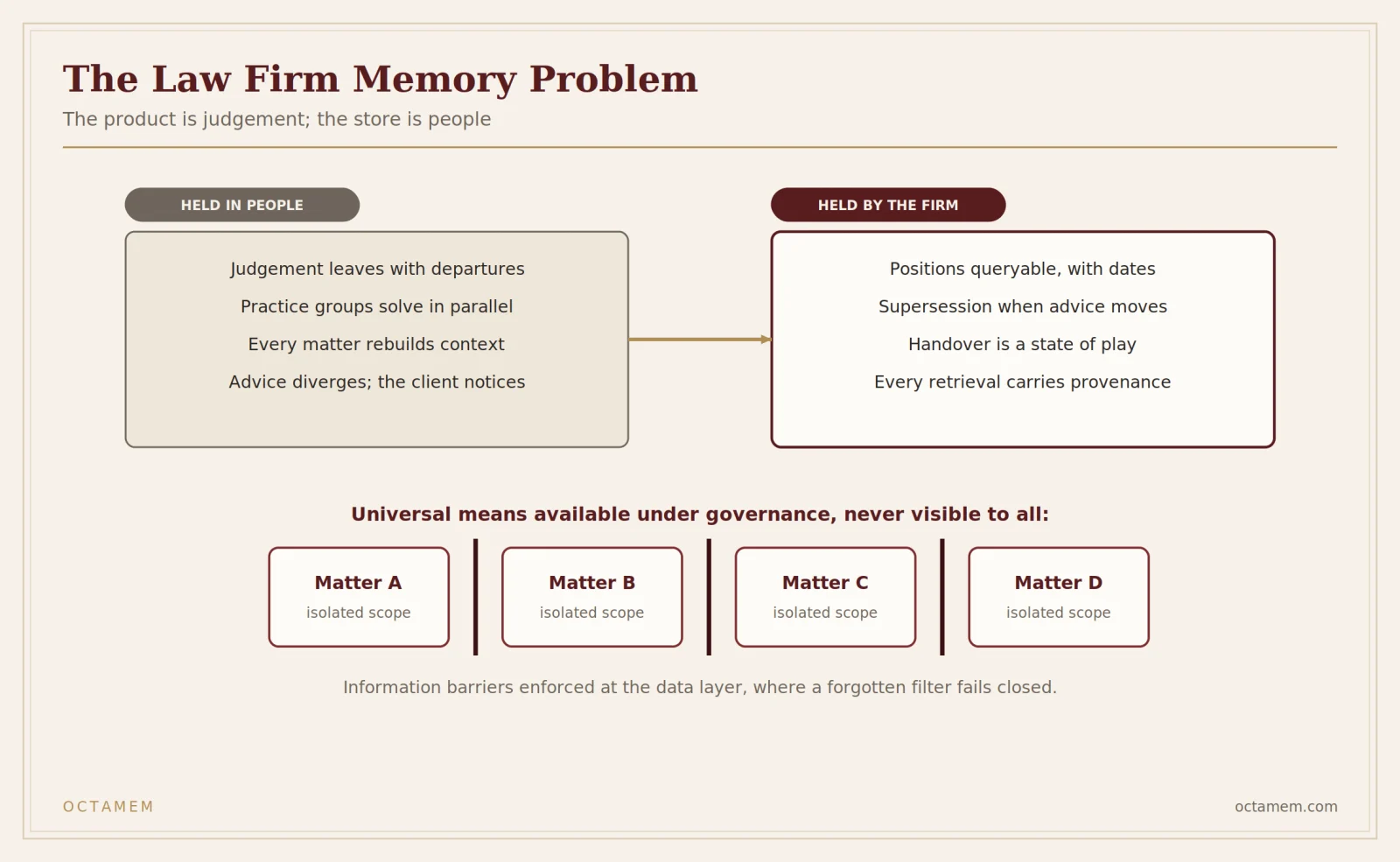
The three ways a firm loses what it knows
Departure. The knowledge that matters most is rarely in the document management system. It is the unwritten context: this client's board hates optionality in advice, that judge reads skeleton arguments closely, the settlement figure the other side blinked at last time. When the person holding it leaves, the firm re-learns it at the client's expense, and clients notice.
Silos. Practice groups solve the same problem in parallel without knowing it. The corporate team negotiates a clause the disputes team litigated last year. Two partners give a client adjacent advice that does not quite agree, and the client is the one who spots it.
Repetition. Every new matter for an existing client begins with reconstruction. Who are the entities, what did we advise before, what fee arrangements apply, what went wrong last time. The associate doing that reconstruction is billing hours the client resents paying and the firm often writes off.
None of this is a document problem. Firms have document management, and it holds documents. What it does not hold is what the firm concluded, decided, and learned. Search can find the memo; it cannot tell you the advice was superseded three months later on a different matter.
Why legal AI without memory underdelivers
The current generation of legal AI tools is genuinely capable at the task in front of it: review this contract, draft this clause, summarise this bundle. The limitation is that the task in front of it is all it has.
Ask one of these tools to draft an engagement letter and it drafts a generic one, because it does not know the firm's precedent positions, the client's negotiated terms, or the partner's preferences. Feed it those things manually and it performs beautifully, once, and then you feed them again tomorrow. The firm's knowledge is being retyped into prompts, one associate at a time, and evaporating on every session close.
An agent with organisational memory behaves differently. It already knows this client caps liability at fees, that the firm's position on this indemnity moved last quarter, and that the last draft for this counterparty came back with the same three objections. The drafting is the easy part. The context is the product.
What "universal" has to mean in a law firm
Here is the objection every managing partner raises, and it is the right objection: a firm-wide brain sounds like a confidentiality breach with a product name.
So the word needs defining. Universal means universally available under governance, not universally visible. A law firm's memory layer must reproduce the walls the firm already lives by, structurally rather than by policy:
Matter-level isolation. Memory scoped to the matter, not just to the user. An agent working matter B cannot retrieve memory from matter A, even for the same client, unless the scopes are deliberately connected. Information barriers are enforced at the data layer, where a forgotten filter fails closed, not at the application layer, where it leaks. We wrote about how this works in practice in memory without breaking walls.
Provenance on every retrieval. When an agent surfaces a piece of firm knowledge, it carries where it came from: which matter, when, derived from what, superseding what. Advice without an audit trail is not advice a regulated professional can rely on. Provenance is also what makes privilege review of AI-assisted work possible at all.
Supersession, not accumulation. Legal positions change. A memory layer that returns the 2023 advice and the 2025 advice side by side, unranked, is a negligence claim waiting for a fact pattern. The old position must be retained, marked superseded, and pointed at its replacement, so the firm can answer both "what do we advise" and "what did we advise then".
Erasure that actually completes. Client data leaves when the client instructs it to, including from derived and consolidated artefacts. Most memory systems cannot do this. The reasons are architectural, and we covered them in GDPR Article 17 and AI memory.
What it looks like in the working day
The abstract case is knowledge retention. The daily case is smaller and more persuasive.
A fee earner opens a matter and the agent briefs them: parties, history, live commitments, the two open questions from the last call, and the one thing the client said they never want to see again. Ten minutes of reconstruction becomes none.
A partner asks whether the firm has taken a position on a clause, and gets the position, the matters it was taken on, and the date it last moved, rather than a folder of possibly relevant documents.
An associate leaves. Their matters transfer with the context intact: not just the files, but the state of play, the decisions and their reasons, the client's temperament. The handover memo writes itself because the memo was being written continuously all along.
A client asks why the firm advised X in March. The answer is retrievable with its provenance, in minutes, which is also precisely what the firm's insurers and regulator want to be true.
Each of these is the same underlying capability, which is the point. A firm does not need nine tools. It needs one memory that its people and its AI tools share.
The compounding argument
Knowledge management has been sold to law firms for thirty years, and partners are right to be tired of it. The pitch always required lawyers to do extra work (tag, file, summarise) for a benefit that arrived later, diffusely, to someone else. Rational people declined.
The economics have inverted. Agents now sit inside the work: in the drafting, the review, the correspondence. Capture is a by-product of the work rather than a tax on it. The associate does not file a lesson learned; the memory layer records that the draft was rejected, why, and what replaced it, because it was in the loop when it happened.
That changes the shape of the asset. A firm that starts accumulating governed memory this year has, in three years, something no lateral hire brings and no competitor copies: the firm's own judgement, queryable, with receipts. Firms that wait are not standing still. They are training every departing lawyer's replacement from zero, forever.
Where OctaMem fits
OctaMem was built with law firms as early design partners, which is why matter-level scoping, provenance on every retrieval, structural supersession, and cascading erasure are the architecture rather than the roadmap. It connects to the AI tools a firm already uses through an API and MCP, so the same governed memory serves every agent.
How it works · Legal · Talk to us
Related reading
- Institutional memory is not search
- GDPR Article 17 and AI memory
- Organisational intelligence: why every company needs a universal brain
Frequently asked questions
What is organisational intelligence for a law firm?
A governed memory layer that holds what the firm knows (advice given, positions taken, client context, matter history) and makes it available to fee earners and AI tools under matter-level access control, with provenance on every retrieval.
Does a firm-wide memory breach information barriers?
Not if isolation is enforced at the data layer. Memory scoped by matter reproduces the firm's walls structurally; nothing crosses a barrier because the query layer never sees it.
How is this different from our document management system?
DMS stores documents. Organisational intelligence stores conclusions: what was decided, advised, and learned, with supersession when positions change. One answers "where is the file"; the other answers "what do we know".
Can we prove what the AI knew when it assisted on a matter?
With provenance-carrying retrieval, yes: which memories were surfaced, when they were written, and what they were derived from. Without it, no, and that gap is a professional-liability question.
What about client confidentiality and GDPR?
Erasure must cascade through derived artefacts, and residency must be controllable, including self-hosted deployment for firms that cannot send client data to a vendor's cloud. Ask any vendor to demonstrate a completed deletion, not describe one.