How to start an AI native company in 2026: the founder's playbook
AI native founders build the company's memory before they build headcount. The seven moves behind $2M per person, and the stack to start with.
Short answer: An AI native company designs every workflow around AI from day one instead of adding AI to workflows built for people. The founders doing this well share one habit: they build the company's memory before they build headcount, so every person, contractor and AI agent works from the same knowledge. Then they hire agents before employees, stay small for longer than feels comfortable, and measure revenue per person, not team size.
The number that changed the game
For two decades the benchmark for a healthy software company was somewhere around $130,000 in revenue per employee. The best ever managed $300,000.
Then the AI native companies showed up. Lovable reached $400 million in annual recurring revenue in early 2026 with 146 full time staff, roughly $2.7 million per person, according to figures TechCrunch reported and Forbes repeated. Cursor passed a $2 billion run rate with a team of around 300. Treat any single per employee figure with caution, since headcounts go stale faster than revenue does, but the direction is not in dispute. Y Combinator partners have started talking about "20x companies": teams of three to five doing what used to take twenty.
Investors noticed. In 2026, a founder who can show real revenue with a tiny team is showing exactly the efficiency capital wants to back.
The question is how. Not what tools to buy, but how these companies are actually put together.
What AI native really means
Most companies use AI. Very few are AI native. The difference is in the order of operations.
A traditional company designs a process for people, then hands them AI tools to do it faster. Marketing writes a brief, an AI drafts, a person edits, a manager approves. The process is the same shape it was in 2019 with a faster typist in the middle.
An AI native company starts from what AI can do and designs the process around it. The agent drafts from the company's memory of every previous campaign, checks it against the brand rules stored in that same memory, and a person reviews the output. One step instead of four. The person's job changed from producing to judging.
Do that across every function and the shape of the company changes. You need fewer people, but each of them has to be better, because they are supervising rather than executing. And you need one thing most startups never build on purpose: a memory that all the agents and all the people work from, because an agent with no memory of your company is a very fast new hire on their first day, forever.
Seven moves the best founders make
1. Pick a painful problem in an industry you already understand. The AI native winners are rarely generic. They are founders who spent years inside real estate, law, logistics, insurance or recruitment, saw the same expensive problem every week, and built for it. Domain knowledge is the advantage now that building is cheap.
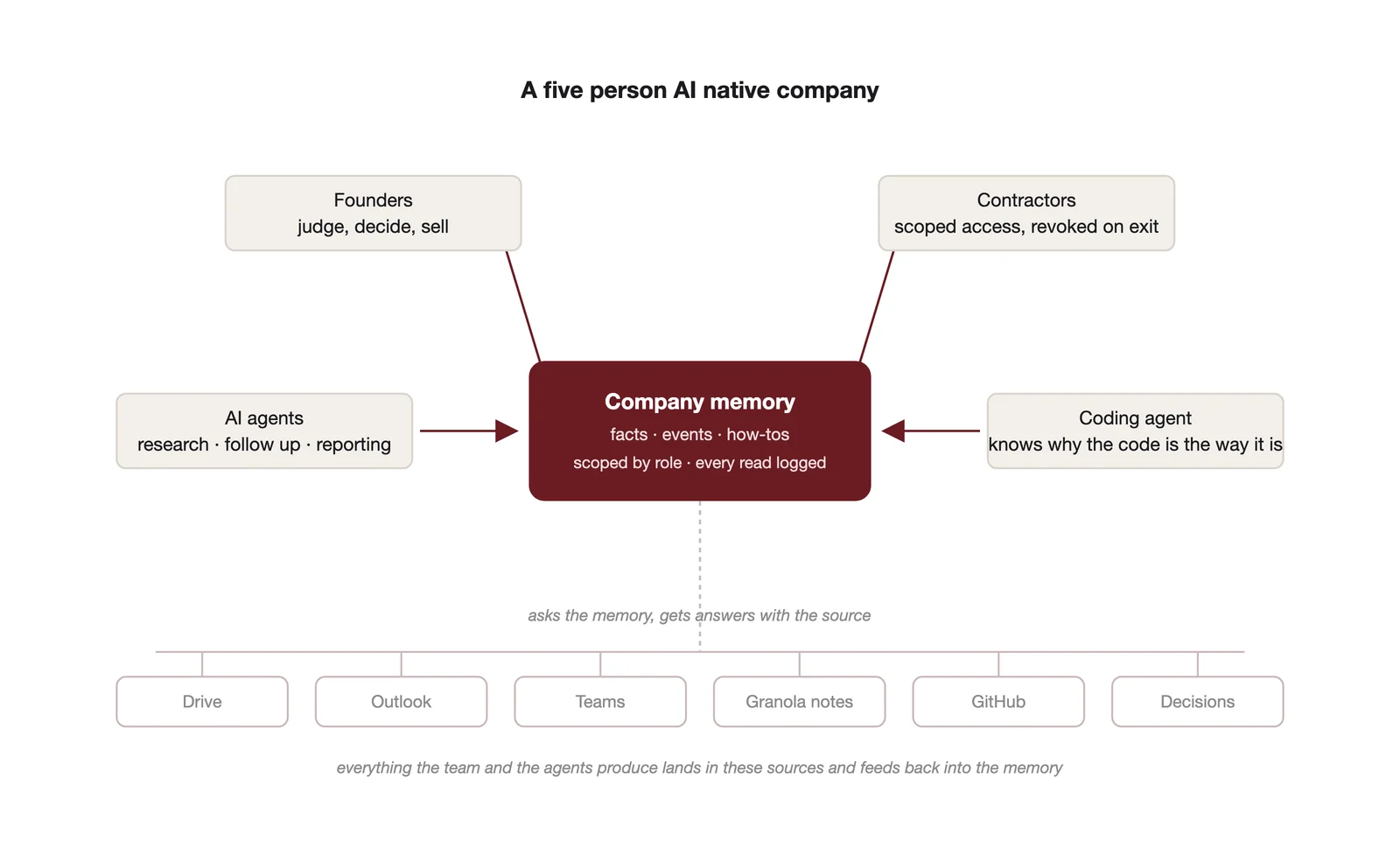
2. Build the memory before the team. On day one, connect your Drive, inbox, meeting notes and code to one memory that every tool can ask. Every document, email and decision after that compounds. Founders who skip this step spend their second year re-explaining the company to every new person and every new AI tool. Founders who do it have a company that knows itself.
3. Hire agents before people. For every task you are about to hire for, ask whether an agent with access to the company memory could do 80% of it. Research, drafting, follow up, first line support, reporting and reconciliation usually qualify. Hire the human for the 20%, and make them the supervisor of the agents doing the rest.
4. Use contractors with scoped memory instead of early employees. You can give a contractor access to exactly the memory they need for the work, nothing else, and revoke it the day the engagement ends. The knowledge they created stays with the company. That removes the two biggest costs of contractors, onboarding time and knowledge loss, and lets you stay flexible for longer.
5. Stop asking people to write things down. Every founder has tried a wiki. It dies within a quarter, because writing documentation is a tax on the busiest people. Let the memory read the work instead: the meeting notes from Granola, the threads in Teams or Slack, the emails in Outlook, the pull requests in GitHub. Knowledge gets captured as a side effect of doing the work.
6. Treat governance as a feature. If you sell to any regulated buyer, and eventually almost everyone does, you will be asked who can see what, what the AI was told and what it produced, and whether you can prove a record was deleted. Building this in from the start costs almost nothing. Retrofitting it costs a rebuild.
7. Stay small until it hurts. Headcount is the easiest way to feel like progress and the hardest cost to reverse. The best founders add a person only when a bottleneck cannot be solved with a better agent, a better process or a contractor. Then they measure revenue per person every month, so the trend is visible before it becomes a problem.
What a founder's day looks like with a company memory
Open the assistant you already use, Claude or ChatGPT, and ask it questions it could not answer yesterday.
What did we promise the pilot customer on last week's call? The answer comes back from the meeting notes, with the source. What is the pattern in the support threads this month? It comes from Teams and the inbox. Which tasks have we assigned three times and never closed? Which decisions did we make in March that we quietly reversed in June? Where are we spending time on questions we have answered before?
That last group is the one founders underestimate. A memory that sees all the work is the fastest way to spot inefficiency, because repeated questions, stalled threads and duplicated effort are visible in it long before they show up in the numbers.
Then the same memory feeds your agents. Your investor update drafts from what actually happened rather than what you remember. Your customer research agent already knows every conversation you have had with every customer. Your coding agent knows why the architecture is the way it is. Nothing starts from zero.
How OctaMem fits
OctaMem is the memory layer built for exactly this. The desktop app connects Google Drive, OneDrive, GitHub, Outlook, Teams and SharePoint in about two minutes and syncs continuously. Everything becomes typed, source linked memory: facts, events and how the company does things.
Founders and contractors get their own memory groups. The admin decides who sees what, down to the individual record, and revokes access on the way out while the memory stays with the company. Every read and write is logged, which is the governance from move six, built in on day one.
The memory is exposed to people through the app and to AI tools through the standard MCP integration, so Claude, ChatGPT, Cursor and Claude Code can all ask it. One memory, every tool. Plans start free, and a solo founder can run on Builder at $49 a month until there is a team to share it with.
Advice, plainly
Three things I would tell a founder starting today.
Do not build your own memory infrastructure unless memory is your product. It is the most tempting engineering project in an AI startup and the least likely to matter to a customer.
Pick one tool per layer of your stack and stop shopping. A Goldman Sachs survey in March 2026 found 48% of small businesses struggle to choose AI tools. The ones winning are not the ones with the best tools. They are the ones who chose fast and spent the saved time with customers.
And write down nothing that the memory could have read. Your time is the scarcest thing in the company. Spend it on judgement.
Frequently asked questions
Do I need to be technical to start an AI native company?
No. Tools like Lovable, Claude Code and Cursor let non technical founders ship real products. What you cannot outsource is knowing the customer's problem better than anyone else.
How small can the team be?
Companies are reaching seven figures in revenue with under ten people. Most AI native founders aim to stay under twenty until well past that.
What should I set up in the first week?
A company memory connected to your sources, one assistant everyone uses, one coding tool, and a simple way to measure revenue per person. Everything else can wait for a real bottleneck.
Is OctaMem only for law and real estate?
No. Law firms and real estate groups were the first customers because forgetting is a compliance problem for them. The product works for any team that wants its people and AI tools to share one governed memory.Build the memory before you build the team. Start free at octamem.com.