The best enterprise AI memory platforms in 2026
Thirteen platforms sold as enterprise AI memory, sorted into the three things they actually are — with deployment, compliance and pricing for each.
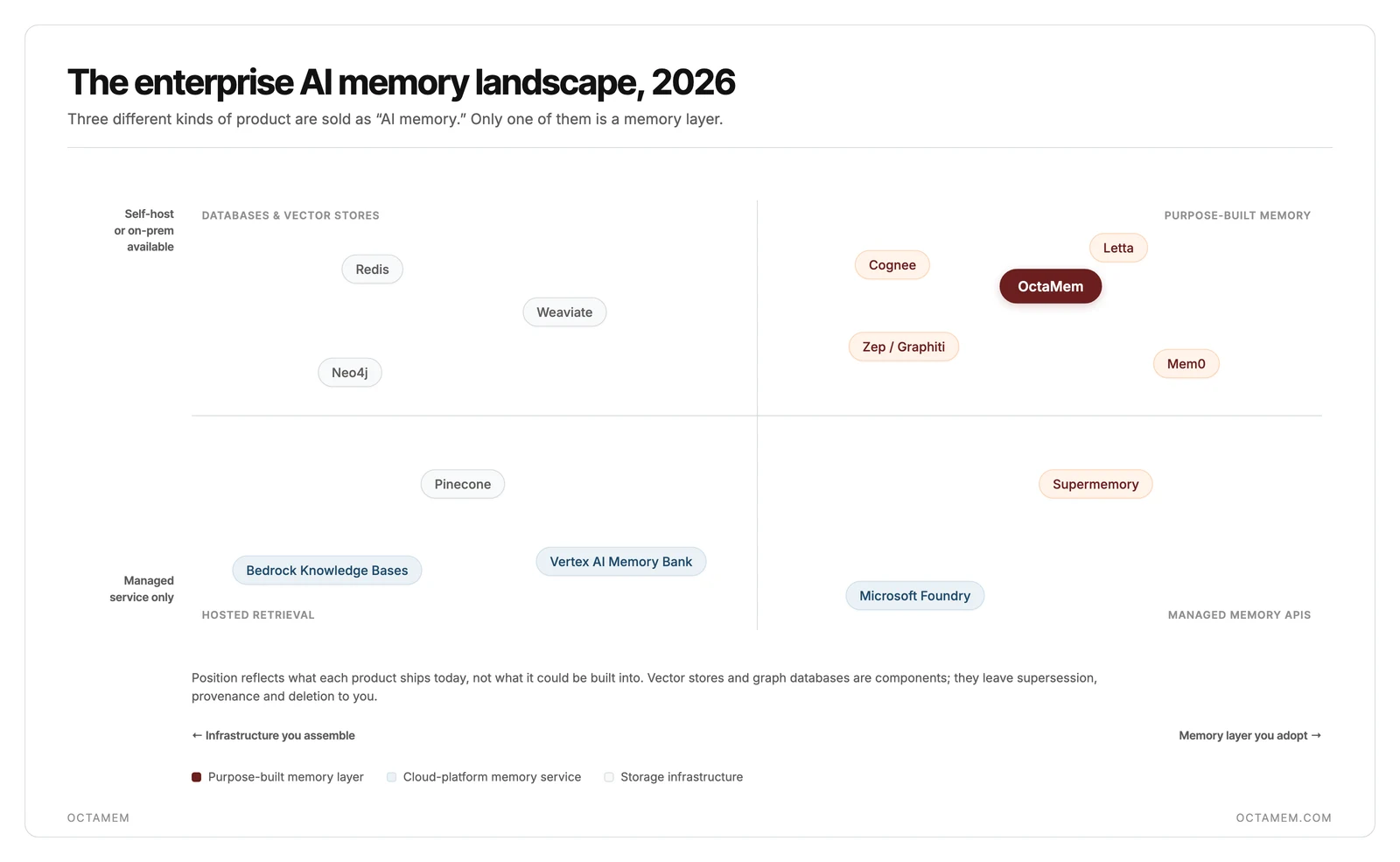
Search for an enterprise AI memory platform and you get a list that mixes three unrelated products: memory layers, cloud agent services, and databases. They are priced differently, they fail differently, and only one of them is what you were looking for. This piece sorts thirteen of them into the right piles first, then reviews each one.
We build one of these, so read the OctaMem section with that in mind. We have tried to earn your attention by being accurate about the others rather than by ranking ourselves first — where a competitor is the better answer for a given constraint, we say so, and there are four such cases below. Every price and capability here was checked against the vendor's own pricing or documentation page on 10 September 2026, and each vendor's screenshot is of that page. Check them again before you sign anything; this category rewrites its pricing every few months.
What enterprise AI memory actually means
Consumer memory has one job: make the assistant feel like it knows you. Enterprise memory has to survive an auditor, a leaver, a subject access request and a contradicting fact — which is a different product, not a bigger one. Four requirements separate them, and none of them appear in a demo:
- Supersession. When a new fact contradicts an old one, the store has to know which is current and keep the old one visible as superseded. A system that simply stores both and lets retrieval ranking pick a winner will confidently report last quarter's price.
- Provenance. Every remembered fact needs a chain back to the message, document or call it came from. Without it you cannot answer "why does the agent believe that", which is the first question anyone asks after a bad answer.
- Deletion that is real. Under GDPR's right to erasure, deleting a source document is not enough if a derived summary still carries the fact. See GDPR's right to erasure and AI memory for what that requires in practice.
- Deployment control. Regulated buyers frequently cannot send memory to a vendor's cloud at all. If on-prem or VPC deployment is not on the price list, the evaluation ends there regardless of how good the retrieval is.
Retrieval quality matters too, and it is the thing every vendor benchmarks. But of the five properties, retrieval is the easiest to improve later and the only one you can test in an afternoon. The other four are architectural: a system that was not built for supersession does not acquire it in a minor release.
The three things sold as "AI memory"
Almost every confused evaluation we see comes from comparing products that are not the same kind of thing. The category splits cleanly:
- Purpose-built memory layers — memory is the product. They decide what to remember, reconcile contradictions, and expose recall over an API or MCP. OctaMem, Mem0, Zep, Letta, Cognee, Supermemory.
- Cloud-platform memory services — memory as a feature of a hyperscaler's agent runtime. Excellent if you are already committed to that cloud and its agent framework; not portable, and usually thinner on provenance and supersession. AWS AgentCore Memory, Google's Memory Bank, Microsoft Foundry.
- Storage infrastructure — vector, graph and key-value stores. These are components. They will hold your embeddings faithfully and leave every hard decision to you. Pinecone, Weaviate, Redis, Neo4j.
That third group is where most "top 10 AI memory platform" lists go wrong. A vector database is to a memory layer roughly what a filesystem is to a document management system: necessary underneath, not a substitute. If you pick one, budget for the six to twelve months of engineering that turns it into memory — extraction, deduplication, supersession, scoping, deletion, audit. That is a real and sometimes correct choice. It is not a shortcut. What an AI memory layer is covers the boundary in more detail.
Quick comparison
The first six rows are memory layers, the next three are cloud-platform services, and the last four are storage you would build on. "From" is the cheapest way to write your first memory, not the cost of running production.
| Platform | Memory model | Self-host | Compliance | From |
|---|---|---|---|---|
| OctaMem | Semantic, episodic, procedural; supersession in the store | VPC, on-prem, air-gapped (Ent.) | SOC 2 II + ISO 27001 in progress; HIPAA BAA (Ent.) | $49/mo |
| Mem0 | Extracted facts, optional graph memory | Open source; on-prem (Ent.) | GDPR-ready; no certs named | Free |
| Zep | Temporal knowledge graph (Graphiti) | BYOC (Ent.) | SOC 2 Type II; HIPAA BAA (Ent.) | Free |
| Letta | Stateful agents with editable memory blocks | Yes, documented | SSO and RBAC (Ent.); no certs published | Free |
| Cognee | Knowledge graph via ECL pipelines | Yes, open source | GDPR and EU AI Act attestation | Free |
| Supermemory | Memory graph, embedding-free retrieval | Scale tier; air-gapped (Ent.) | SOC 2 and HIPAA from the $399 tier | Free |
| AWS AgentCore Memory | Short-term sessions + long-term extraction | No | Inherits your AWS posture | Usage |
| Google Memory Bank | Sessions + extracted long-term memories | No | Inherits your GCP posture | Usage |
| Microsoft Foundry | Persistent threads; no cross-session extraction | No | Inherits your Azure posture | Usage |
| Pinecone | Managed vector search | No | Enterprise certifications available | Free |
| Weaviate | Vector + hybrid search, open source | Yes | Enterprise certifications available | Free |
| Redis | In-memory session state and vector search | Yes | Enterprise certifications available | Free |
| Neo4j | Property graph | Yes | Enterprise certifications available | Free |
Credit and token pricing diverges sharply at volume, and three of these vendors bill on units — credits, memory operations, processed tokens — that are not comparable without modelling your own traffic first.
Purpose-built memory layers
1. OctaMem
Our own. OctaMem stores all three types of agent memory — semantic, episodic and procedural — as distinct record types rather than as one undifferentiated pile of extracted text, and treats supersession as a property of the store rather than of the ranking function. When a fact changes, the old record stays queryable and marked superseded, with a pointer to what replaced it. Every record carries provenance back to its source, and deletion propagates to derived records.
Access is API, MCP and SDK on every tier, with Google Workspace and Microsoft 365 connectors included. Pricing runs $49/mo (Builder, 5,000 MOps) through $199 and $750 to $3,000/mo (Scale, adding SSO, SCIM and a 99.95% SLA), with Enterprise from $100k/yr for your own VPC, on-prem or air-gapped deployment, plus the legal and real-estate workflows. Full detail is on the pricing page.
Be honest about where we are behind: our SOC 2 Type II and ISO 27001 audits are in progress — controls are in operation but the certificates are not issued, which our trust page states plainly. Zep holds SOC 2 Type II today. If your procurement process requires a completed report at signature rather than a remediation plan, that is a real gap and you should weigh it. We also have no free tier: evaluation starts at $49, where most of this list starts at zero. On retrieval we published a full LOCOMO run at 93.51% — 1,440 of 1,540 questions at about $0.00076 each — with the per-category breakdown and the questions we get wrong, rather than a selected slice. That is the number to argue with.
Best for: regulated teams — legal, real estate, financial services — that need provenance and deletion to hold up under review, and that expect to need on-prem eventually.
2. Mem0
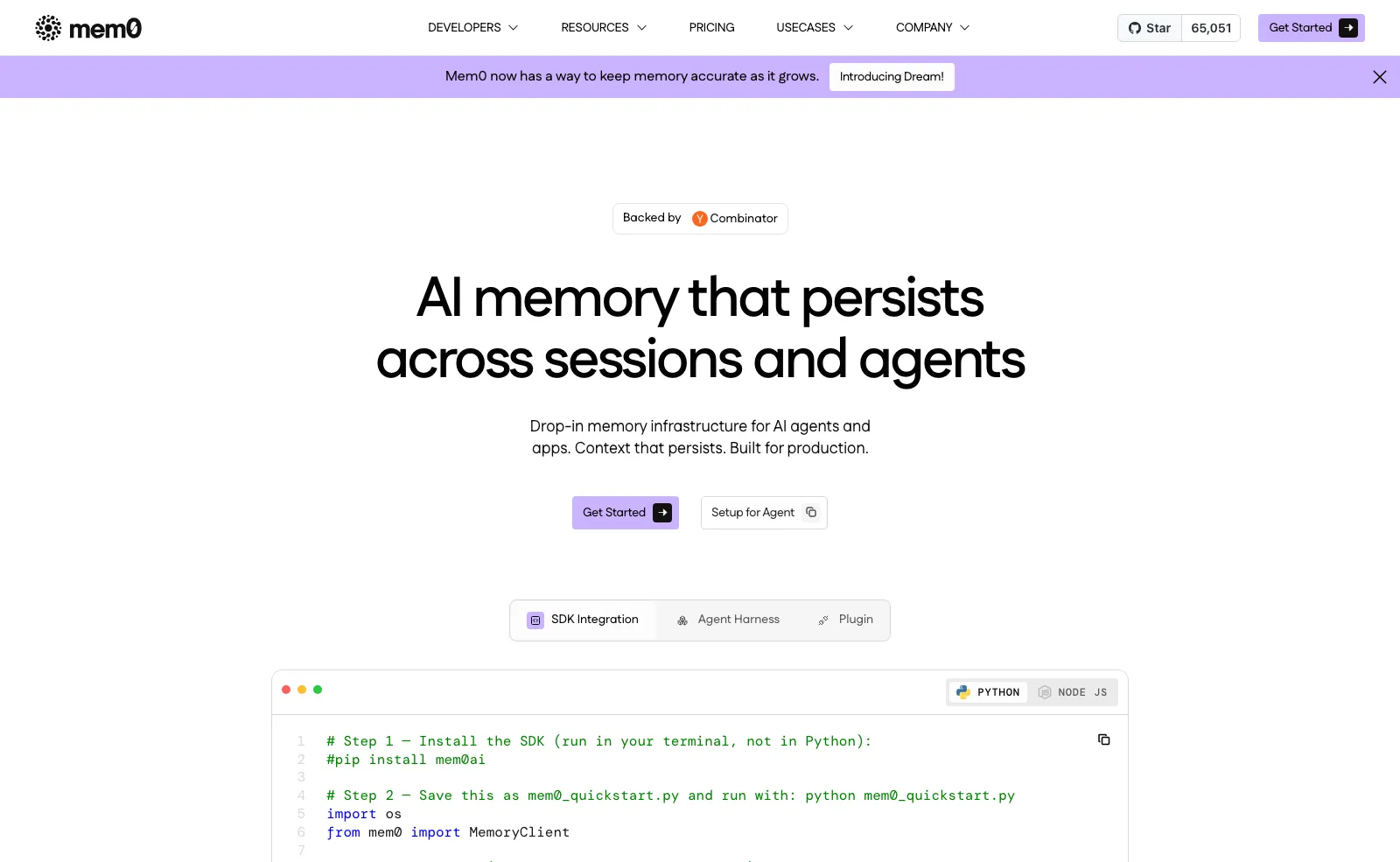
The most widely adopted option on this list, and the easiest to start with. Mem0 extracts facts from conversations and serves them back over a small, well-documented API, with optional graph memory on the Pro tier for relationships between entities. The open-source project is the default answer for a team that wants persistent memory working this afternoon, and the Python and TypeScript SDKs are genuinely pleasant.
Pricing: free Hobby tier (10,000 add and 1,000 retrieval requests a month), Starter at $19/mo, Pro at $249/mo for 500,000 adds plus graph memory and analytics, and Enterprise with on-prem deployment, audit logs, SSO and an SLA. Usage-based pricing is available for traffic that does not fit the tiers.
The trade-off is architectural: extraction is fast and append-leaning, so contradiction handling and provenance are lighter than a graph-first or supersession-first design. Its pricing page advertises GDPR readiness and a trust centre but names no certifications, so ask for the current report directly. Best for: startups and product teams that want memory shipped this week, and anyone whose compliance bar is "reasonable" rather than "audited".
3. Zep
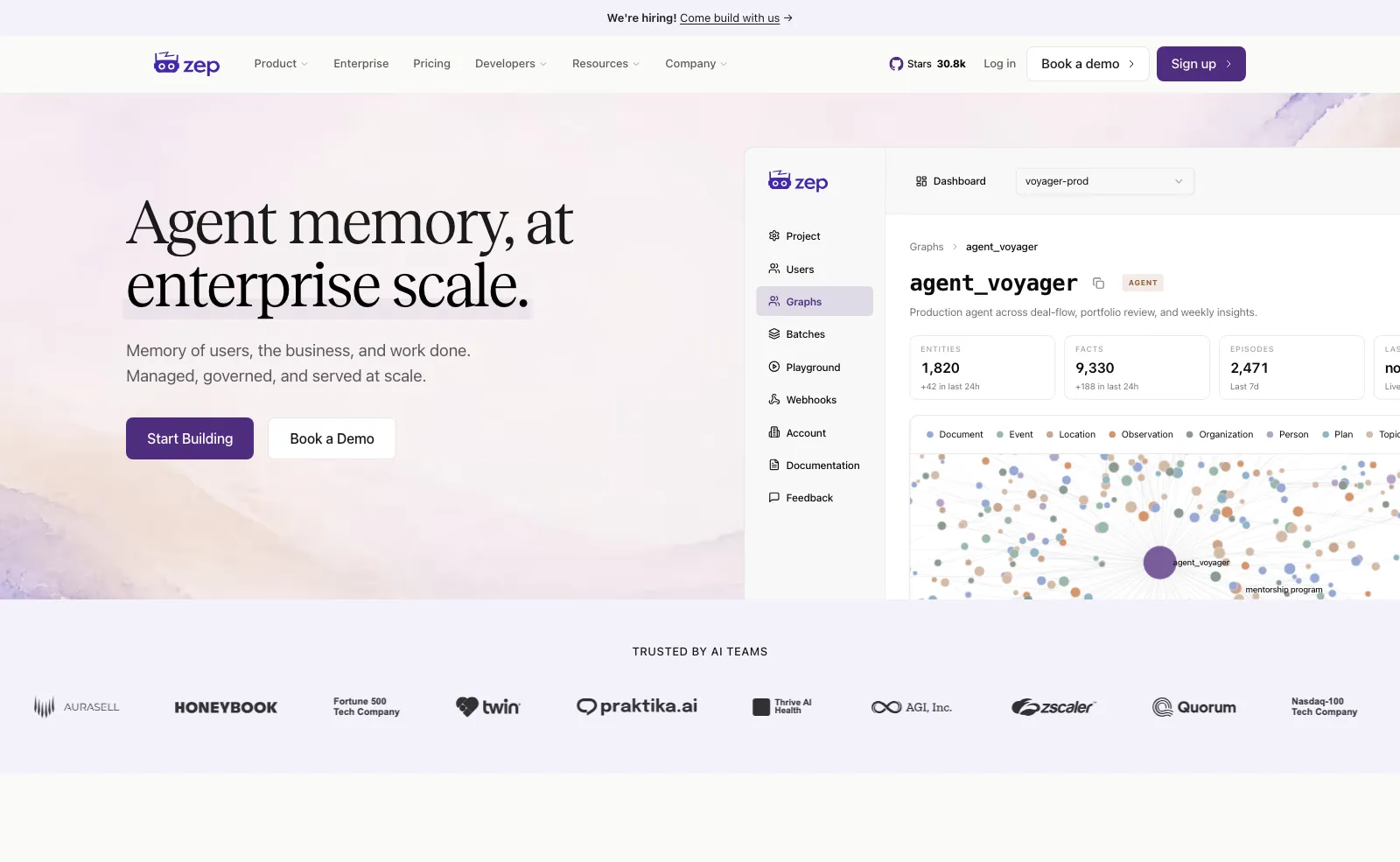
Zep is the strongest of the memory layers on temporal reasoning. Its Graphiti engine builds a temporal knowledge graph where facts carry validity intervals, so "what did we believe in March" is a first-class query rather than a reconstruction. If your domain is one where the history of a belief matters as much as its current value — case files, deal history, clinical timelines — this design is the closest fit on the list.
Pricing is credit-based: a free tier with 10,000 credits a month, Flex at $125/mo for 50,000 credits, Flex Plus at $375/mo for 200,000, and negotiated Enterprise rates. A credit is one episode up to 350 bytes, plus one per additional 350 bytes, with storage and retrieval unmetered — which is unusually transparent, and worth modelling against your real message sizes, because chatty agents consume credits faster than the tier names suggest.
Where Zep beats us: SOC 2 Type II is in hand on every tier, HIPAA BAAs are available on Enterprise, and bring-your-own-cloud deployment covers the middle ground between managed and on-prem. If you need a completed audit report today, Zep is the honest recommendation. Our three-way comparison with Mem0 and Zep goes deeper on the differences.
4. Letta
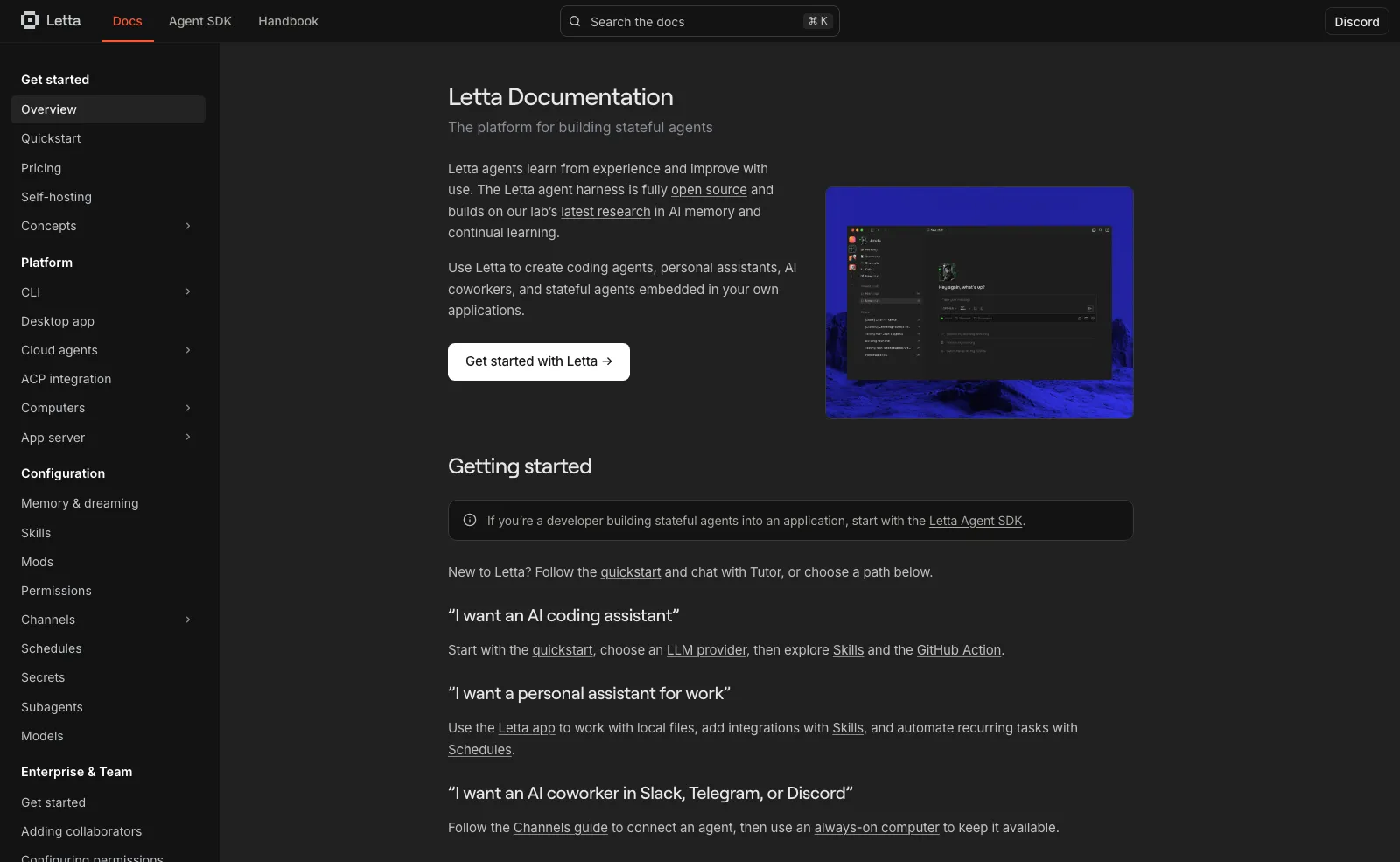
Letta is the research-native option, descended from the MemGPT work. Its model is different from everything else here: memory is a set of editable blocks that the agent itself rewrites as it learns, rather than a store a pipeline writes into. Agents are stateful objects you create and address, with self-hosting documented and a fully open agent harness.
Pricing: free for 3 stateful agents with your own API keys, $20/mo Personal Pro for 20 agents, $20/seat for Teams Pro, and an API plan at $20/mo plus usage — $0.10 per active agent per month and $0.00015 per second of tool execution. Enterprise adds SAML/OIDC SSO and role-based access control; no compliance certifications are published.
The per-agent model is the thing to check. It is elegant when you have tens or hundreds of long-lived agents and awkward when you have one agent serving a hundred thousand users, which is the shape most enterprise deployments take. Best for: teams building agents as persistent entities — coworkers, assistants, long-running coding agents — rather than memory as a service behind a product.
5. Cognee
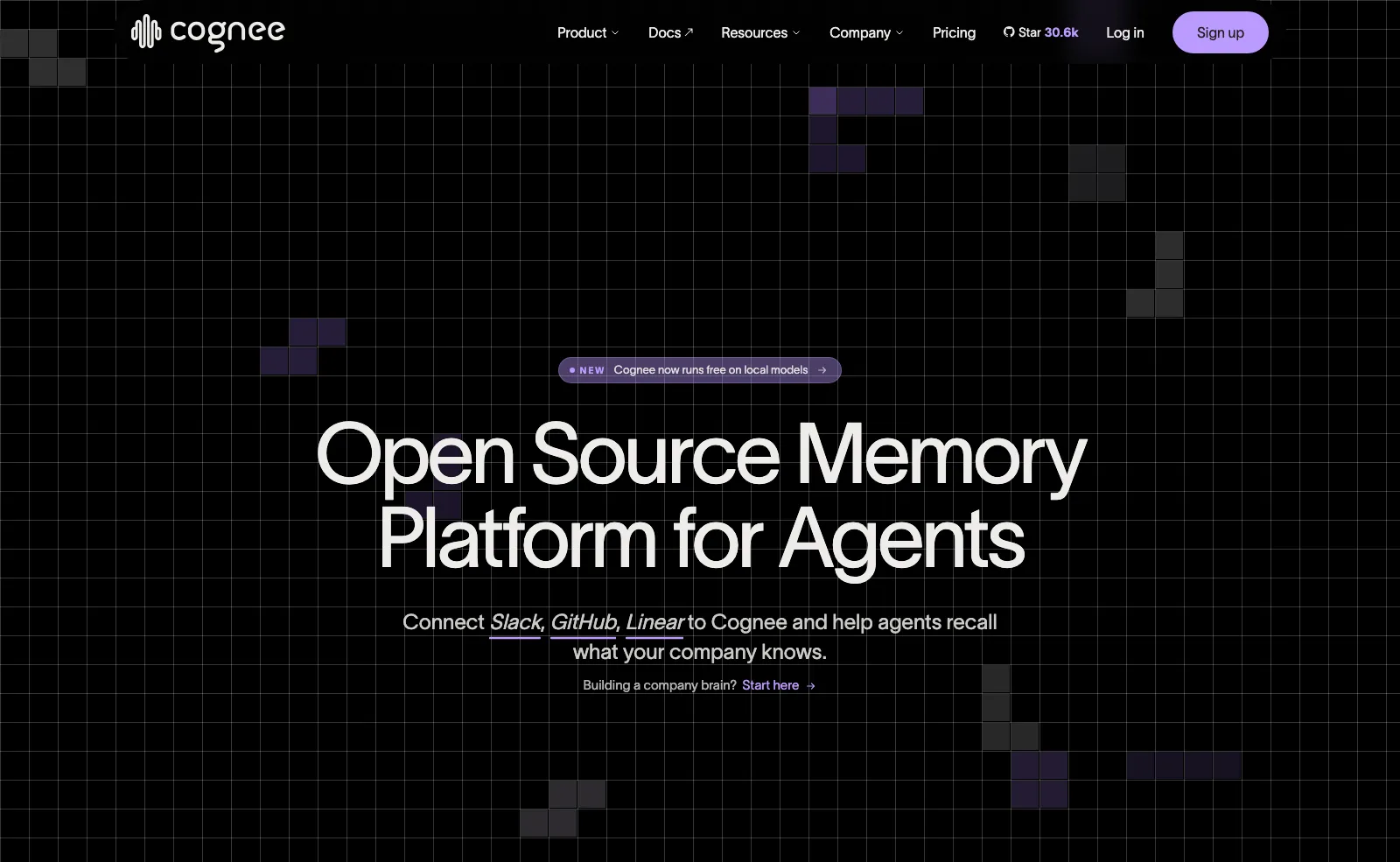
Cognee builds a knowledge graph out of your sources through what it calls ECL pipelines — extract, cognify, load — and is open source end to end, so a self-hosted deployment costs you infrastructure rather than licence. It ships connectors for Slack, Notion, Linear and Google Drive, plus code indexing, which makes it a natural fit for engineering-heavy organisations that want the graph on their own hardware.
Pricing is refreshingly simple: free for 1M tokens and one workspace, then $1.00 per 1M tokens processed with $5 per extra workspace, and an Enterprise BYOC engagement deployed in your own VPC with a reduced-rate startup package for pre-Series B companies. It holds GDPR and EU AI Act attestation through heyData rather than SOC 2.
Token pricing cuts both ways: cheap for occasional ingestion, less predictable if you are re-processing large corpora, since cognification is not a one-off cost. Best for: teams that want the graph, want the source, and have the engineers to run it.
6. Supermemory
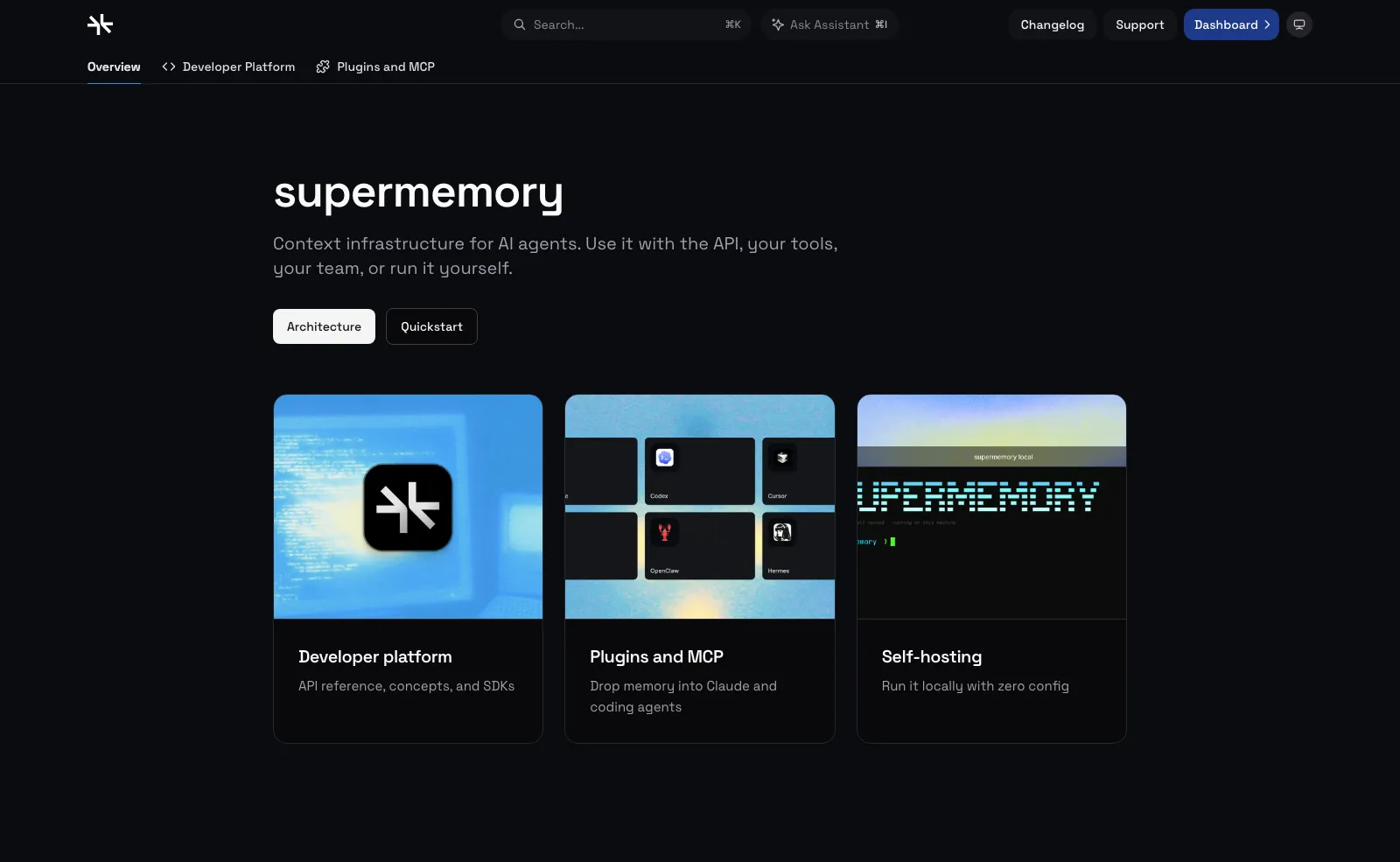
Supermemory positions itself as context infrastructure rather than a memory product: an API for storing, searching and graphing memory with multimodal extraction, and a retrieval approach it describes as working without conventional embeddings. It publishes a full rate card — roughly $0.005–$0.010 per 1K tokens stored, $0.001–$0.002 per 1K retrieved — which makes it one of the few here you can model precisely before signing up.
Tiers run Free ($5 of credits), Pro at $19/mo, Max at $100/mo, Scale at $399/mo — which is where SOC 2 and HIPAA appear alongside S3 and web crawlers and self-hosting — and Enterprise with fully air-gapped deployment and a dedicated engineer. Qualifying early-stage startups and academic teams get Scale free for three months.
Compliance sitting behind the $399 tier is the wrinkle: a small regulated team pays Scale prices for controls, not capacity. Best for: developers who want predictable per-token cost and are comfortable being early on a fast-moving platform.
Cloud-platform memory services
These are memory as a feature of an agent runtime you are already paying for. The economics are hard to argue with if you are committed to the cloud in question, and the lock-in is equally hard to argue with if you are not. None of the three offers self-hosting, by design.
7. Amazon Bedrock AgentCore Memory
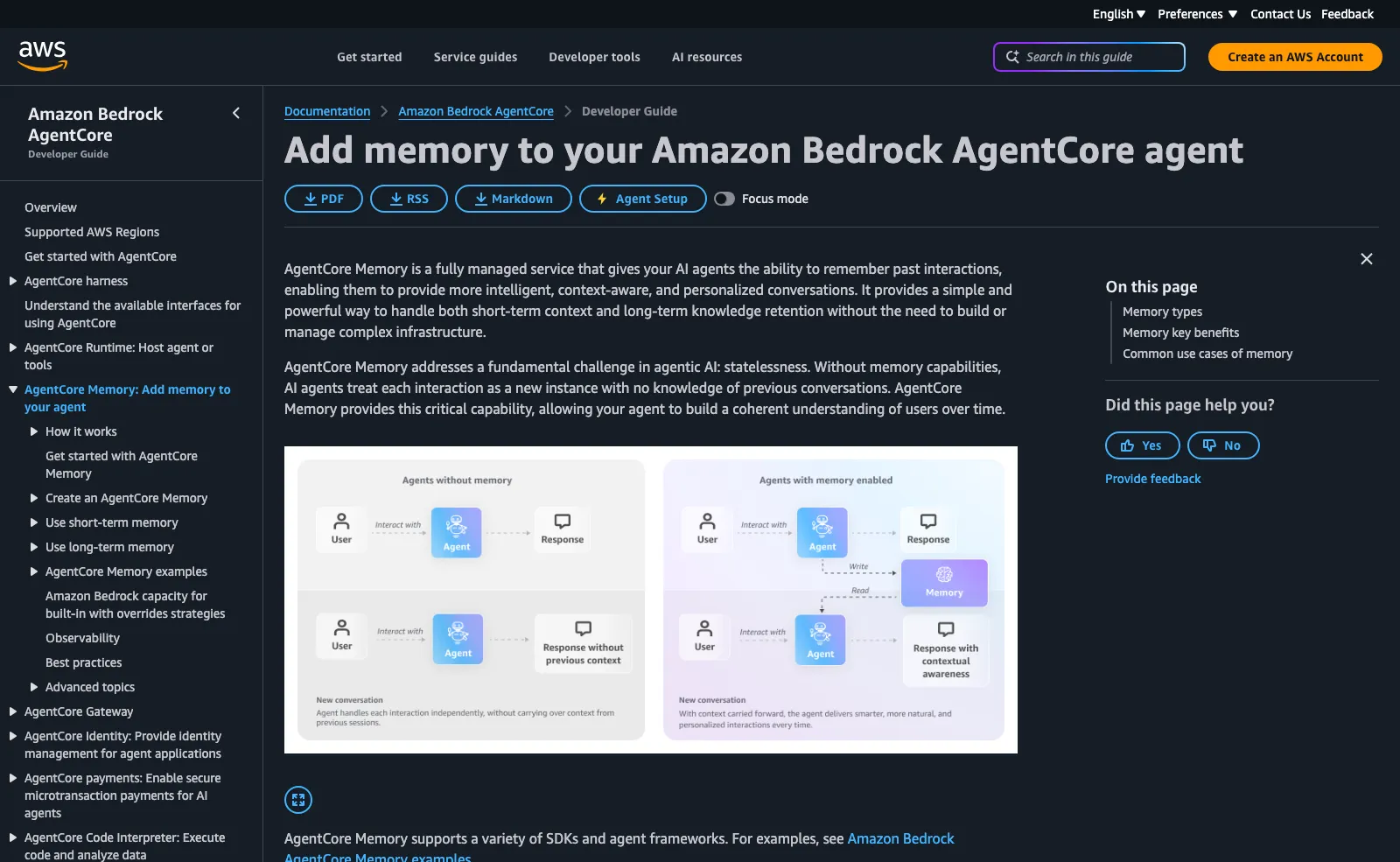
The most complete of the three. AgentCore Memory is a fully managed service with an explicit split between short-term memory — turn-by-turn context inside one session — and long-term memory, which extracts user preferences, salient facts and session summaries across sessions using configurable strategies, including custom ones. It works with LangChain, the OpenAI Agents SDK, the Claude Agent SDK and Strands rather than only with an AWS framework, which is a genuine advantage over the usual hyperscaler pattern.
Do not confuse it with Bedrock Knowledge Bases, which is retrieval over static documents and a different product. Pricing is usage-based within Bedrock. Compliance is whatever your AWS account already carries, which for most enterprises is the fastest possible procurement path. Best for: teams already deep in Bedrock who want memory without a new vendor, and who can accept that the memory does not leave AWS.
8. Google Agent Platform Memory Bank
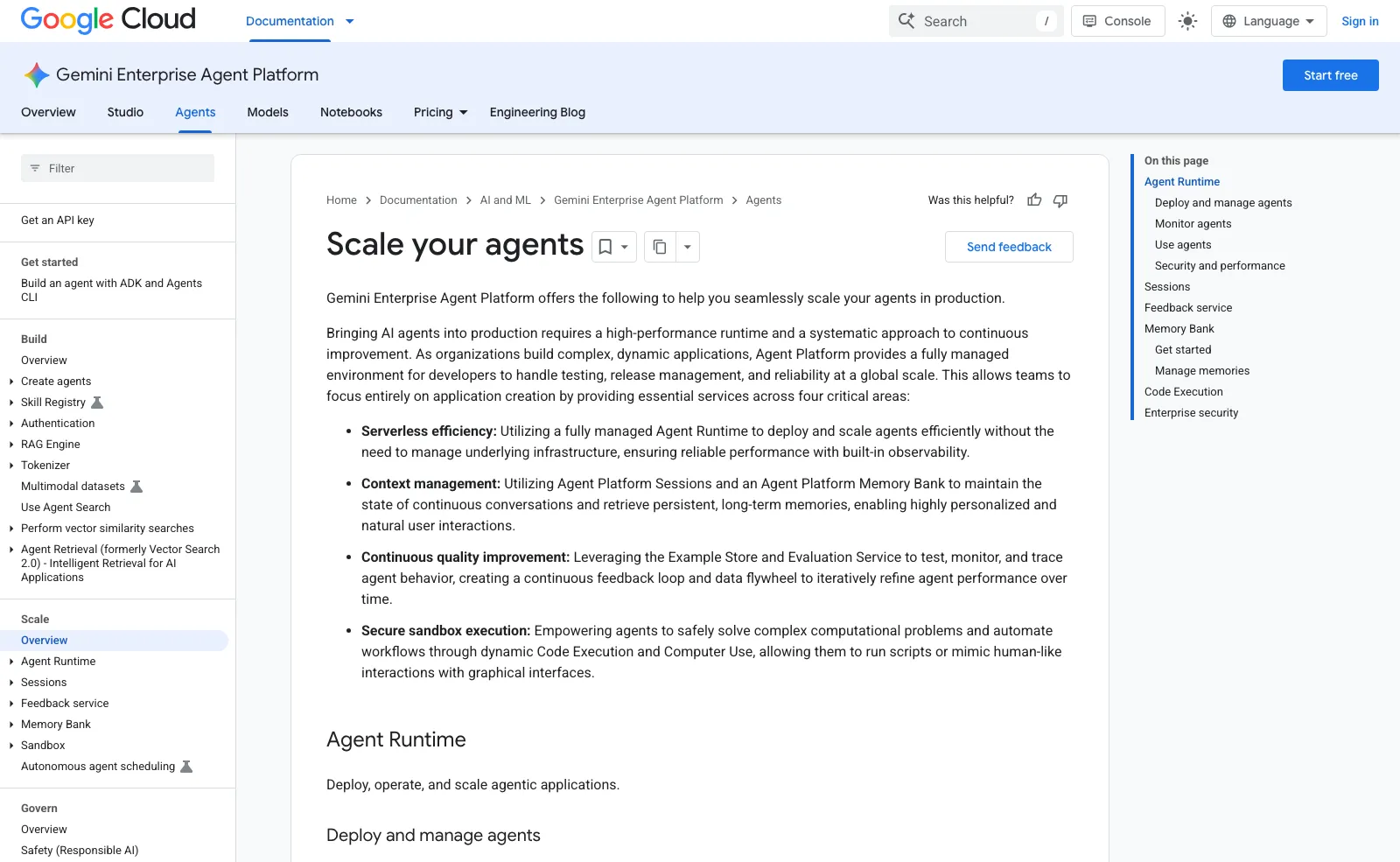
Google's agent stack — now branded Gemini Enterprise Agent Platform, formerly Vertex AI Agent Engine — separates Sessions, which hold the state of a continuing conversation, from Memory Bank, which retrieves persistent long-term memories for personalisation. Around them sit the managed Agent Runtime, an Example Store, an evaluation service and sandboxed code execution, so memory arrives as one piece of a fairly opinionated production platform.
That is the appeal and the cost: excellent if you are building on Google's runtime, close to irrelevant if you are not, since Memory Bank is not sold as a standalone store you point other infrastructure at. Best for: teams standardising on Gemini and the Agent Platform who want the whole runtime rather than a memory component.
9. Microsoft Foundry Agent Service
Worth being precise here, because Foundry appears on every list of memory platforms and does not quite belong. Foundry Agent Service gives agents persistent threads: conversation sessions that store messages, hold up to 100,000 of them, truncate automatically to fit the model's context window, and persist until deleted. In the Standard setup those threads live in your own Azure Cosmos DB account, which is a real data-residency advantage.
But a thread is history, not memory. There is no cross-session extraction of durable facts, no supersession when a stored message is contradicted, and no provenance model beyond the message list itself — you get the transcript and the tools to search files, and the reconciliation is yours to build. Best for: Azure-committed teams that need conversation continuity and are willing to build the memory layer above it, or to put one of the products above alongside it.
Storage you would build on, not buy
These four are excellent products that are not memory layers, and they belong in this article only because they are so often listed as alternatives to one. If you choose this route, you are choosing to build. The cost of that build is the subject of what an AI memory layer actually costs.
10. Pinecone
The default managed vector database, and deservedly so: serverless, fast, operationally boring in the best sense. Its marketing has moved toward agent knowledge, but the product is vector search. It will return the nearest neighbours to your query embedding and has no opinion about whether one of them was superseded last Tuesday. Choose it as the retrieval substrate under memory you are building, not as the memory.
11. Weaviate
Weaviate is the open-source answer to the same problem, with hybrid keyword-and-vector search, a good schema model, and both managed and self-hosted deployment. For an organisation that has ruled out sending memory to a vendor cloud but also cannot buy an on-prem memory layer, Weaviate plus your own extraction pipeline is a common and defensible architecture. Budget for the pipeline.
12. Redis
Redis is where short-term memory actually lives in most production agent systems — session state, working context, caches — and it now carries vector search as well. Nobody regrets putting Redis under their agent. Just note that the working-memory tier it serves is the one part of the memory problem that was never hard; the durable, reconciled, auditable tier is the expensive one, and Redis is not trying to solve it for you.
13. Neo4j
The property-graph database under a good many home-built memory layers, including some of the graph-based products above. If your team already runs Neo4j and has graph modelling skill in-house, building memory on it is a real option, and you will understand your own schema better than any vendor's. You will also own supersession, extraction quality, deletion propagation and the audit trail forever.
How to choose
Read the shortlist in this order, because each question eliminates more candidates than the next:
- Can the memory leave your infrastructure? If no, you are choosing between OctaMem Enterprise, Zep BYOC, Supermemory Enterprise, self-hosted Cognee or Letta, or a build on Weaviate or Neo4j. The three cloud services are out, and so is every managed-only tier.
- Does procurement need a completed audit report? If yes, Zep and Supermemory's Scale tier are the two with certificates in hand today; the hyperscalers inherit yours. Ask everyone else, us included, for the current status in writing.
- Does the history of a fact matter, or only its current value? If history matters, you want a temporal or supersession-aware store — Zep or OctaMem — rather than an extraction-and-append design.
- Are you already committed to one cloud's agent runtime? If yes, price AgentCore or Memory Bank first. The integration savings are real and the procurement is nearly free.
- Then run the tests. Our ten-test buyer's checklist takes an afternoon on trial accounts and will tell you more than every page on this list combined, including this one.
Category winners
| If you need… | Start with | Why |
|---|---|---|
| A completed SOC 2 report today | Zep | SOC 2 Type II on every tier, HIPAA BAA on Enterprise, and BYOC deployment |
| Memory working this afternoon | Mem0 | Largest ecosystem, best SDKs, genuinely usable free tier |
| Provenance and deletion that survive review | OctaMem | Supersession in the store, provenance per record, deletion that propagates to derived facts |
| Open source you can run yourself | Cognee | Fully open, graph-based, $1 per 1M tokens if you use the cloud |
| Agents as long-lived entities | Letta | Self-editing memory blocks and stateful agents, per-agent pricing |
| Predictable per-token cost | Supermemory | Published rate card, no credit translation needed |
| Memory inside a cloud you already use | AWS AgentCore Memory | Framework-agnostic, real long-term extraction, no new vendor |
| A component to build on | Weaviate or Redis | Honest infrastructure that does not pretend to be memory |
Four of those eight are competitors. That is not modesty, it is the actual shape of the market in 2026: the category is young enough that the products are genuinely differentiated, and a vendor claiming to win every row is telling you something about its marketing rather than its architecture.
What to watch for in any pitch, ours included
- A benchmark with no failure cases. Every memory system fails somewhere. A vendor that cannot tell you where theirs fails has not looked.
- "GDPR compliant" as a badge. Ask what happens to a summary derived from a document you deleted. The answer separates a deletion feature from a deletion architecture.
- Certification language that hides tense. "SOC 2 aligned", "controls in operation", "audit-ready" and "SOC 2 Type II certified" are four different things. We use the third; be sure you know which one you are being sold.
- Pricing in invented units. Credits, MOps and processed tokens are all fine, but model your own traffic in the vendor's unit before comparing headline prices. The cheapest tier at 10,000 writes a month is rarely the cheapest at 10 million.
Frequently asked questions
What is enterprise AI memory?
A store that lets agents remember durable facts across sessions, with the controls an enterprise needs around them: supersession when facts change, provenance back to the source, deletion that reaches derived records, and deployment options that keep data where policy requires. Consumer memory needs none of those four, which is why it is a much simpler product.
Is a vector database an AI memory platform?
No. A vector database stores and searches embeddings; it has no view on which of two contradicting facts is current, where a fact came from, or what else must be deleted when a source is erased. Vector databases sit underneath memory layers — including several on this list — but choosing one means committing to build the memory layer yourself.
Which enterprise AI memory platforms can be self-hosted?
Cognee and Letta are open source and self-hostable directly. Mem0 has an open-source project plus on-prem on its Enterprise tier. Zep offers bring-your-own-cloud on Enterprise, Supermemory offers self-hosting from its Scale tier and air-gapped deployment on Enterprise, and OctaMem offers VPC, on-prem and air-gapped on Enterprise. The three hyperscaler services cannot be self-hosted at all.
How much does an enterprise AI memory platform cost?
Entry pricing ranges from free tiers to $49/mo, mid-tiers cluster between $100 and $400 a month, and production tiers run $250 to $3,000 a month before enterprise agreements — which typically start in the tens of thousands per year and rise sharply with on-prem deployment. The headline number matters less than the billing unit: credits, memory operations and processed tokens diverge by an order of magnitude at scale.
Do the cloud providers' memory services replace a memory layer?
AWS AgentCore Memory comes closest — it does real long-term extraction across sessions and works with several agent frameworks. Google's Memory Bank is capable but tied to its own Agent Platform. Microsoft Foundry provides persistent threads rather than extracted memory, so it is conversation state rather than a memory layer. All three trade portability for procurement speed.
What is the fastest way to compare two memory platforms?
Write two contradicting facts on a trial account and ask which is true. A system that reports the superseded fact, or returns both without ranking, has told you more in five minutes than a week of reading vendor pages. Nine further tests of that kind are in our buyer's checklist.