Why does my AI keep forgetting? A plain English guide to AI memory
ChatGPT, Claude and Gemini forget for the same three reasons. What AI memory really is, why the built-in fixes fall short, and what a company needs.
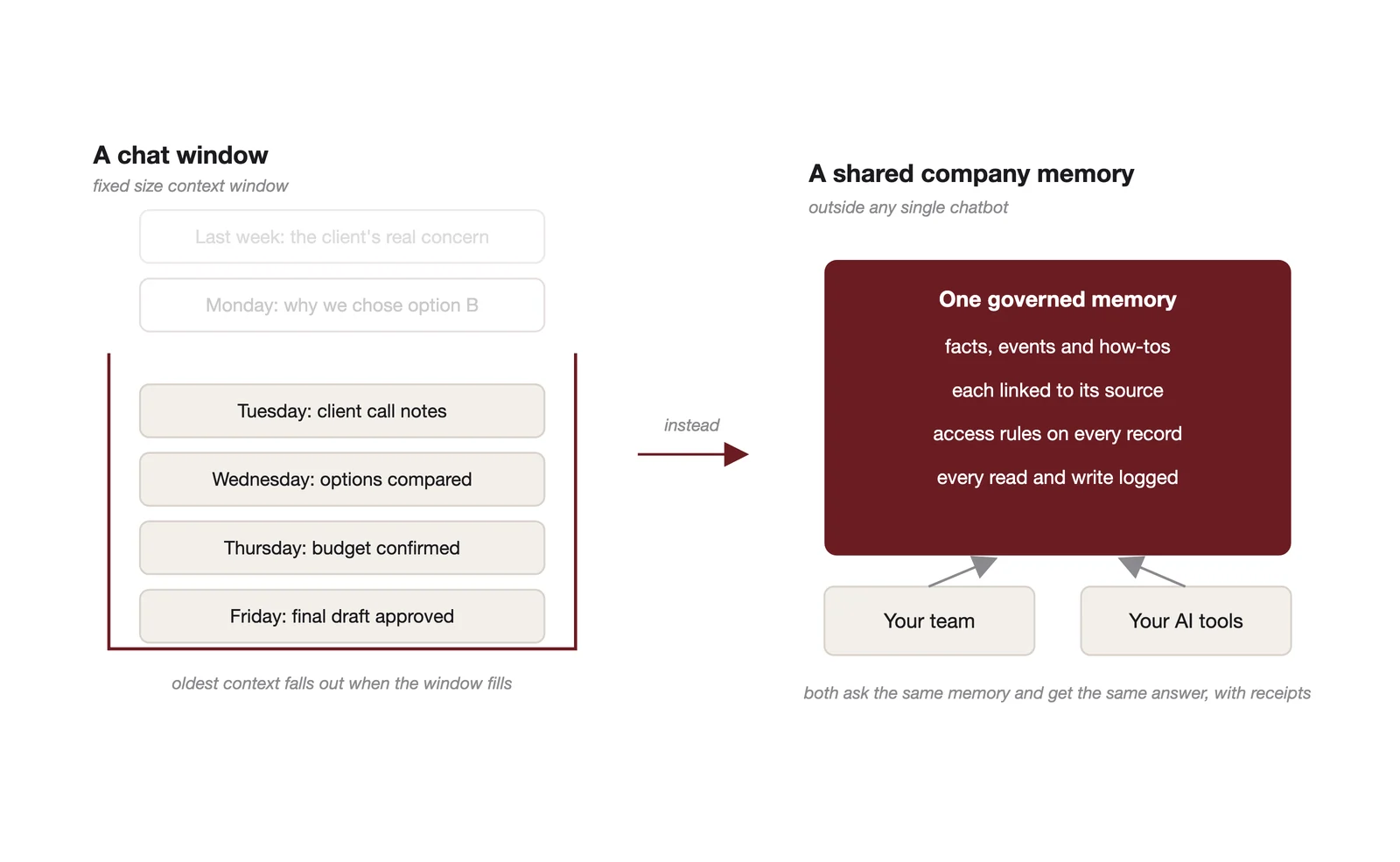
Short answer: Your AI forgets because it does not have memory in the way you do. Every conversation runs inside a fixed size window. When the window fills, the oldest parts drop out. The "memory" features in ChatGPT, Claude and Gemini store short notes about you, not what you actually worked on. That is fine for one person. It is a real problem for a company.
The Tuesday problem
You open your AI assistant. You ask it to pick up the project you were deep in last week. It replies, politely, that it would love to help and could you please give it some context.
So you explain the whole thing again. The client. The constraints. The three options you already ruled out. Ten minutes later it finally becomes useful, and you have done a chunk of the work it was supposed to save you.
Most people assume this is a bug or a settings problem. It is neither. It is how these systems are built.
Three reasons your AI forgets
1. The window fills up. Every AI model works inside a context window, which is a hard limit on how much text it can look at in one go. Your messages, its replies, any files you upload, all of it counts. Long sessions blow past the limit faster than you would think. When that happens, the oldest material is silently dropped or squashed into a summary. The AI is not being lazy. It cannot see that part of the conversation any more.
2. The saved memory is a notepad, not a record. ChatGPT's memory feature, and the equivalents in other assistants, write short one line facts about you: your job, your writing preferences, the name of your dog. OpenAI reworked this in June 2026 so the system writes more of these notes on its own, but even OpenAI's own documentation says the visible summary will not show you everything it holds. What none of these features store is the substance of the work. The decisions you made. The reasons you rejected an option. The email chain that changed the plan.
3. The memory belongs to the tool, not to you. Whatever ChatGPT has learned about you stays in ChatGPT. Open Claude, or Gemini, or the AI built into your CRM, and you start from zero. Switch tools and you lose everything you taught the last one.
If you are one person using AI for personal tasks, you can live with all three. Delete a few saved notes when the "memory full" warning appears and carry on.
If you are a business, this is where it gets expensive.
Why the business version of the problem is worse
Think about what "forgetting" means when ten people at the same firm each use AI separately.
Every one of them re-explains the company to a different chatbot. Every one of them gets slightly different answers to the same question, because each AI only knows what that one person typed into it. When someone leaves, whatever they taught their AI leaves with them. And nobody can tell you afterwards what the AI was told, what it answered, or where the answer came from.
The consumer memory features were never designed for this. They store personal preferences for a single account. A company needs something different: one memory, shared across the team, that every person and every AI tool can ask. With rules about who sees what. With a record of every question and every answer.
That is a different category of product. We call it a memory layer, or, when it covers a whole organisation, a company brain.
What a company memory actually does
A memory layer sits outside any single chatbot. It connects to the places your knowledge already lives, which for most firms means Google Drive or OneDrive, Outlook, Teams or Slack, and maybe GitHub. It reads those sources continuously and turns them into structured memory: facts, events and how to instructions, each one linked back to the document or email it came from.
Then any person, and any AI assistant or agent you run, can ask it questions. The answer comes back with the source attached. When someone asks "what did we agree with the lender on the Bristol deal?", they get the answer and the email that proves it.
Three things separate a proper company memory from a bigger chat window:
It is shared. Everyone on the team asks the same memory, so everyone gets the same answer.
It is governed. Access follows your rules, down to the individual record. A junior associate does not see what a partner sees unless you say so.
It is auditable. Every read and every write is logged. When someone asks what the AI knew and when, you can show them.
Where OctaMem fits
OctaMem is a company memory built for teams whose context has to outlive the people who created it. Law firms and real estate groups were the first to use it, because in those businesses a forgotten detail is a liability, not an inconvenience.
Setup takes about two minutes. You point the desktop app at your Drive, inbox or repositories and set how often it syncs. From then on, every file, email and decision feeds one memory that your team and your AI tools can ask. Every answer comes with receipts. Every record can be deleted, and the deletion can be proven.
On the standard LoCoMo benchmark for long term conversational memory, OctaMem answered 93.51% of questions correctly, 1,440 out of 1,540. We publish the full results, including the questions we got wrong, at octamem.com/benchmarks.
Frequently asked questions
Does ChatGPT remember previous conversations?
Partly. It keeps short notes about you across chats, and since mid 2026 it writes more of those notes automatically. It does not keep the full content of old conversations, and what it remembers stays inside ChatGPT.
Can I make my AI remember everything?
Not inside one chatbot. The window limit is a hard constraint of the model. The practical fix is a memory that lives outside the chatbot and feeds it the right context on demand.
Is an AI memory layer the same as a knowledge base?
No. A knowledge base is a folder of documents people search. A memory layer is structured, typed memory that AI agents and people can query in plain language, with access rules and an audit trail on every record.
What does a company memory cost?
OctaMem has a free tier for trying it, and paid plans start at $49 a month. Enterprise deployments with sovereign hosting are priced separately.OctaMem turns your company's files, emails and decisions into one auditable memory every person and every AI agent can ask. Start free at octamem.com, or talk to us about a deployment for your firm.