A Second Brain for Your AI Agents: Personal Memory That Travels With You
You built a second brain for yourself. Your agents cannot read it, and their memories are locked per vendor. Why you need one portable memory layer.
The second brain movement solved the wrong half of the problem. A decade of personal knowledge management produced beautifully linked notes that exactly one reader ever visits: you. Meanwhile the actual workers in your life, the four or five AI agents you use daily, cannot read any of it, and each has been quietly building its own private memory of you that you neither control nor can move.
Your coding agent knows your architecture but not your writing voice. Your chat assistant knows your projects but not your codebase. Your research agent knows nothing, freshly, every single morning. And you, the supposed beneficiary of all this intelligence, spend a noticeable fraction of every session re-introducing yourself to your own tools.
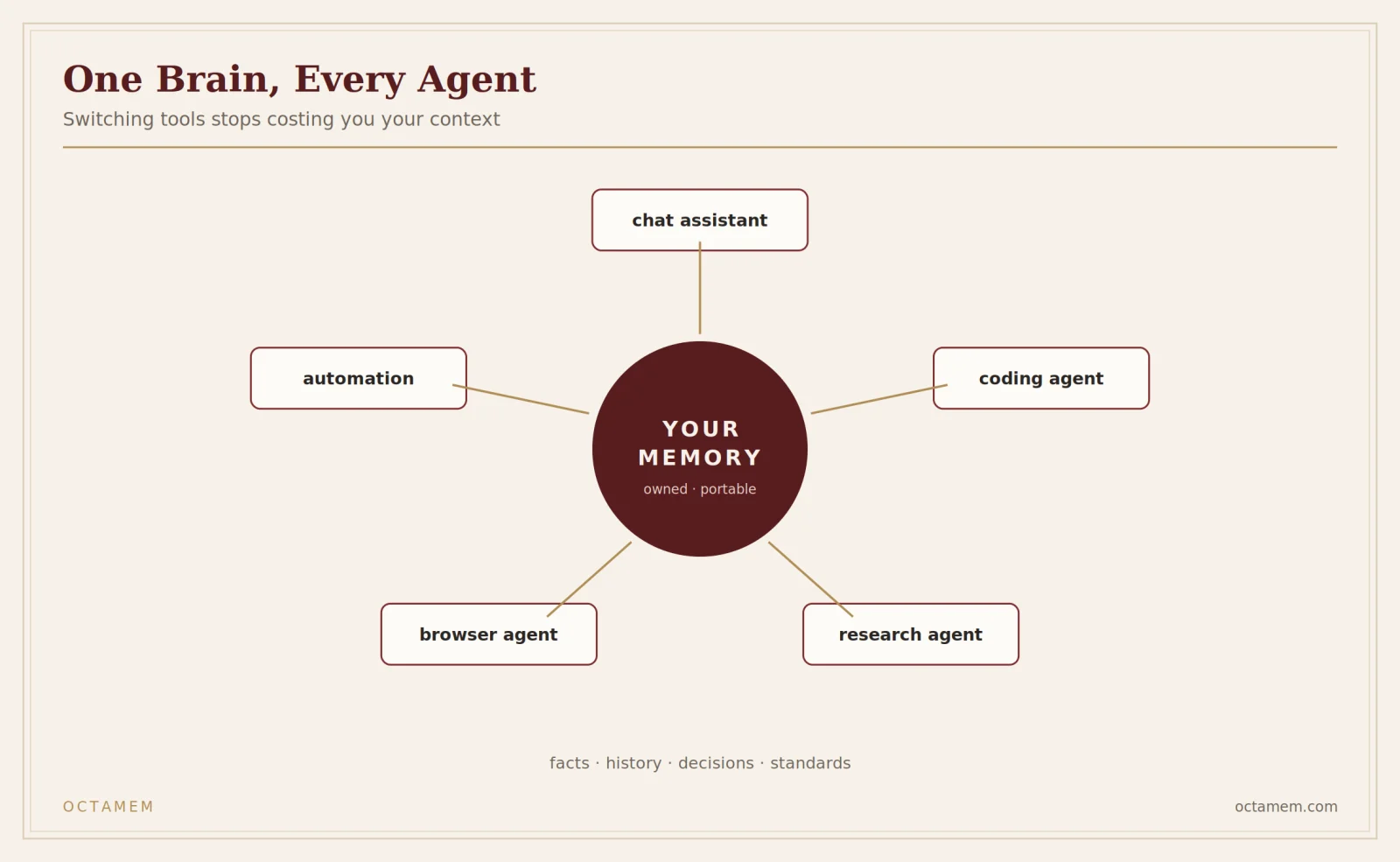
The fix is a personal memory layer: one second brain that every agent reads from and writes to, owned by you, portable across vendors. It is the same organisational intelligence argument at the scale of one person, and in some ways the case is even cleaner, because there is no committee to convince. There is just you, saying the same things to five different amnesiacs.
The vendor-memory trap
Most major AI assistants now offer some form of memory, and each one works the same way: it remembers you inside that product. This is presented as a feature, and within one tool it genuinely is. Across your actual working life it creates a specific trap worth naming.
Your context fragments. The assistant knows your preferences, the coding agent knows your conventions, the browser agent knows your research trails. No tool has the whole picture, so no tool ever performs at the level your accumulated context should make possible.
Your context is hostage. The memory a vendor builds about you is theirs, held in their format, on their servers, exportable exactly as much as they decide. Two years of accumulated understanding becomes the reason you cannot switch to a better tool, which is, of course, part of why it exists.
Your context is unaccountable. When an assistant confidently asserts something about you, can you see where it learned it, correct it, or delete it, and verify the deletion took? Usually one of the three, rarely all.
The pattern is familiar from every platform era: the valuable asset is being accumulated on the platform's side of the line. The unusual thing this time is that the asset is a working model of your mind.
What a portable second brain holds
The useful content is not your notes. Notes are documents; agents need conclusions. Four kinds, and they map exactly onto how memory works for any agent:
Your facts. The stable truths of your life and work: your stack, your clients, your constraints, your setup. Written once, superseded when they change, retrieved by whichever agent needs them.
Your history. What you tried and what happened. The framework you abandoned and why. The outreach angle that worked. Agents that can see your history stop recommending your past mistakes back to you, which, if you have used stateless assistants for any length of time, you will recognise as a daily event.
Your decisions. The reasoning behind your current setup, kept, so that future-you (and future-you's agents) inherit conclusions rather than re-deriving them. This is the part your existing second brain, if you have one, probably does best on paper and worst in practice, because the agents doing the work never read it.
Your standards. How you like things done: code style, writing voice, the format that makes you actually read a summary. Every agent applying the same standards is the difference between tools that assist you and tools that assist a generic user who vaguely resembles you.
How it works mechanically
The reason this is now practical for an individual, rather than an enterprise project, is MCP. A memory layer that runs as an MCP server plugs into every MCP-speaking tool (Claude Desktop, Claude Code, Cursor, and a growing list) through a few lines of configuration. The agent gains two abilities: retrieve relevant memory before acting, and write conclusions back after.
Setup is genuinely small. Add the server to your client's config, allowlist its tools so retrieval does not prompt you every turn, and start working. The brain fills itself as a by-product of the work, which is exactly the property that every manual second-brain system lacked. You capture nothing. The agents in the loop do.
Two disciplines keep it healthy. First, correct the record when it is wrong; supersession makes that a one-line act, and a corrected memory is worth ten new ones. Second, scope it: keep client work, personal life, and side projects in separate memory groups, so the agent drafting for client A never retrieves client B, and the tool helping with your mortgage never surfaces in a work session.
Own it like the asset it is
Whatever you accumulate context in, apply three tests before you rely on it, because a second brain is a decade-long relationship and these are the prenup:
Export, tested. Get everything out, in a documented format, including the provenance and supersession history. Run the export in week one, not year three.
Deletion, verified. Remove something and confirm it is gone, including from any consolidated summaries. Most systems fail this quietly, and for a personal store the stakes are your own privacy.
Provenance, visible. Every memory should show where it came from. Partly for trust, partly for safety: an agent that stores content from web pages and files can store text you never wrote, and provenance is how you see that a "memory" originated in a README rather than in you.
If a tool fails these, it is not a second brain. It is a first brain that belongs to someone else.
Where OctaMem fits
OctaMem runs as a personal memory layer with a free tier and an MCP server, so your agents share one brain from this afternoon: provenance on every retrieval, supersession when your life changes, memory groups to keep its compartments separate, and an export path you can test before you trust it.
Get started free · Cursor setup · Claude Desktop setup
Related reading
- MCP memory servers: how they work and how to choose one
- Why your startup needs a company brain
- Context engineering vs memory
Frequently asked questions
What is a second brain for AI agents?
A personal memory layer that every AI tool you use can read from and write to: your facts, history, decisions, and standards, portable across vendors and owned by you.
How is this different from ChatGPT or Claude remembering me?
Vendor memory lives inside one product and moves with none. A personal memory layer sits outside the tools and serves all of them through MCP or an API, so switching tools costs you nothing you have accumulated.
How is this different from Notion, Obsidian, or my notes?
Notes are documents written for a human reader. Agent memory is structured conclusions with supersession and provenance, retrieved automatically at the moment of work. The two complement each other; only one of them makes your agents smarter.
Do I have to maintain it manually?
No, and systems that require it fail. Agents in the loop write conclusions as a by-product of the work. Your role is occasional correction, which supersession makes trivial.
Is my data safe in a memory layer?
Make the vendor prove it: tested export, verified deletion, visible provenance, and scoping between the compartments of your life. A free tier exists so you can run those tests before anything matters.