Context Engineering vs Memory: What Is the Difference?
Context engineering assembles the best prompt for one call. Memory decides what exists to assemble from. Where they overlap, and why you need both.
Context engineering is the practice of assembling the best possible input for a single model call. Memory is the system that decides what is available to assemble from, and persists it between calls. One operates within a request. The other operates across a relationship.
The terms get used interchangeably and they are not the same thing. Teams that conflate them tend to solve one problem twice and the other not at all.
Two different questions
Context engineering asks: given everything I could put in this prompt, what should I put in it, in what order, in what format, within what token budget?
Memory asks: what should exist to draw from, how does it get written, when does it become stale, and what happens when two things contradict?
A concrete version. Your agent is about to answer a customer question. Context engineering decides that the system prompt goes first, then three retrieved memories, then two documentation chunks, then the conversation's last six turns, then the question, and that the retrieved memories should be formatted as a bulleted fact list rather than raw transcript. Memory decides that those three retrieved items are the right three out of the forty thousand stored, that one of them supersedes an older fact, and that the customer's tier changed last month so the old value should not surface.
Both decisions affect the answer. They are made by different systems with different failure modes.
Where each one lives
| Context engineering | Memory | |
|---|---|---|
| Scope | One model call | Across sessions, indefinitely |
| Owns | Assembly, ordering, formatting, budget | Write, retrieve, update, forget |
| State | Stateless by nature | Stateful by definition |
| Fails by | Wrong things included, bad ordering, budget blown | Stale facts, missed writes, contradictions unresolved |
| Fixed in | Prompt assembly code | Storage architecture |
| Iteration speed | Minutes | Weeks |
That last row is the practical reason to keep them separate. Context engineering is cheap to change: edit the assembly function, redeploy, measure. Memory architecture is expensive to change because you have accumulated data in a shape, and changing the shape means migrating it. Treating a memory problem as a prompt problem produces months of prompt iteration that cannot fix it.
The overlap
They meet at retrieval, and this is where the confusion is reasonable rather than careless.
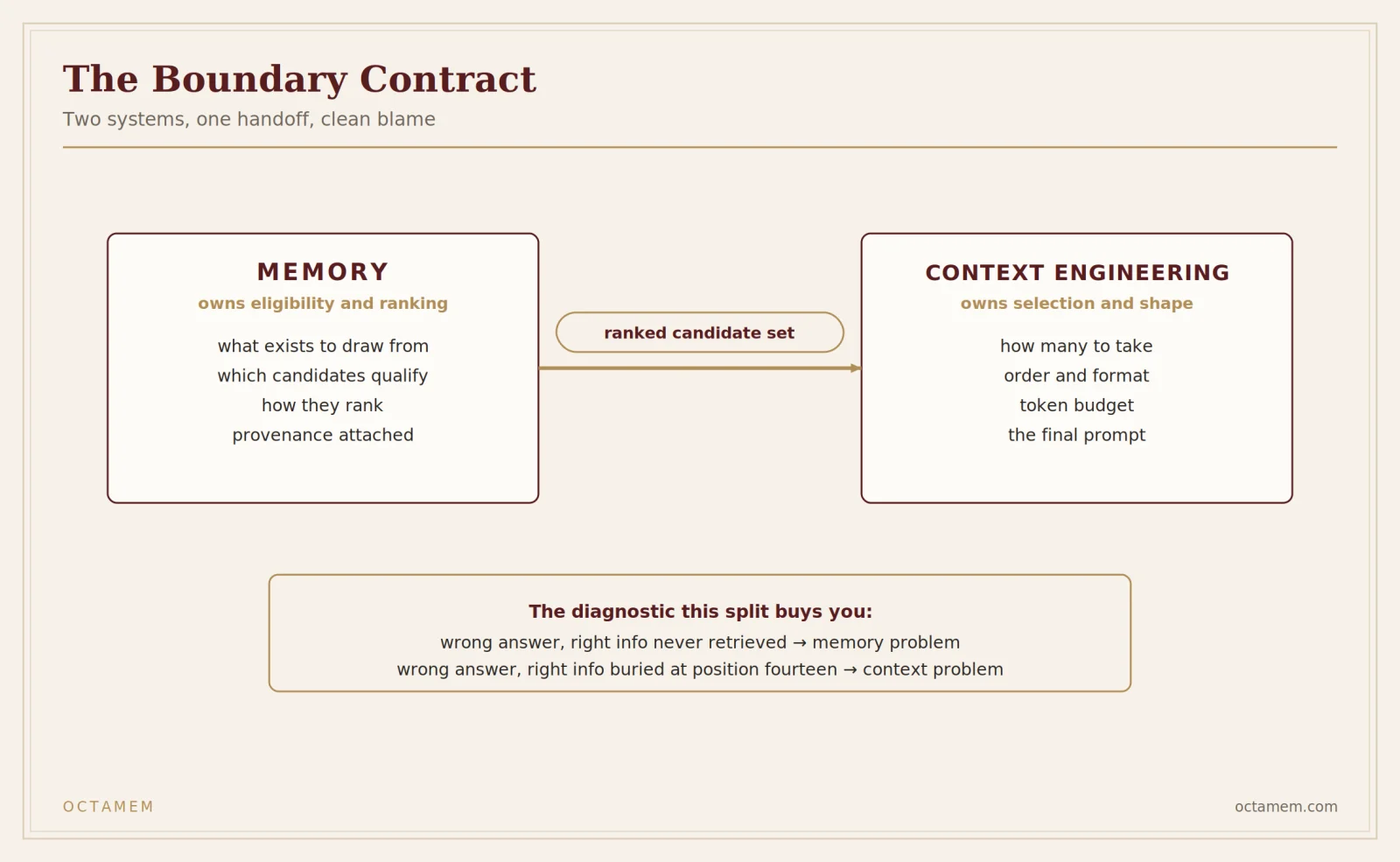
Retrieval is the last operation of memory and the first input to context engineering. Deciding to return five memories instead of twenty is arguably both: a memory ranking decision and a context budget decision. In practice most teams implement it in one place and argue about which team owns it.
A workable division: memory decides what is eligible and how it ranks. Context engineering decides how much of the ranked list to take and how to present it. Memory produces an ordered candidate set with provenance. Context assembly takes the top-k that fits the budget and formats it.
That split has a useful property. If answers are wrong because the right information was never retrieved, that is memory. If answers are wrong because the right information was retrieved and then buried at position fourteen in a 40,000-token prompt, that is context engineering. You can diagnose which one you have by inspecting the candidate set.
Why "just use a bigger context window" is not an answer
The most common version of this confusion is treating a large context window as a substitute for memory. Put everything in the prompt and let the model sort it out.
Three problems, and none of them go away as windows grow.
Cost is per call. You pay for the entire history on every single turn, including the ninety percent the model ignores. Memory pays to store once and retrieve a little.
Accuracy degrades over long contexts even in models with large advertised windows. Information in the middle gets used less reliably than information at the edges, which means dumping everything actively harms recall of the thing you needed.
Windows are finite; relationships are not. Two years of customer interaction will not fit at any window size currently plausible, and even if it did, a system with no notion of supersession would be retrieving contradictory facts from across those two years with no way to rank them.
Larger windows raise the threshold at which you need memory. They do not remove it. What they genuinely do is make context engineering more forgiving, because you have room for slack.
Where context engineering ends and memory has to start
Four signals that you have hit the wall on prompt work.
You are trimming history to fit and losing things you need. Compression is a context technique with a floor. Below it you need selective retrieval, which is memory.
The same information gets re-derived every session. If the agent works out the user's preferences from scratch each time, you are paying repeatedly for a conclusion nobody stored. That is a missing write path.
Answers are confidently outdated. No amount of prompt instruction fixes a store with no supersession. The prompt cannot know that a retrieved fact is stale.
You cannot answer what the system knew last month. Prompts leave no record. If someone asks why the agent said something in June, you need stored state with timestamps and provenance.
Doing both well
Context engineering, briefly, because it is well covered elsewhere: put stable content first for cache reuse, format retrieved facts as facts rather than transcript, put the task last, and treat your token budget as a constraint rather than a target to fill. Cutting top-k in half and measuring is one of the highest-yield experiments available and it improves quality more often than people expect.
Memory, briefly: separate facts from events because they need different update rules, supersede rather than append, retrieve on multiple signals rather than similarity alone, and record provenance so you can explain any retrieval. We go deeper in what is an AI memory layer.
The healthiest arrangement we have seen is one team owning the boundary contract: memory returns a ranked candidate set with provenance and timestamps, context assembly consumes it. Both sides can then iterate without breaking the other, and when an answer is wrong you can tell which side to look at.
Related reading
Frequently asked questions
What is context engineering?
The practice of assembling the best possible input for a single model call: what to include, in what order, in what format, within a token budget.
Is context engineering the same as prompt engineering?
It is broader. Prompt engineering usually means wording and instruction design. Context engineering covers the whole assembled input, including retrieved content, ordering, and budget.
Is memory part of context engineering?
No, though they meet at retrieval. Memory is stateful and persists between calls. Context engineering operates within one call.
Do I need memory if I have a large context window?
Yes, once history exceeds what you can afford to send on every call, or once facts start changing. Larger windows raise the threshold rather than removing it.
Which should I fix first?
Context engineering, because it is cheaper and faster to iterate. Move to memory when you are losing information you need, re-deriving the same conclusions, or serving outdated facts.
Who owns retrieval?
Cleanest split: memory decides what is eligible and how it ranks; context engineering decides how much to take and how to present it.