Why Your Startup Needs a Company Brain Before Its Next Hire
A startup's context lives in two founders' heads and evaporates each session. Why the cheapest headcount you can add is a memory layer.
A five-person startup already employs more agents than people. Coding agents in the repo, a research assistant in the browser, a drafting agent on the outbound, something answering support. Count the sessions in a normal week and the agent workforce outnumbers the human one several times over.
Every one of those agents shares a defect no founder would tolerate in a hire: total amnesia. Each session starts from zero. The context that makes the work good (what the product actually is, who the customer actually is, what was decided last Tuesday and why) lives in the founders' heads, and the founders re-type it into prompts all day. That is the most expensive data-entry role in the company, and both founders are doing it.
A company brain, an organisational memory layer shared by the humans and the agents, is how a small team stops paying that tax and starts compounding instead.
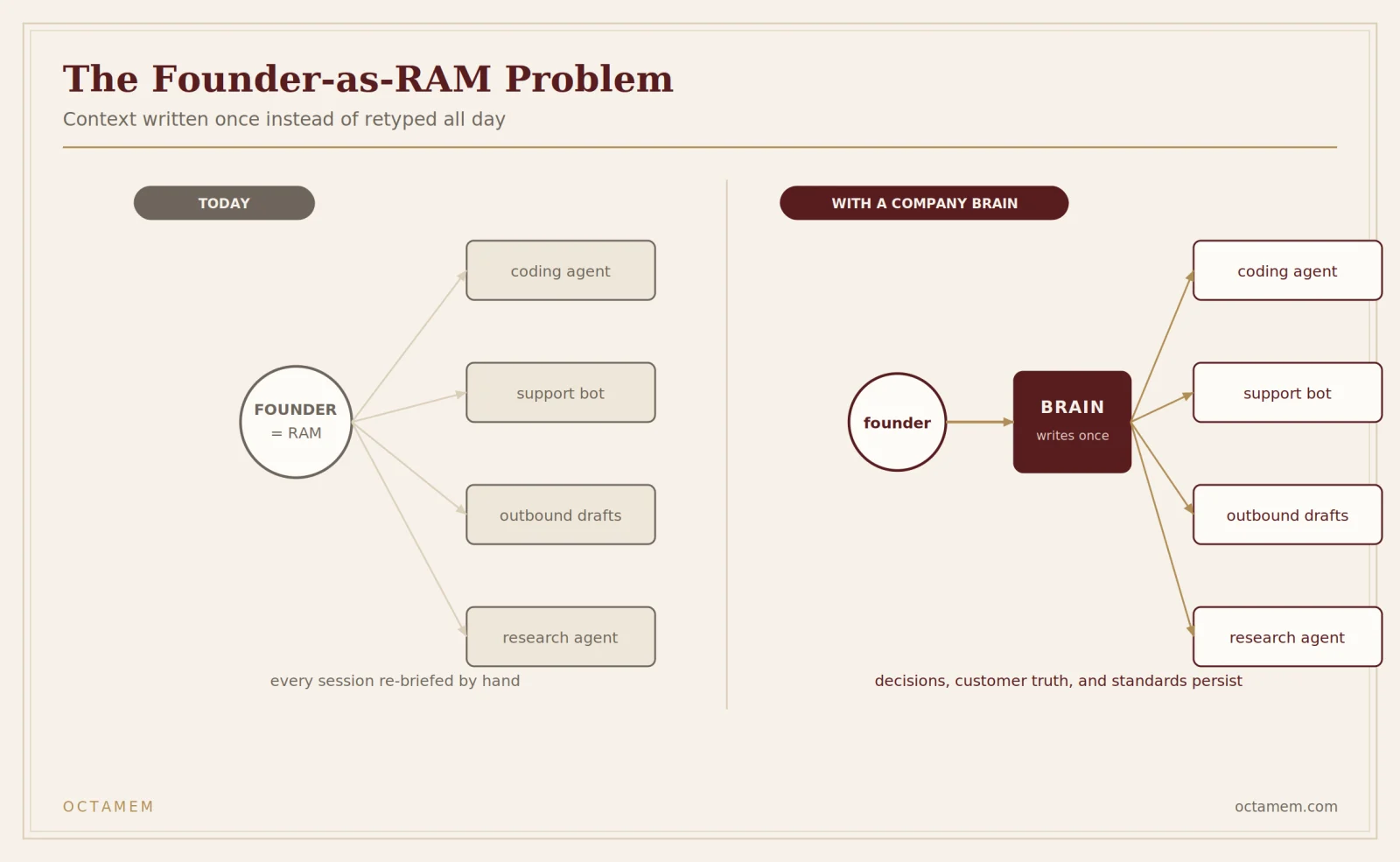
The founder-as-RAM problem
In an early-stage company, the org chart is a lie and the real architecture is simpler: everything routes through one or two people. Customer context, technical decisions, investor state, pricing logic. That works, barely, when the consumers of context are three colleagues.
Agents broke the maths. Agents consume context voraciously, per session, and give none of it back. The better your agents, the more context they deserve, and the more of your day becomes feeding them. Founders notice this as a feeling before they name it as a cost: the tools are impressive and somehow the days got shorter.
The naive fixes fail in order. Longer prompts help one session and expire with it. A CONTEXT.md in the repo helps the coding agent and goes stale in a fortnight, silently, which is worse than absent. Vendor-native memory (the assistant that remembers you) helps one tool and strands the context inside it, unreadable by the other five agents and unowned by the company.
What is actually missing is not a bigger prompt. It is a place where the company's knowledge lives once, stays current, and reaches every agent.
What compounds when you start early
The case for starting at five people rather than fifty is not tidiness. It is that three specific assets only exist if you started accumulating them early, and each one is worth real money later.
Decision history. Startups make irreversible decisions weekly and remember almost none of the reasoning. Why this pricing, why not that market, why the pivot. Six months later the same debate reopens, minus the evidence that settled it. A brain that records decisions with their context and reasoning ends the relitigation, and it produces something with a surprising second life: when diligence comes (investors, acquirers, enterprise security reviews), a company that can show why it did what it did reads as a different class of operation.
Customer truth. Every call, ticket, and churned account produces conclusions. In most startups those conclusions live in the head of whoever was on the call, which means the company's understanding of its customer is actually four partial understandings that have never been reconciled. Written into a shared memory with supersession, they become one evolving picture that every agent (the one drafting outbound, the one answering support, the one writing the changelog) draws from.
Onboarding at startup speed. The first ten hires each cost a founder-week of context transfer, delivered orally, with variance. A company brain turns that week into a day: the new engineer's coding agent already knows the architecture decisions and their reasons; the new salesperson's assistant already knows the objections and what beats them. The hire is productive before the founder has finished the welcome coffee.
None of these can be backfilled. A company that decides at fifty people to want its decision history discovers the history was never written.
The bus factor, finally solvable
Every early team carries a quiet risk it prefers not to price: the company's operating knowledge has a bus factor of one, maybe two. Investors ask about it obliquely. Founders wave at documentation that both parties know does not exist.
An organisational memory changes the honest answer. Not because it captures everything (it will not) but because it captures the load-bearing layer as a by-product of work: the decisions, the customer conclusions, the procedures that exist because something broke. The knowledge stops being co-located with the people and starts being an asset of the company, which is, after all, what the investors thought they were buying.
How to start without a project
The whole thing fails if it becomes a process initiative. Five-person teams do not have a spare person to be the librarian, and the correct amount of new process to add is approximately none. The viable path is narrow and specific:
Connect, don't migrate. A memory layer joins through an API and MCP, which means the agents you already run (coding agent, chat assistant, support bot) plug into it in an afternoon. No new tool to check. The brain works through the tools that exist.
Start with one loop. Pick the workflow where amnesia hurts most. For most technical founders it is the coding agent re-learning the architecture every session; for sales-led founders it is customer context. Wire that one loop: the agent retrieves before acting, writes conclusions after. Expand when the first loop pays.
Let the agents do the writing. The discipline that killed every wiki (humans filing knowledge after the fact) is not required. Agents in the loop record what the task produced, with provenance, at the moment it happened. Your job is occasionally correcting the record, which the supersession model makes a one-line act rather than an edit war.
Own the store. Whatever you choose, confirm the export path and the deletion path on day one, while the store is small. Your accumulated context will become one of the company's real assets; do not build it inside something you cannot leave. The full checklist is in how to choose an AI memory layer.
Where OctaMem fits
OctaMem is a company brain you can start on a free tier and grow into governance: scoped access, provenance on every retrieval, supersession, and an export path you can test before you depend on it. Connect your first agent through MCP this afternoon.
Pricing · Docs · How it works
Related reading
- Organisational intelligence: why every company needs a universal brain
- A second brain for your AI agents
- MCP memory servers: how they work
Frequently asked questions
What is a company brain?
A shared, governed memory layer that holds a company's facts, decisions, customer knowledge, and procedures, and serves them to every person and AI agent through an API or MCP.
Is this overkill for a five-person startup?
The tax it removes is proportional to agent usage, not headcount, and small teams are the heaviest agent users per person. It is also the only stage at which decision history can be captured from the beginning.
How is this different from Notion or a wiki?
A wiki stores pages humans write and search. A company brain stores conclusions captured in the flow of work, keeps them current through supersession, and pushes them to agents at the moment of need. One is a filing cabinet; the other is a colleague who briefs.
Which agents can use it?
Anything that speaks MCP or can call an API: coding agents, desktop assistants, support bots, custom internal agents. One memory, every tool.
What does it cost at startup scale?
Memory infrastructure has free and low-cost tiers suitable for small teams; the real question is the pricing model at growth, which we broke down in how much does an AI memory layer cost.