Organisational Intelligence: Why Every Company Needs a Universal Brain
Organisational intelligence makes what a company knows available to every person and agent, under governance. What it is and how to build it incrementally.
Organisational intelligence is the layer that makes what a company knows available to every person and every AI agent in it, under governance. Not the documents. The knowledge: what was decided and why, what was learned and from which mistake, what is currently true and what used to be. A universal brain, scoped so the right parts reach the right hands, with a record of where every piece came from.
(In American English the term is spelled organizational intelligence. Same idea, same layer.)
Companies have talked about institutional knowledge for decades and mostly failed to keep it. What changed is not the problem. It is that companies now employ two workforces, and the second one, the agents, has no memory at all.
The problem was always real. Agents made it urgent.
Every organisation already knew, roughly, that its knowledge was leaking. People leave and take context with them. Teams re-solve solved problems. Decisions get remade because nobody remembers making them, or worse, unmade because nobody remembers why they were made. The cost was real but diffuse, so it lost every budget fight to things with invoices.
Then agents arrived, and the diffuse cost became a visible one, multiplied.
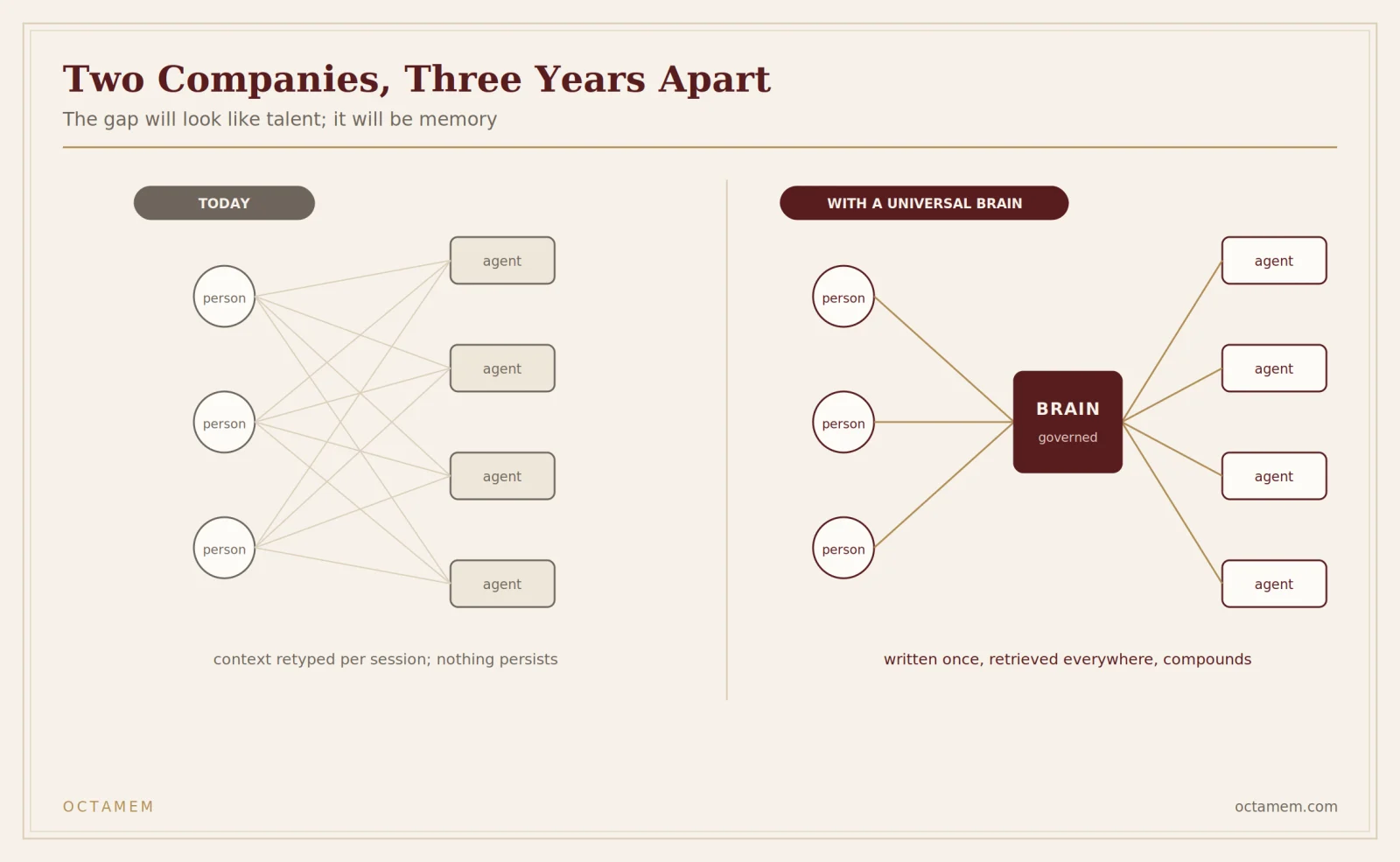
A company running AI seriously now has agents drafting, reviewing, researching, answering customers, and writing code. Each one is stateless. Each one starts every session knowing nothing about the company it works for. Each one gets its context the same way: a human retypes it into a prompt, at the moment of need, from their own partial recollection.
So the old failure mode, knowledge trapped in individual heads, has acquired a new tax: every agent interaction pays a context toll, and the toll is collected in the scarcest currency the company has, which is its people's attention. The organisation is paying its best people to be RAM for its software.
There is a second effect, quieter and worse. Agents do not just consume knowledge; they generate it. Every agent-assisted task produces conclusions: this draft was rejected for this reason, this customer's situation changed, this approach failed. In a company without a memory layer, all of it evaporates on session close. The organisation is running thousands of experiments a day and recording none of the results.
What a universal brain actually holds
The word "knowledge" hides four different things, and a working organisational brain treats them differently, because they change differently.
Facts. The current truth: this client is on these terms, this system has this owner, this policy took effect in June. Facts get superseded. The old value is kept, marked, and pointed at its replacement, so the company can answer both "what is true" and "what was true when we acted".
Events. What happened: the launch slipped, the customer escalated, the deploy failed on the migration step. Events decay in relevance but never in truth, and the useful ones consolidate into patterns.
Decisions. The highest-value and least-captured category. A decision worth remembering has a shape: the situation, the options considered, the choice made, the reasoning, and eventually the outcome. Companies that record decisions in this shape stop relitigating them and start learning from them. Companies that do not are doomed to hold the same meeting annually.
Procedures. How the company does things: the playbook that works, the checklist that exists because of an incident, the routine an agent learned. Procedures are code, whether or not they look like it, and they get versioned like code.
This is the same taxonomy that governs memory for individual AI agents, applied at company scope, with one addition that changes everything: governance. An individual's memory has one reader. An organisation's memory has hundreds, and most of them must not see most of it.
Governance is the product, not the feature
Any pitch for a "company brain" collides immediately with the correct instinct of every serious operator: absolutely not, that is a breach engine.
The instinct is right about naive implementations. A universal brain is only viable if universal means universally available under rules, never universally visible. Four properties are non-negotiable, and they happen to be the same four that separate real memory infrastructure from a vector database with ambitions:
Scoping below the user. Memory bounded by team, client, matter, project, and deal, enforced at the data layer so a forgotten filter fails closed. What one scope knows, another cannot retrieve, unless the connection is deliberate.
Provenance on every retrieval. Every answer carries its sources: which memory, written when, derived from what. An organisation acting on unsourced intelligence is an organisation running on rumour with better formatting.
Supersession with history. The current truth wins, and the record of what it replaced survives. This is what makes the brain auditable, and auditability is what makes it deployable anywhere that answers to a regulator, a client, or a board.
Erasure that completes. When data must go (a client instructs it, a regulator requires it, an employee exercises a right), it goes, including from summaries and derived artefacts. Most systems cannot do this, and the gap is architectural.
A company evaluating vendors in this category should test all four before believing any of them. The tests take an afternoon and are laid out in how to choose an AI memory layer.
Why this is not knowledge management, round two
Veterans of the last three decades have earned their scepticism. Knowledge management failed on a single, stable fact: it asked busy people to do extra work now for diffuse benefit later. Wikis went stale, taxonomies rotted, and the intranet became where documents went to be undiscoverable.
Two things are structurally different this time.
Capture became a by-product. Agents sit inside the work: in the draft, the review, the customer thread, the code change. The knowledge a task generates can be recorded by the tool doing the task, at the moment it is generated, with its context attached. Nobody files a lesson learned. The lesson is in the loop.
Retrieval became active. The old model waited for a human to search. The new one briefs: the agent preparing your meeting already pulled the client's history, the open commitments, and the thing that went wrong last quarter. Knowledge that finds its moment is worth an order of magnitude more than knowledge that waits to be found, and only a memory layer wired into the agents can deliver it.
The honest caveat: none of this repeals the need for judgement about what enters the brain. A memory layer that stores everything indiscriminately reproduces the intranet problem at higher speed. Writing is a quality discipline, which is why it is the least benchmarked and most decisive part of any memory system.
The compounding asset
Here is the strategic frame, stated plainly.
Headcount scales linearly and leaks. Software scales but does not learn your business. A governed organisational memory is the third thing: an asset that appreciates with use, survives departures, transfers to every new tool the company adopts, and cannot be hired away or copied by a competitor, because it is made of the company's own history.
Two firms of equal talent, three years from now. One has been compounding governed memory across its people and agents since 2026: every decision recorded with its reasoning, every client's full context one query away, every new agent productive on day one because the brain briefs it. The other has been re-explaining itself to its own software daily. The gap between them will look like a talent gap or a technology gap. It will actually be a memory gap.
Where OctaMem fits
OctaMem is organisational intelligence as infrastructure: semantic, episodic, and procedural memory with governance built in. Scoped access below user level, provenance on every retrieval, structural supersession, cascading erasure, and controllable residency, connected to your agents through an API and MCP. It is the universal brain, built for companies that have to prove what they know.
Platform · How it works · Talk to us
Related reading
- Why law firms need organisational intelligence
- Why real estate firms need a universal brain
- Why your startup needs a company brain
- What is an AI memory layer?
Frequently asked questions
What is organisational intelligence?
The layer that makes a company's knowledge (facts, events, decisions, procedures) available to its people and AI agents under governance, with provenance, supersession, and scoped access.
Is a universal brain the same as a knowledge base or wiki?
No. A wiki stores documents humans write and search. A universal brain stores conclusions generated in the flow of work, keeps them current through supersession, and actively feeds them to agents and people at the moment of need.
Does every employee see everything?
No, and a system designed that way should be rejected. Memory is scoped by team, client, matter, or project at the data layer; universal means available under rules, not visible to all.
How do AI agents use organisational memory?
Through an API or MCP connection: agents retrieve relevant, scoped memory before acting and write conclusions back after, so the same brain serves every tool the company runs.
What is the difference between individual AI memory and organisational intelligence?
Scope and governance. Individual memory serves one person and one assistant. Organisational intelligence serves the whole company across every agent, which makes access control, provenance, and erasure the core of the product rather than features.
How does a company start?
One team, one workflow, one agent connected to governed memory. Expansion follows results. The failed alternative is the enterprise-wide mandate, which has a thirty-year track record of producing stale wikis.