Why Real Estate Firms Need a Universal Brain: Organisational Intelligence for Property
In real estate, deal and relationship memory produces the revenue, and it lives in agents' heads. What changes when an agency governs it centrally.
A real estate business has two assets: its instructions and its memory. The first is on the books. The second is in the heads and phones of its people: what this landlord will actually accept, why the last two sales on that street fell through, which buyer is genuinely proceedable and which one has been "cash ready" for eight months.
When a negotiator leaves, the CRM keeps the contact records and the business loses the relationship intelligence around them. When a deal takes fourteen months from first viewing to completion, the context scatters across email threads, WhatsApp messages, call notes, and three people's recollections, and no single system can answer the only question that matters at each stage: what do we actually know here?
Real estate is now adopting AI faster than almost any services sector: valuation drafting, listing copy, enquiry handling, negotiation prep. Every one of these tools shares the same defect. It is brilliant for the length of a session and blank the next morning. Organisational intelligence, a universal brain for the firm, is what turns those tools from clever assistants into something that compounds.
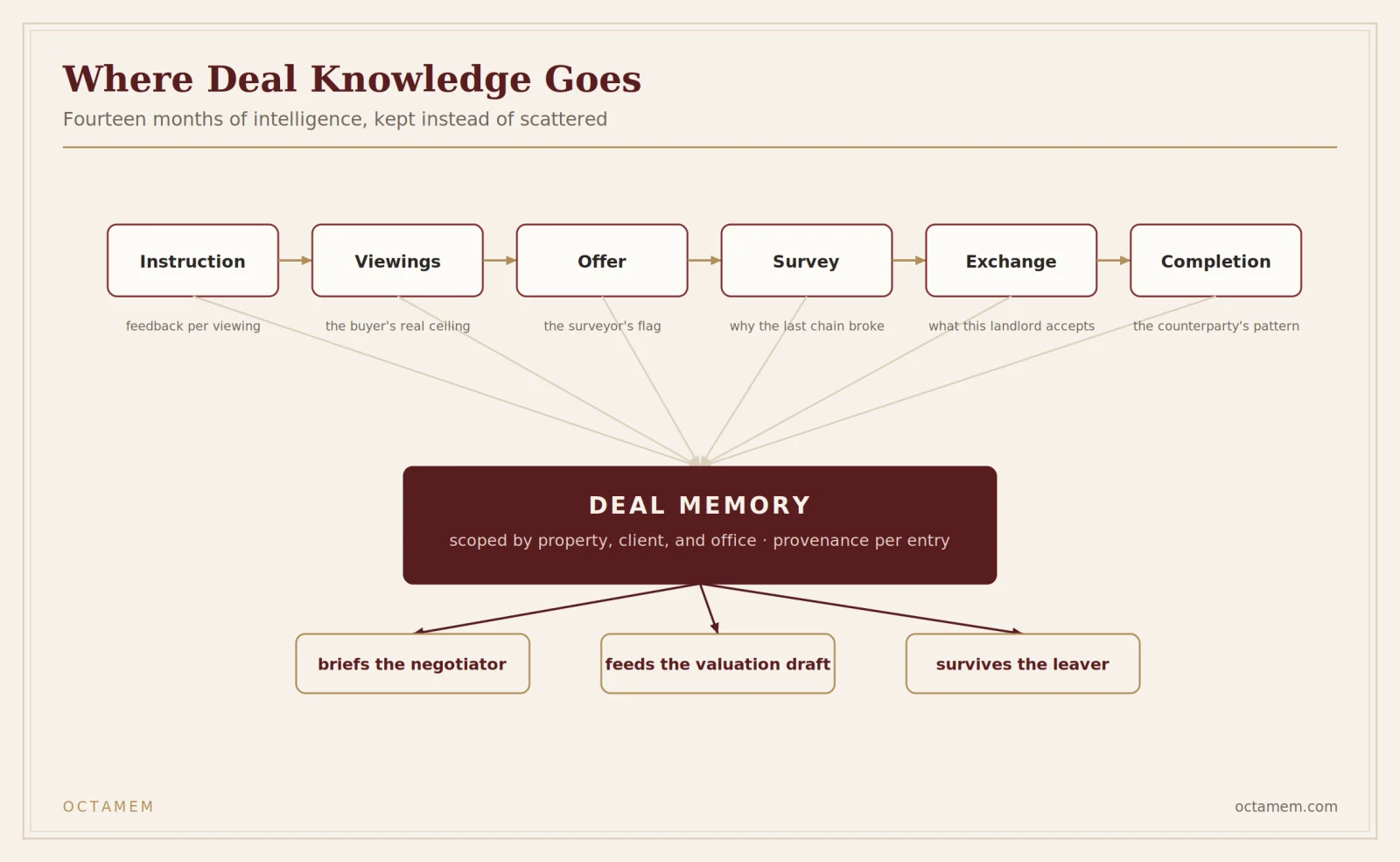
Where property knowledge actually lives
Walk through what a competent agency knows and where that knowledge is stored.
Property memory. Every viewing produces feedback. Every survey surfaces issues. Every price reduction has a reason. Over years, a building accumulates a history that determines how it should be marketed and negotiated the next time it trades. In most agencies, that history exists as fragments in old email chains and in the memory of whoever handled it, if they still work there.
Counterparty memory. The solicitor who sits on enquiries for three weeks. The developer who renegotiates after exchange has been agreed in principle. The landlord who says no twice and yes the third time. This is negotiation-critical intelligence, and it is transmitted, when it is transmitted at all, by one negotiator warning another in the kitchen.
Client memory. What a buyer says they want and what they respond to at viewings are different data sets, and the second is more valuable. An applicant's real constraints, their timeline pressure, the property they almost offered on: these determine what to send them and how to negotiate for them.
Deal memory. Why the chain collapsed. What the surveyor flagged. Which condition the other side conceded. Completed transactions are the firm's case law, and they are filed as if they were paperwork.
Every category has the same shape: high-value, longitudinal, relational knowledge, stored in a medium (a person, a phone) that the firm does not control and cannot query.
The churn problem, priced honestly
Sales teams in property turn over quickly. That is the industry, and no memory system changes it. What can change is what leaves with them.
Today, a departing negotiator takes their pipeline knowledge, their applicant relationships, and their counterparty intelligence, and the replacement rebuilds all three from the CRM's skeleton. The rebuild takes months, the firm pays for it in lost deals rather than a line item, and some fraction of the departed knowledge walks directly to a competitor.
An agency running a governed memory layer loses the person and keeps the intelligence. The new negotiator inherits not just the contacts but the context: this applicant went quiet after the survey on Elm Road, this landlord needs the rent review handled before any sale conversation, this chain has a weak link two transactions down. The handover stops being an afternoon of anecdotes and becomes a queryable state of play.
What the universal brain does that the CRM does not
This is the objection worth answering directly, because every agency already pays for a CRM and most feel they underuse it.
A CRM is a system of record: contacts, instructions, activity logs, pipeline stages. It stores what happened as entries. It does not store what the firm concluded, and it has no mechanism for conclusions changing.
A memory layer is a system of judgement. The difference shows in three behaviours:
It supersedes. "Applicant budget £850k" written in March and "stretched to £925k for the right garden" learned in June are, in a CRM, two notes. In a memory layer, the second supersedes the first, the first is retained with its date, and any agent or AI tool asking about this applicant gets the current truth with the history behind it.
It carries provenance. When the system says this landlord refuses tenanted viewings, it can say who learned that, when, and on which property. Intelligence without a source is rumour, and in a business built on trust, rumour presented confidently is a liability.
It feeds every tool, not just its own screen. The point is not another dashboard. The memory layer sits behind the AI tools the firm runs: the enquiry-handling agent knows the applicant's real history, the valuation draft cites what actually happened on comparable instructions, the negotiation prep pulls the counterparty's pattern. One brain, many hands.
The CRM remains the system of record. The brain is what reads it, along with everything the CRM never captured, and turns it into answers.
Compliance is not optional context
Property firms handle exactly the data categories regulators care about: identity documents, source-of-funds information, financial circumstances, family situations. AML obligations require records to be kept; GDPR requires them to be deletable on request; both require the firm to know what it holds.
A memory layer in this sector therefore has to meet the same bar we set out for legal work: scoping below user level (per office, per instruction, per client), erasure that cascades through derived and consolidated information, residency the firm controls, and an audit trail for what any AI tool knew when it acted. The mechanics are covered in GDPR Article 17 and AI memory, and the buying tests in how to choose an AI memory layer apply verbatim.
A firm that gets this right does not just avoid a problem. It gains a line for the pitch to landlords and institutional clients that competitors cannot say: every piece of intelligence we hold about your asset is governed, sourced, and provable.
Starting without a transformation project
The failed knowledge-management projects of the last two decades all began with a mandate that busy fee-earning staff record more. That mandate has never survived contact with a Saturday viewing schedule, and it does not need to be issued now.
Agents capture as a by-product of the tools already in the loop. The AI that drafts the follow-up email records the viewing feedback it was given. The assistant that preps the negotiation stores the outcome. Connection happens through an API and MCP rather than a rip-and-replace, which means the sensible start is one office, one workflow (applicant memory on the sales side is the usual first win), and expansion by result rather than by decree.
Where OctaMem fits
OctaMem gives a property business one memory across its people and its AI tools: scoped to office, instruction, and client; provenance on every retrieval; supersession so the current truth wins without losing the history; and deployment options for firms that keep client data close.
How it works · Industries · Talk to us
Related reading
- Organisational intelligence: why every company needs a universal brain
- Nine ways agent memory fails in production
- What is an AI memory layer?
Frequently asked questions
What is organisational intelligence for a real estate firm?
A governed memory layer holding the firm's property, client, counterparty, and deal knowledge, available to staff and AI tools under access control, with provenance and supersession built in.
How is this different from our CRM?
The CRM records activity. The memory layer holds conclusions and keeps them current: what the firm knows, who learned it, and what superseded what. It feeds the CRM's data to every AI tool the firm uses rather than leaving it in one system's screens.
Does this work with the tools we already have?
That is the design constraint. A memory layer connects via API and MCP, so the same governed memory sits behind enquiry handling, drafting, valuation prep, and whatever the firm adopts next.
What happens when a negotiator leaves?
The relationship intelligence they accumulated stays queryable: applicant context, counterparty patterns, deal state. The replacement inherits a state of play rather than a contact list.
Is client data safe in a system like this?
It has to be provably safe: scoped access, cascading deletion, controllable residency, and audit trails. Any vendor should demonstrate a completed erasure on request rather than describe one.